

18.4. Chiral anomalies
249
18.4 Chiral anomalies
In all our discussions of symmetries so far – unbroken, approximate, and
spontaneously broken – there is one result on which we have relied, and never
queried. We refer to Noether’s theorem, as discussed in section 12.3.1. This
states that for every continuous symmetry of a Lagrangian, there is a corresponding conserved current. We demonstrated this result in some special
cases, but we have now to point out that while it is undoubtedly valid at
the level of the classical Lagrangian and field equations, we did not investigate whether quantum corrections might violate the classical conservation
law. This can, in fact, happen and when it does the afflicted current (or its
divergence) is said to be ‘anomalous’, or to contain an ‘anomaly’. General
analysis shows that anomalies occur in renormalizable theories of fermions
coupled to both vector and axial vector currents. We may therefore expect to
find anomalies among the vector and axial vector flavour currents which we
have been discussing.
One way of understanding how anomalies arise is through consideration of
the renormalization process, which is in general necessary once we get beyond
the classical (‘tree level’) approximation. As we saw in volume 1, this will
invariably entail some regularization of divergent integrals. But the specific
example of the O(e
2 ) photon self-energy studied in section 11.3 showed that
a simple cut-off form of regularization already violated the current conservation (or gauge invariance) condition (11.21). In that case, it was possible to
find alternative regularizations which respected electromagnetic current conservation, and were satisfactory. Anomalies arise when both axial and vector
symmetry currents are present, since it is not possible to find a regularization scheme which preserves both vector and axial vector current conservation
(Adler 1970, Jackiw 1972, Adler and Bardeen 1969).
We shall not attempt an extended discussion of this technical subject. But
we do want to alert the reader to the existence of these anomalies; to indicate
how they arise in one simple model; and to explain why, in some cases, they
are to be welcomed, while in others they must be eliminated.
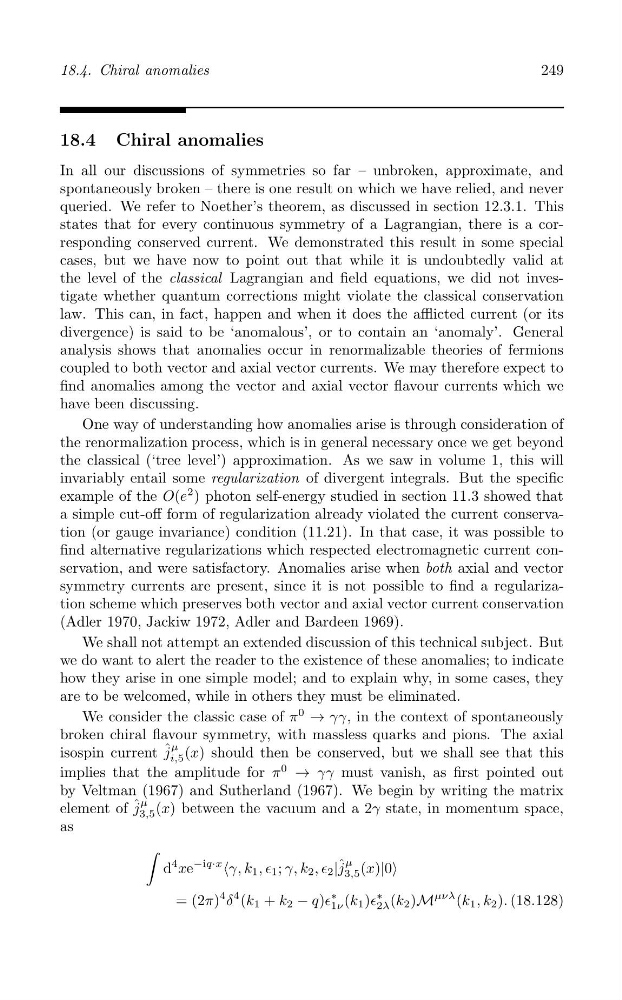
We consider the classic case of π
0
→ γγ, in the context of spontaneously
broken chiral flavour symmetry, with massless quarks and pions. The axial
isospin current ˆ μ
j i,5 (x) should then be conserved, but we shall see that this
implies that the amplitude for π
0
→ γγ must vanish, as first pointed out
by Veltman (1967) and Sutherland (1967). We begin by writing the matrix
ˆ μ
element of j 3,5 (x) between the vacuum and a 2γ state, in momentum space,
as
∫
d
4 xe
−iq·x
‹
μ
γ, k 1 , ∈ 1 ; γ, k
ˆ
2 , ∈ 2 |j 3,5 (x)|0›
= (2π)
4 δ
4 (k 1 + k 2 − q)∈
∗
1ν (k 1 )∈
∗
2λ (k 2 )M
μνλ (k 1 , k 2 ). (18.128)