

248
18. Chiral Symmetry Breaking
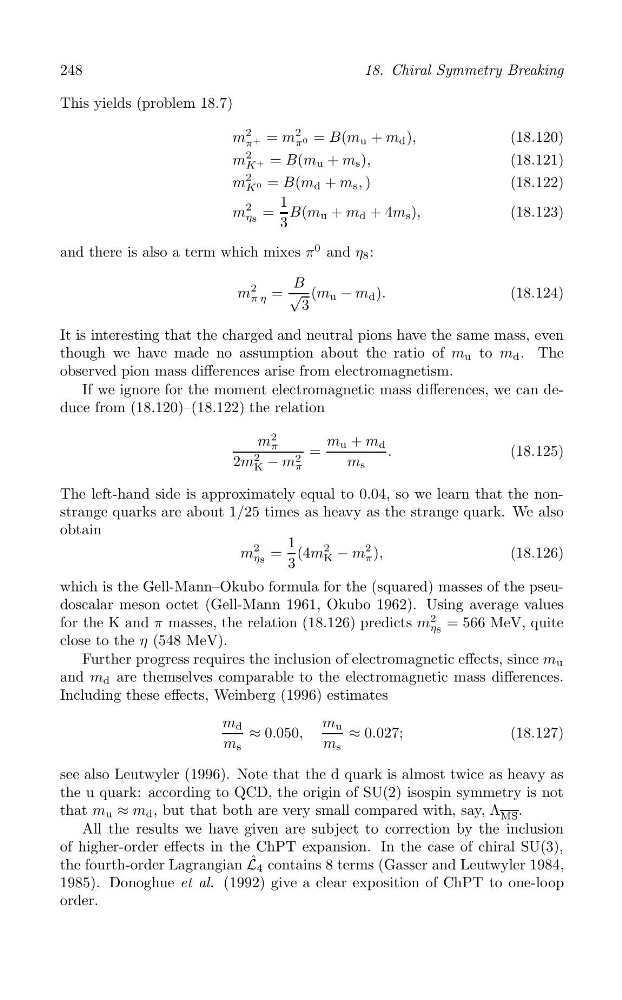
This yields (problem 18.7)
2
2
B(m u + m d ),
(18.120)
m π + = m π 0 =
2
= B(m u + m s ),
(18.121)
m +
K
2 = B(m d + m s , )
(18.122)
m 0
K
1
2
B(m u + m d + 4m s ),
(18.123)
m =
η8
3
and there is also a term which mixes π
0 and η 8 :
B
m
2
√ (m u − m d ).
(18.124)
π η =
3
π
It is interesting that the charged and neutral pions have the same mass, even
though we have made no assumption about the ratio of m u to m d . The
observed pion mass differences arise from electromagnetism.
If we ignore for the moment electromagnetic mass differences, we can deduce from (18.120)–(18.122) the relation
2
m 2
m u +
m
m d .
(18.125)
π
=
2 −
2m
m s
K
The left-hand side is approximately equal to 0.04, so we learn that the nonstrange quarks are about 1/25 times as heavy as the strange quark. We also
obtain
1
2
2
2
K −
(4m
),
(18.126)
m =
m
η
π
8
3
which is the Gell-Mann–Okubo formula for the (squared) masses of the pseudoscalar meson octet (Gell-Mann 1961, Okubo 1962). Using average values
2
for the K and π masses, the relation (18.126) predicts m 8 = 566 MeV, quite
η
close to the η (548 MeV).
Further progress requires the inclusion of electromagnetic effects, since m u
and m d are themselves comparable to the electromagnetic mass differences.
Including these effects, Weinberg (1996) estimates
m d ≈ 0.050,
m u ≈ 0.027;
(18.127)
m s
m s
see also Leutwyler (1996). Note that the d quark is almost twice as heavy as
the u quark: according to QCD, the origin of SU(2) isospin symmetry is not
that m u ≈ m d , but that both are very small compared with, say, Λ MS .
All the results we have given are subject to correction by the inclusion
of higher-order effects in the ChPT expansion. In the case of chiral SU(3),
the fourth-order Lagrangian L ˆ 4 contains 8 terms (Gasser and Leutwyler 1984,
1985). Donoghue et al. (1992) give a clear exposition of ChPT to one-loop
order.