

237
18.2. Pion decay and the Goldberger–Treiman relation
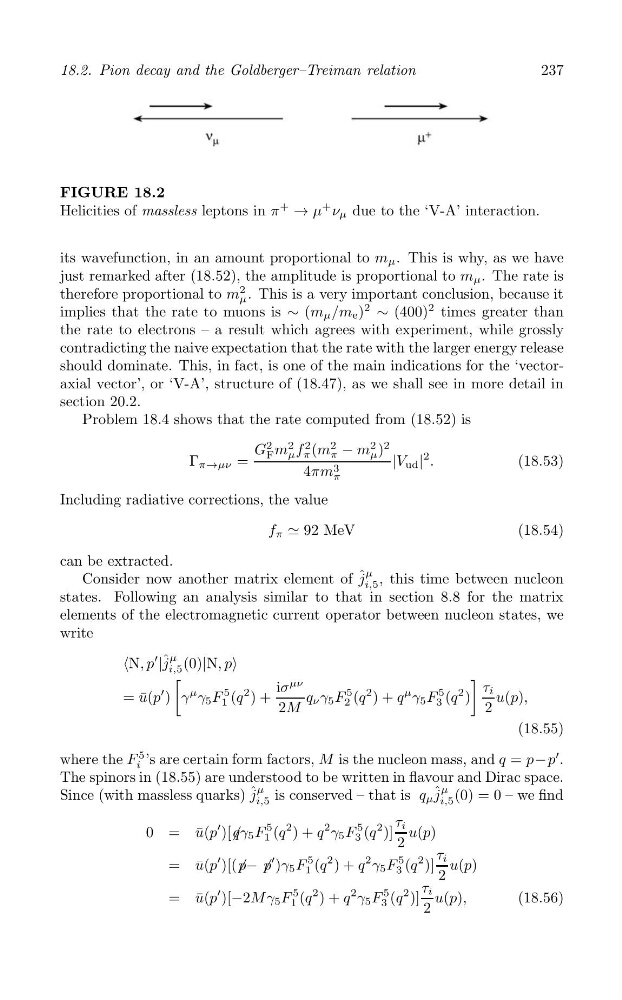
FIGURE 18.2
Helicities of massless leptons in π
+
→ μ
+ ν μ due to the ‘V-A’ interaction.
its wavefunction, in an amount proportional to m μ . This is why, as we have
just remarked after (18.52), the amplitude is proportional to m μ . The rate is
2
therefore proportional to m μ . This is a very important conclusion, because it
implies that the rate to muons is ∼ (m μ /m e )
2
∼ (400)
2 times greater than
the rate to electrons – a result which agrees with experiment, while grossly
contradicting the naive expectation that the rate with the larger energy release
should dominate. This, in fact, is one of the main indications for the ‘vectoraxial vector’, or ‘V-A’, structure of (18.47), as we shall see in more detail in
section 20.2.
Problem 18.4 shows that the rate computed from (18.52) is
2
2
2
G
2
f
2 (m − m )
2
F m μ π π
μ
Γ π→μν =
|V ud |
2 .
(18.53)
4πm 3
π
Including radiative corrections, the value
f π ⋍ 92 MeV
(18.54)
can be extracted.
μ
Consider now another matrix element of ˆ j , this time between nucleon
i,5
states. Following an analysis similar to that in section 8.8 for the matrix
elements of the electromagnetic current operator between nucleon states, we
write
μ
‹N, p
′
| ˆ j (0)|N, p›
i,5
[
]
= ¯
u(p
′ ) γ
μ γ 5 F 1
5 (q
2 ) +
iσ
μν
q ν γ 5 F 2
5 (q
2 ) + q
μ γ 5 F 3
5 (q
2 )
τ i u(p),
2M
2
(18.55)
′
where the F
5 ’s are certain form factors, M is the nucleon mass, and q = p−p .
i
The spinors in (18.55) are understood to be written in flavour and Dirac space.
μ
Since (with massless quarks) ˆ j i,
μ
5 is conserved – that is q μ ˆ j i,5 (0) = 0 – we find
τ i
0 = u ¯(p
′ )[/ qγ 5 F 1
5 (q
2 ) + q
2 γ 5 F 3
5 (q
2 )] u(p)
2
τ i
= ¯
u(p
′ )[(/ p− / p
′ )γ 5 F 1
5 (q
2 ) + q
2 γ 5 F 3
5 (q
2 )] u(p)
2
= ¯
u(p
′ )[−2M γ 5 F 1
5 (q
2 ) + q
2 γ 5 F 3
5 (q
2 )]
τ i u(p),
(18.56)
2