

238
18. Chiral Symmetry Breaking
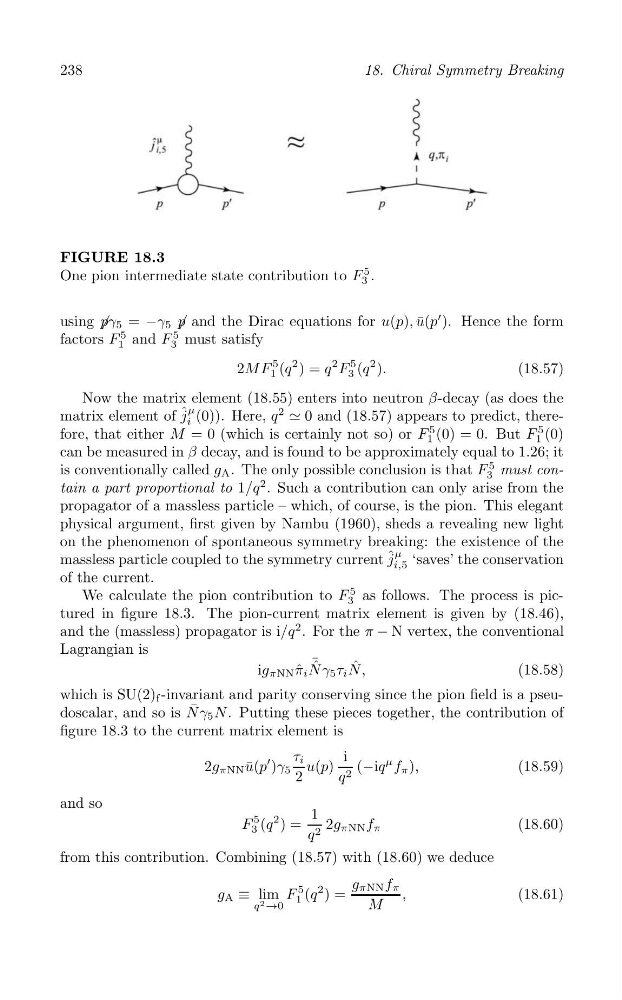
FIGURE 18.3
One pion intermediate state contribution to F 3
5 .
using / pγ 5 = −γ 5 / p and the Dirac equations for u(p), u ¯(p
′ ). Hence the form
factors F
5 and F
5 must satisfy
1
3
2 F
5 2 ).
2M F 1
5 (q
2 ) = q 3 (q
(18.57)
Now the matrix element (18.55) enters into neutron β-decay (as does the
μ
matrix element of ˆ j (0)). Here, q
2
⋍ 0 and (18.57) appears to predict, therei
fore, that either M = 0 (which is certainly not so) or F 1
5 (0) = 0. But F 1
5 (0)
can be measured in β decay, and is found to be approximately equal to 1.26; it
is conventionally called g A . The only possible conclusion is that F
5 must con3
tain a part proportional to 1/q
2 . Such a contribution can only arise from the
propagator of a massless particle – which, of course, is the pion. This elegant
physical argument, first given by Nambu (1960), sheds a revealing new light
on the phenomenon of spontaneous symmetry breaking: the existence of the
μ
massless particle coupled to the symmetry current ˆ j ‘saves’ the conservation
i,5
of the current.
We calculate the pion contribution to F
5 as follows. The process is pic3
tured in figure 18.3. The pion-current matrix element is given by (18.46),
and the (massless) propagator is i/q
2 . For the π − N vertex, the conventional
Lagrangian is
¯ ˆ
ˆ
ig πNN π ˆ i N γ 5 τ i N,
(18.58)
which is SU(2) f -invariant and parity conserving since the pion field is a pseudoscalar, and so is ¯
Nγ 5 N . Putting these pieces together, the contribution of
figure 18.3 to the current matrix element is
τ i
i
2g πNN u ¯(p
′ )γ 5 u(p)
(−iq
μ f π ),
(18.59)
2
q 2
and so
F 3
5 (q
2 ) =
1 2g πNN f π
(18.60)
q 2
from this contribution. Combining (18.57) with (18.60) we deduce
g πNN f π
g A ≡ lim F 1
5 (q
2 ) =
,
(18.61)
q 2 →0
M