

236
18. Chiral Symmetry Breaking
where G F is Fermi constant and V ud is an element of the Cabibbo–Kobayashi–
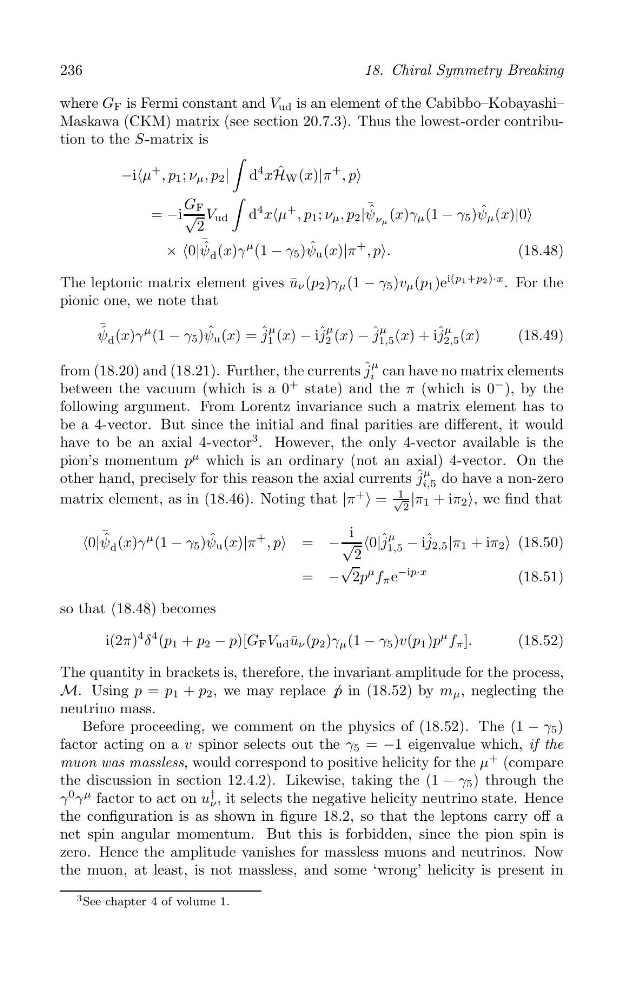
Maskawa (CKM) matrix (see section 20.7.3). Thus the lowest-order contribution to the S-matrix is
∫
−i‹μ
+
ˆ
, p 1 ; ν μ , p |
4
2
d xH W (x)|π
+ , p›
∫
G
ˆ
i
4
¯
√
F
= −
ˆ
V ud d x‹μ
+ , p 1 ; ν μ , p 2 |ψ νμ (x)γ μ (1 − γ 5 )ψ μ (x)
2
|0›
¯
× ‹0| ˆ
ψ d (x)γ
μ (1 −
ˆ
γ 5 )ψ u (x)|π
+ , p›.
(18.48)
The leptonic matrix element gives u ¯ ν (p 2 )γ μ (1 − γ 5 )v
i(
μ (p 1 )e
p1+p2)·x . For the
pionic one, we note that
¯ ˆ
μ
−
ˆ
ˆ μ
ˆ μ
ˆ μ
ˆ μ
ψ d (x)γ (1 γ 5 )ψ u (x) = j 1 (x) − ij 2 (x) − j 1,5 (x) + ij 2,5 (x)
(18.49)
μ
from (18.20) and (18.21). Further, the currents ˆ j i can have no matrix elements
between the vacuum (which is a 0
+ state) and the π (which is 0
− ), by the
following argument. From Lorentz invariance such a matrix element has to
be a 4-vector. But since the initial and final parities are different, it would
have to be an axial 4-vector
3 . However, the only 4-vector available is the
pion’s momentum p
μ which is an ordinary (not an axial) 4-vector. On the
μ
other hand, precisely for this reason the axial currents ˆ j i,5 do have a non-zero
matrix element, as in (18.46). Noting that |π
+
› = √ 1
2
|π 1 + iπ 2 ›, we find that
¯
i
‹0| ˆ
ˆ
ψ d (x)γ
μ (1 − γ 5 )ψ u (x)|π
+ , p› = − √ ‹0| ˆ j
μ
1,5 − i ˆ j 2,5 |π 1 + iπ 2
2
› (18.50)
=
√
− 2p
μ f π e
−ip·x
(18.51)
so that (18.48) becomes
i(2π)
4 δ
4 (p 1 + p 2 − p)[G F V ud u ¯ ν (p 2 )γ μ (1 − γ 5 )v(p 1 )p
μ f π ].
(18.52)
The quantity in brackets is, therefore, the invariant amplitude for the process,
M. Using p = p 1 + p 2 , we may replace p in (18.52) by m μ , neglecting the
neutrino mass.
Before proceeding, we comment on the physics of (18.52). The (1 − γ 5 )
factor acting on a v spinor selects out the γ 5 = −1 eigenvalue which, if the
muon was massless, would correspond to positive helicity for the μ
+ (compare
the discussion in section 12.4.2). Likewise, taking the (1 − γ 5 ) through the
γ
0 γ
μ factor to act on u
†
ν , it selects the negative helicity neutrino state. Hence
the configuration is as shown in figure 18.2, so that the leptons carry off a
net spin angular momentum. But this is forbidden, since the pion spin is
zero. Hence the amplitude vanishes for massless muons and neutrinos. Now
the muon, at least, is not massless, and some ‘wrong’ helicity is present in
3 See chapter 4 of volume 1.
/