

17.7. The BCS superconducting ground state
223
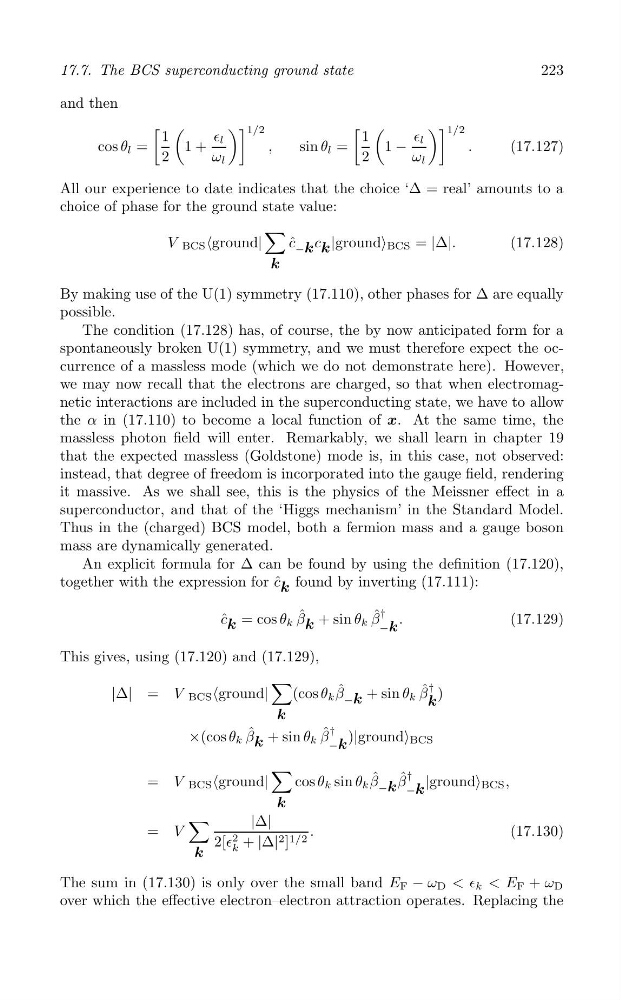
and then
[ (
)] 1/2
[ (
)] 1/2
1
∈ l
1
∈ l
cos θ l =
1 +
,
sin θ l =
1
2
ω l
2
−
.
(17.127)
ω l
All our experience to date indicates that the choice ‘Δ = real’ amounts to a
choice of phase for the ground state value:
∑
V BCS ‹ground|
c ˆ c
−k k |ground› BCS = |Δ|.
(17.128)
k
By making use of the U(1) symmetry (17.110), other phases for Δ are equally
possible.
The condition (17.128) has, of course, the by now anticipated form for a
spontaneously broken U(1) symmetry, and we must therefore expect the occurrence of a massless mode (which we do not demonstrate here). However,
we may now recall that the electrons are charged, so that when electromagnetic interactions are included in the superconducting state, we have to allow
the α in (17.110) to become a local function of x. At the same time, the
massless photon field will enter. Remarkably, we shall learn in chapter 19
that the expected massless (Goldstone) mode is, in this case, not observed:
instead, that degree of freedom is incorporated into the gauge field, rendering
it massive. As we shall see, this is the physics of the Meissner effect in a
superconductor, and that of the ‘Higgs mechanism’ in the Standard Model.
Thus in the (charged) BCS model, both a fermion mass and a gauge boson
mass are dynamically generated.
An explicit formula for Δ can be found by using the definition (17.120),
together with the expression for c ˆ found by inverting (17.111):
k
ˆ
ˆ
c ˆ = cos θ k β + sin θ k β
† .
(17.129)
k
k
−k
This gives, using (17.120) and (17.129),
∑
|Δ| = V BCS ‹
ˆ
ground|
ˆ
(cos θ k β
+ sin θ
−k
k β
† )
k
k
×
ˆ
ˆ
(cos θ k β + sin θ
k
k β
† )
−k
|ground› BCS
∑
= V BCS ‹ground|
ˆ ˆ
cos θ k sin θ k β β
†
grou
−k −k
|
nd› BCS ,
k
∑
Δ
= V
.
(17.130)
2[∈ 2
| |
+ |Δ| 2 ] 1/2
k
k
The sum in (17.130) is only over the small band E F − ω D < ∈ k < E F + ω D
over which the effective electron–electron attraction operates. Replacing the