

224
17. Spontaneously Broken Global Symmetry
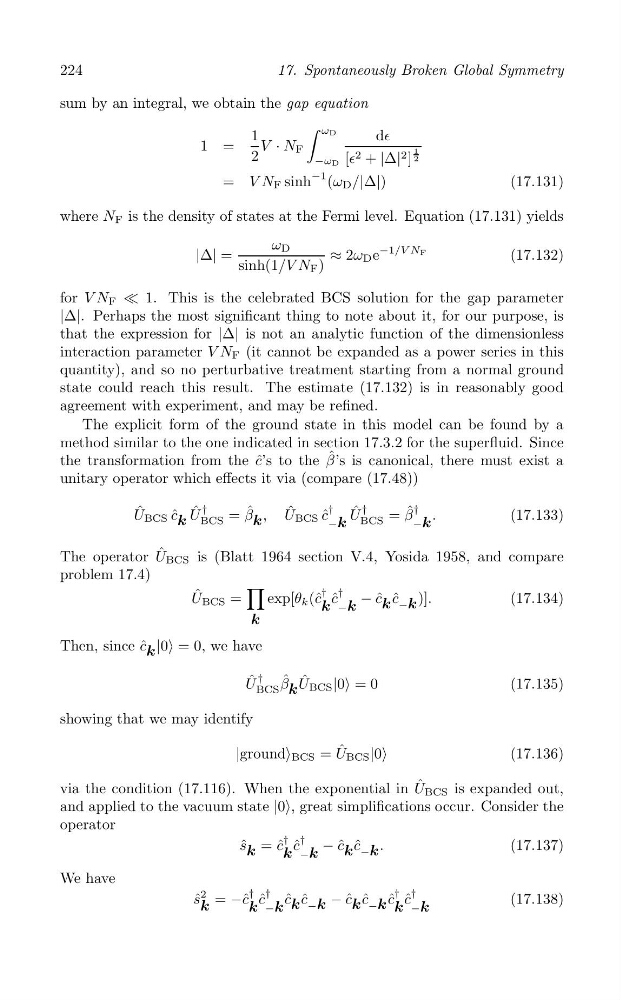
sum by an integral, we obtain the gap equation
∫
1
ωD
d∈
1 =
V · N F
2
−ωD [∈ 2 + |Δ| 2 ]
1
2
= V N F sinh
−1 (ω D /|Δ|)
(17.131)
where N F is the density of states at the Fermi level. Equation (17.131) yields
ω
|Δ|
D
= sinh(1/V N F )
≈ 2ω D e
−1/V NF
(17.132)
for V N F ≪ 1. This is the celebrated BCS solution for the gap parameter
|Δ|. Perhaps the most significant thing to note about it, for our purpose, is
that the expression for |Δ| is not an analytic function of the dimensionless
interaction parameter V N F (it cannot be expanded as a power series in this
quantity), and so no perturbative treatment starting from a normal ground
state could reach this result. The estimate (17.132) is in reasonably good
agreement with experiment, and may be refined.
The explicit form of the ground state in this model can be found by a
method similar to the one indicated in section 17.3.2 for the superfluid. Since
ˆ
the transformation from the c ˆ’s to the β’s is canonical, there must exist a
unitary operator which effects it via (compare (17.48))
ˆ
ˆ
ˆ
ˆ
ˆ
ˆ
U BCS c ˆ U
k BCS
†
= β , U BCS c ˆ
†
U
†
k
−k BCS = β
† .
(17.133)
−k
ˆ
The operator U BCS is (Blatt 1964 section V.4, Yosida 1958, and compare
problem 17.4)
∏
ˆ
U BCS =
exp[θ k (ˆ c
† c ˆ
†
k −k
− c ˆ c ˆ )].
(17.134)
k −k
k
Then, since c ˆ k |0› = 0, we have
ˆ
U BCS
†
ˆ ˆ
β U
k BCS |0› = 0
(17.135)
showing that we may identify
|ground›
ˆ
BCS = U BCS |0›
(17.136)
ˆ
via the condition (17.116). When the exponential in U BCS is expanded out,
and applied to the vacuum state |0›, great simplifications occur. Consider the
operator
s ˆ = ˆ
c
† c ˆ
†
k
k −k
− c ˆ c ˆ .
(17.137)
k −k
We have
s ˆ
2 = −c ˆ
† c ˆ
† c ˆ c ˆ
c ˆ
k
k −k k −k − c ˆ c ˆ
† c ˆ
†
(17.138)
k −k k −k