

222
17. Spontaneously Broken Global Symmetry
ˆ
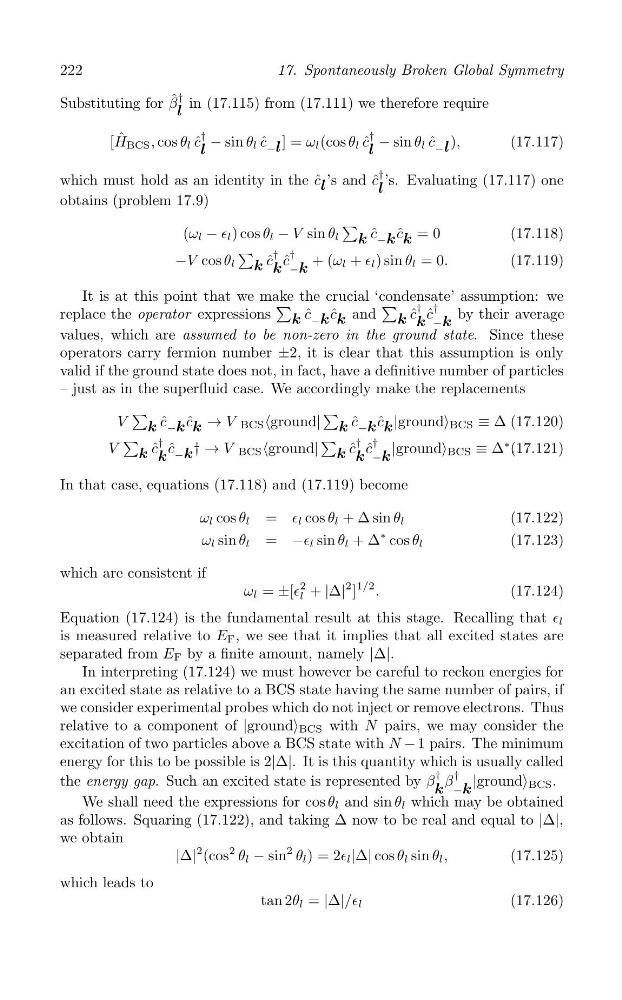
Substituting for β
† in (17.115) from (17.111) we therefore require
l
ˆ
[H BCS , cos θ l c ˆ
† − sin θ l c ˆ ] = ω l (cos θ l c ˆ
† − sin θ l c ˆ ),
(17.117)
l
−l
l
−l
which must hold as an identity in the c ˆ ’s and c ˆ
† ’s. Evaluating (17.117) one
l
l
obtains (problem 17.9)
(ω l − ∈ l ) cos θ l − V sin θ l
c ˆ c ˆ = 0
(17.118)
k −k k
−V cos θ l
c ˆ
† c ˆ
†
+ (ω l + ∈ l ) sin θ l = 0.
(17.119)
k k −k
It is at this point that we ma ke the crucial ‘co ndensate’ assumption: we
replace the operator expressions
c ˆ c ˆ and
c ˆ
† c ˆ
†
by their average
k −k k
k k −k
values, which are assumed to be non-zero in the ground state. Since these
operators carry fermion number ±2, it is clear that this assumption is only
valid if the ground state does not, in fact, have a definitive number of particles
– just as in the superfluid case. We accordingly make the replacements
V
c ˆ c ˆ
V
k k k → BCS ‹ground
−
|
c ˆ c ˆ ground
Δ (17.120)
k −k k |
BCS
›
≡
V
c ˆ
† c ˆ
d
k − † → V BCS ‹groun
k
k
|
c ˆ
† c ˆ
†
k k −k
|ground› BCS ≡ Δ
∗ ( .17.121)
In that case, equations (17.118) and (17.119) become
ω l cos θ l = ∈ l cos θ l + Δ sin θ l
(17.122)
ω l sin θ l = −∈ l sin θ l + Δ
∗ cos θ l
(17.123)
which are consistent if
ω l = ±[∈
2
l + |Δ|
2 ]
1/2 .
(17.124)
Equation (17.124) is the fundamental result at this stage. Recalling that ∈ l
is measured relative to E F , we see that it implies that all excited states are
separated from E F by a finite amount, namely |Δ|.
In interpreting (17.124) we must however be careful to reckon energies for
an excited state as relative to a BCS state having the same number of pairs, if
we consider experimental probes which do not inject or remove electrons. Thus
relative to a component of |ground› BCS with N pairs, we may consider the
excitation of two particles above a BCS state with N − 1 pairs. The minimum
energy for this to be possible is 2|Δ|. It is this quantity which is usually called
the energy gap. Such an excited state is represented by β
† β
†
k −k
|ground› BCS .
We shall need the expressions for cos θ l and sin θ l which may be obtained
as follows. Squaring (17.122), and taking Δ now to be real and equal to |Δ|,
we obtain
|Δ|
2 (cos
2 θ l − sin
2 θ l ) = 2∈ l |Δ| cos θ l sin θ l ,
(17.125)
which leads to
tan 2θ l = |Δ|/∈ l
(17.126)