

17.3. Spontaneously broken symmetry in condensed matter physics
205
operator. However, it is important to be clear that the number non-conserving
aspect of (17.35) is of a completely different kind, conceptually, from that
which would be associated with a (hypothetical) ‘explicit ’ number violating
term in the original Hamiltonian – for example, the addition of a term of the
form ‘a ˆ
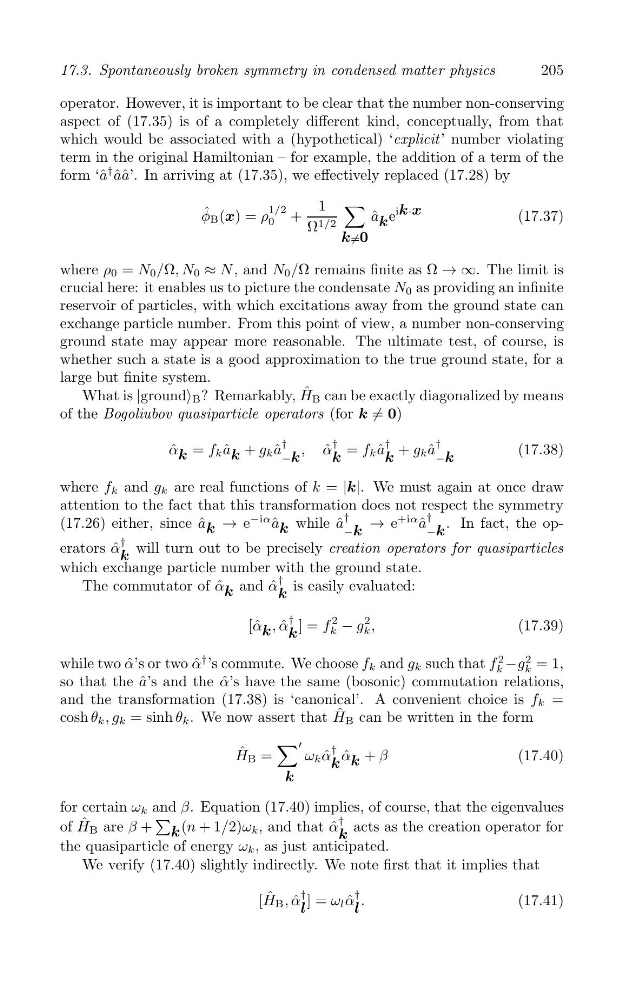
† a ˆa ˆ’. In arriving at (17.35), we effectively replaced (17.28) by
∑
ˆ
1/2
1
φ B (x) = ρ 0 +
·x
a ˆ e
ik
(17.37)
1/2
k
Ω
k=0
where ρ 0 = N 0 /Ω, N 0 ≈ N , and N 0 /Ω remains finite as Ω → ∞. The limit is
crucial here: it enables us to picture the condensate N 0 as providing an infinite
reservoir of particles, with which excitations away from the ground state can
exchange particle number. From this point of view, a number non-conserving
ground state may appear more reasonable. The ultimate test, of course, is
whether such a state is a good approximation to the true ground state, for a
large but finite system.
|
›
ˆ
What is ground B ? Remarkably, H B can be exactly diagonalized by means
of the Bogoliubov quasiparticle operators (for k = 0)
α ˆ = f
k
k a ˆ + g
k
k a ˆ
† , α ˆ
† = f
k
k
k a ˆ
† + g a
k
k ˆ
†
(17.38)
−
−k
where f k and g k are real functions of k = |k|. We must again at once draw
attention to the fact that this transformation does not respect the symmetry
(17.26) either, since a ˆ → e
−iα a ˆ while a ˆ
†
e
+iα a ˆ
† . In fact, the opk
k
−k
→
−k
erators α ˆ
† will turn out to be precisely creation operators for quasiparticles
k
which exchange particle number with the ground state.
The commutator of α ˆ and α ˆ
† is easily evaluated:
k
k
[ˆ α , α ˆ
† ] = f
2
k k
k − g
2
k ,
(17.39)
while two α ˆ’s or two α ˆ
† ’s commute. We choose f k and g k such that f
2
k −g
2
k = 1,
so that the a ˆ’s and the α ˆ’s have the same (bosonic) commutation relations,
and the transformation (17.38) is ‘canonical’. A convenient choice is f k =
ˆ
cosh θ k , g k = sinh θ k . We now assert that H B can be written in the form
∑
ˆ
′
H B =
ω k α ˆ
† α ˆ + β
(17.40)
k k
k
for certain ω k and β. Equation (17.40) implies, of course, that the eigenvalues
ˆ
of H B are β +
(n + 1/2)ω , and that α ˆ
† acts as the creation operator for
k
k
k
the quasiparticle of energy ω k , as just anticipated.
We verify (17.40) slightly indirectly. We note first that it implies that
ˆ
[H B , α ˆ
† ] = ω
l
l α ˆ
† .
(17.41)
l
/
/