

204
17. Spontaneously Broken Global Symmetry
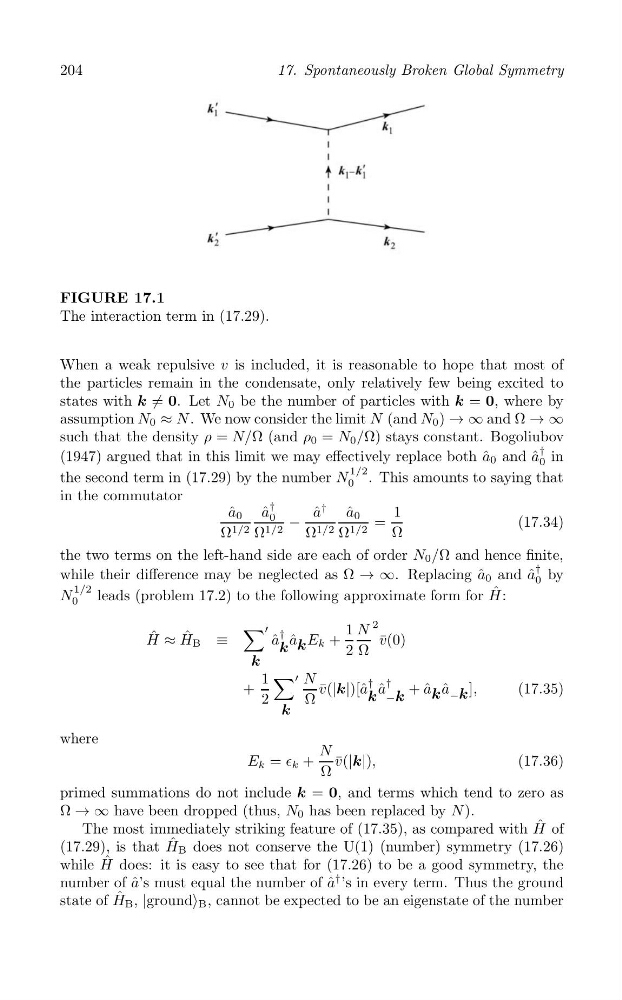
FIGURE 17.1
The interaction term in (17.29).
When a weak repulsive v is included, it is reasonable to hope that most of
the particles remain in the condensate, only relatively few being excited to
states with k = 0. Let N 0 be the number of particles with k = 0, where by
assumption N 0 ≈ N . We now consider the limit N (and N 0 ) → ∞ and Ω → ∞
such that the density ρ = N/Ω (and ρ 0 = N 0 /Ω) stays constant. Bogoliubov
(1947) argued that in this limit we may effectively replace both a ˆ 0 and a ˆ
†
0 in
1/2
the second term in (17.29) by the number N 0 . This amounts to saying that
in the commutator
a ˆ 0 a ˆ
†
0
a ˆ
†
a ˆ
1
=
Ω
−
0
(17.34)
1/2 Ω 1/2
Ω 1/2 Ω 1/2
Ω
the two terms on the left-hand side are each of order N 0 /Ω and hence finite,
while their difference may be neglected as Ω → ∞. Replacing a ˆ 0 and a ˆ
†
0 by
1/2
ˆ
N 0 leads (problem 17.2) to the following approximate form for H:
∑
ˆ
H ≈ ˆ
′
1 N
2
H B ≡
a ˆ
† a ˆ E k +
v ¯(0)
k k
2 Ω
k
1 ∑ ′ N
+
v ¯(|k|)[a ˆ
† a ˆ
†
+ ˆ
a a ˆ ],
(17.35)
2
Ω
k −k
k −k
k
where
N
E k = ∈ k + v ¯(|k
Ω
|),
(17.36)
primed summations do not include k = 0, and terms which tend to zero as
Ω → ∞ have been dropped (thus, N 0 has been replaced by N ).
ˆ
The most immediately striking feature of (17.35), as compared with H of
ˆ
(17.29), is that H B does not conserve the U(1) (number) symmetry (17.26)
ˆ
while H does: it is easy to see that for (17.26) to be a good symmetry, the
number of a ˆ’s must equal the number of a ˆ
† ’s in every term. Thus the ground
ˆ
state of H B , |ground› B , cannot be expected to be an eigenstate of the number
/