

206
17. Spontaneously Broken Global Symmetry
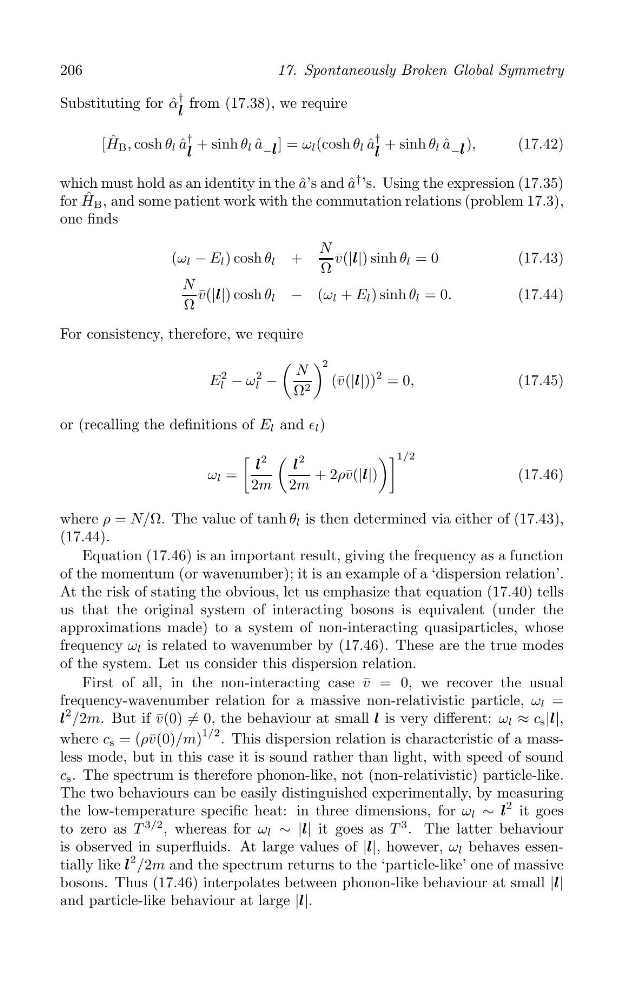
Substituting for ˆ
α
† from (17.38), we require
l
†
†
[H ˆ B , cosh θ l a ˆ + sinh θ l a ˆ −l ] = ω l (cosh θ l a ˆ + sinh θ l a ˆ −l ),
(17.42)
l
l
which must hold as an identity in the a ˆ’s and ˆ
a
† ’s. Using the expression (17.35)
for H ˆ B , and some patient work with the commutation relations (problem 17.3),
one finds
N
(ω l − E l ) cosh θ l +
v ¯(|l|) sinh θ l = 0
(17.43)
Ω
N v ¯(|l|) cosh θ l − (ω l + E l ) sinh θ l = 0.
(17.44)
Ω
For consistency, therefore, we require
( ) 2
N
E
2
− ω
2
−
(¯ v(|l|))
2 = 0,
(17.45)
l
l
Ω 2
or (recalling the definitions of E l and ∈ l )
[
(
)]1/2
l
2
l
2
ω l =
+ 2ρv ¯(|l|)
(17.46)
2m 2m
where ρ = N/Ω. The value of tanh θ l is then determined via either of (17.43),
(17.44).
Equation (17.46) is an important result, giving the frequency as a function
of the momentum (or wavenumber); it is an example of a ‘dispersion relation’.
At the risk of stating the obvious, let us emphasize that equation (17.40) tells
us that the original system of interacting bosons is equivalent (under the
approximations made) to a system of non-interacting quasiparticles, whose
frequency ω l is related to wavenumber by (17.46). These are the true modes
of the system. Let us consider this dispersion relation.
First of all, in the non-interacting case ¯
v = 0, we recover the usual
frequency-wavenumber relation for a massive non-relativistic particle, ω l =
l
2 /2m. But if ¯
v(0) = / 0, the behaviour at small l is very different: ω l ≈ c s |l|,
1/2
where c s = (ρv ¯(0)/m) . This dispersion relation is characteristic of a massless mode, but in this case it is sound rather than light, with speed of sound
c s . The spectrum is therefore phonon-like, not (non-relativistic) particle-like.
The two behaviours can be easily distinguished experimentally, by measuring
the low-temperature specific heat: in three dimensions, for ω l ∼ l
2 it goes
to zero as T
3/2 , whereas for ω l ∼ |l| it goes as T
3 . The latter behaviour
is observed in superfluids. At large values of |l|, however, ω l behaves essentially like l
2 /2m and the spectrum returns to the ‘particle-like’ one of massive
bosons. Thus (17.46) interpolates between phonon-like behaviour at small |l|
and particle-like behaviour at large |l|.