

126
15. QCD II: Asymptotic Freedom, the Renormalization Group
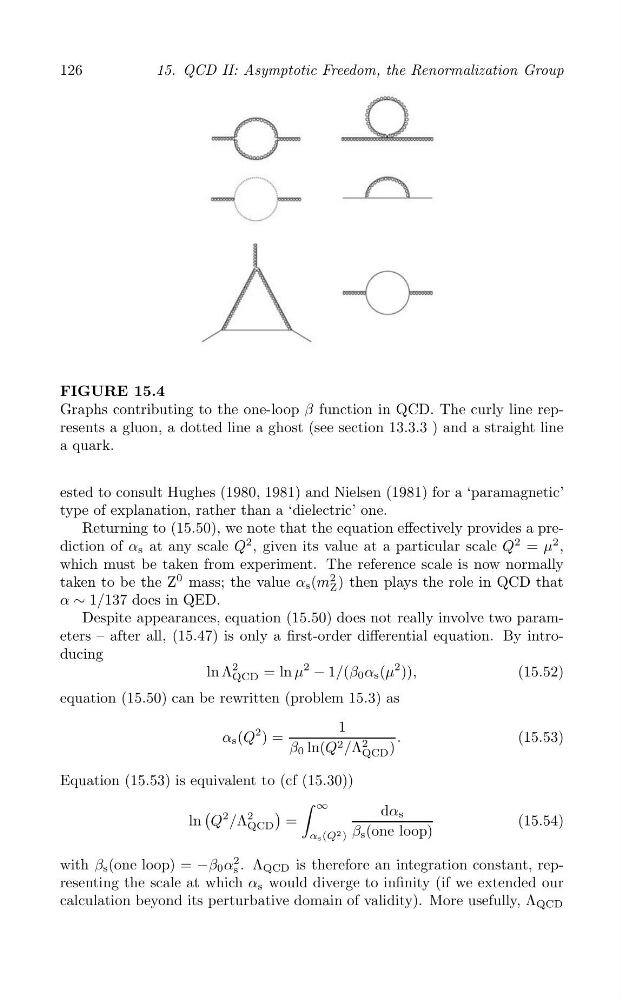
FIGURE 15.4
Graphs contributing to the one-loop β function in QCD. The curly line represents a gluon, a dotted line a ghost (see section 13.3.3 ) and a straight line
a quark.
ested to consult Hughes (1980, 1981) and Nielsen (1981) for a ‘paramagnetic’
type of explanation, rather than a ‘dielectric’ one.
Returning to (15.50), we note that the equation effectively provides a prediction of α s at any scale Q
2 , given its value at a particular scale Q
2 = μ
2 ,
which must be taken from experiment. The reference scale is now normally
2
taken to be the Z
0 mass; the value α s (m ) then plays the role in QCD that
Z
α ∼ 1/137 does in QED.
Despite appearances, equation (15.50) does not really involve two parameters – after all, (15.47) is only a first-order differential equation. By introducing
ln Λ
2
(μ
2 )),
(15.52)
QCD = ln μ
2
− 1/(β 0 α s
equation (15.50) can be rewritten (problem 15.3) as
α s (Q
2 ) =
1
.
(15.53)
β 0 ln(Q 2 /Λ 2 )
QCD
Equation (15.53) is equivalent to (cf (15.30))
∫ ∞
(
)
dα s
ln Q
2 /Λ
2
=
(15.54)
QCD
(Q 2 ) β s (one loop)
αs
with β s (one loop) = −β 0 α
2 . Λ QCD is therefore an integration constant, reps
resenting the scale at which α s would diverge to infinity (if we extended our
calculation beyond its perturbative domain of validity). More usefully, Λ QCD