

15.3. Back to QCD: asymptotic freedom
125
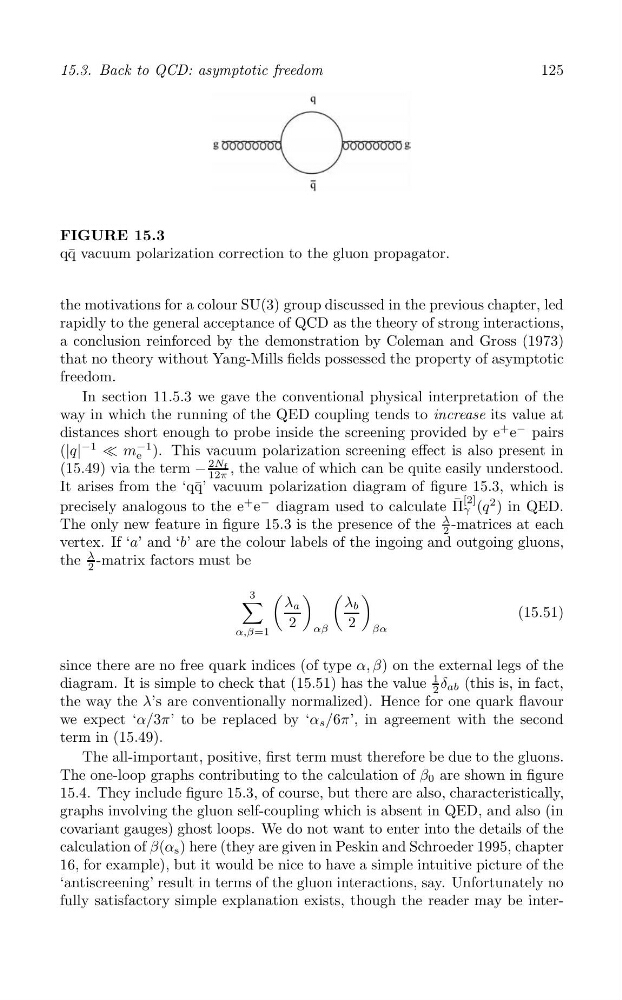
FIGURE 15.3
q¯ q vacuum polarization correction to the gluon propagator.
the motivations for a colour SU(3) group discussed in the previous chapter, led
rapidly to the general acceptance of QCD as the theory of strong interactions,
a conclusion reinforced by the demonstration by Coleman and Gross (1973)
that no theory without Yang-Mills fields possessed the property of asymptotic
freedom.
In section 11.5.3 we gave the conventional physical interpretation of the
way in which the running of the QED coupling tends to increase its value at
distances short enough to probe inside the screening provided by e
+ e
− pairs
(|q|
−1
≪ m
−1
e ). This vacuum polarization screening effect is also present in
(15.49) via the term −
2N f , the value of which can be quite easily understood.
12π
It arises from the ‘qq’ ¯ vacuum polarization diagram of figure 15.3, which is
[2]
precisely analogous to the e
+ −
¯
e diagram used to calculate Π γ (q
2 ) in QED.
The only new feature in figure 15.3 is the presence of the
λ -matrices at each
2
vertex. If ‘a’ and ‘b’ are the colour labels of the ingoing and outgoing gluons,
the
λ -matrix factors must be
2
3
( ) ( )
∑ λ a
λ b
(15.51)
2 αβ 2 βα
α,β=1
since there are no free quark indices (of type α, β) on the external legs of the
diagram. It is simple to check that (15.51) has the value
1 δ ab (this is, in fact,
2
the way the λ’s are conventionally normalized). Hence for one quark flavour
we expect ‘α/3π’ to be replaced by ‘α s /6π’, in agreement with the second
term in (15.49).
The all-important, positive, first term must therefore be due to the gluons.
The one-loop graphs contributing to the calculation of β 0 are shown in figure
15.4. They include figure 15.3, of course, but there are also, characteristically,
graphs involving the gluon self-coupling which is absent in QED, and also (in
covariant gauges) ghost loops. We do not want to enter into the details of the
calculation of β(α s ) here (they are given in Peskin and Schroeder 1995, chapter
16, for example), but it would be nice to have a simple intuitive picture of the
‘antiscreening’ result in terms of the gluon interactions, say. Unfortunately no
fully satisfactory simple explanation exists, though the reader may be inter-