

15.3. Back to QCD: asymptotic freedom
127
is a measure of the scale at which α s really does become ‘strong’. The extraction of a value of Λ QCD is a somewhat complicated matter, as we shall briefly
indicate in the following section, but a typical value is in the region of 200
MeV. Note that this is a distance scale of order (200 MeV)
−1
∼ 1 fm, just
about the size of a hadron – a satisfactory connection.
15.3.2 Higher-order calculations, and experimental comparison
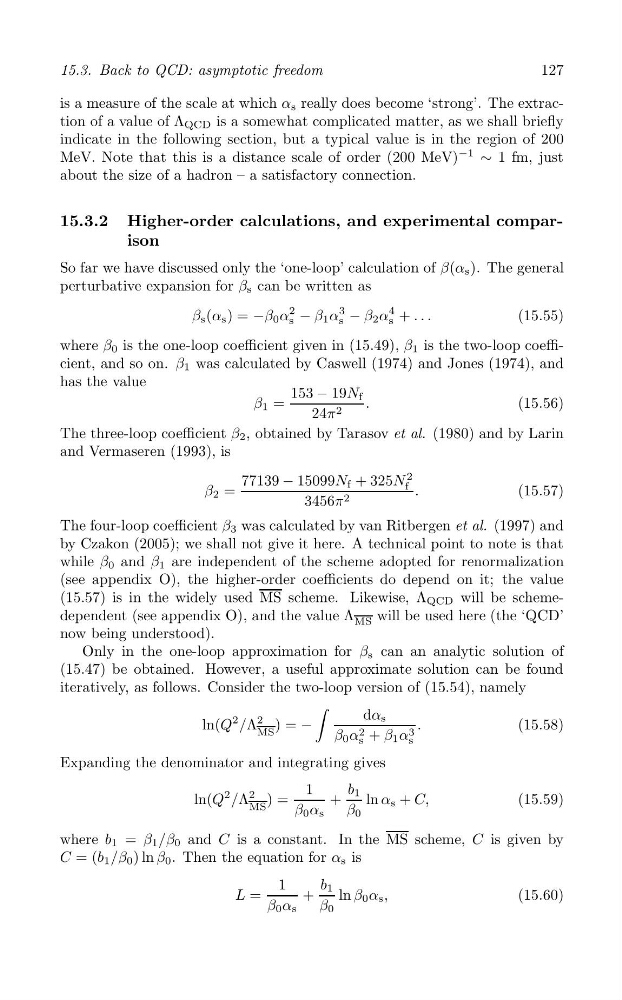
So far we have discussed only the ‘one-loop’ calculation of β(α s ). The general
perturbative expansion for β s can be written as
β s (α s ) = −β 0 α
2
s − β 1 α
3
s − β 2 α
4
s + . . .
(15.55)
where β 0 is the one-loop coefficient given in (15.49), β 1 is the two-loop coefficient, and so on. β 1 was calculated by Caswell (1974) and Jones (1974), and
has the value
153
β 1 =
− 19N f .
(15.56)
24π 2
The three-loop coefficient β 2 , obtained by Tarasov et al. (1980) and by Larin
and Vermaseren (1993), is
77139 − 15099N f + 325N
2
β 2 =
f .
(15.57)
3456π 2
The four-loop coefficient β 3 was calculated by van Ritbergen et al. (1997) and
by Czakon (2005); we shall not give it here. A technical point to note is that
while β 0 and β 1 are independent of the scheme adopted for renormalization
(see appendix O), the higher-order coefficients do depend on it; the value
(15.57) is in the widely used MS scheme. Likewise, Λ QCD will be schemedependent (see appendix O), and the value Λ MS will be used here (the ‘QCD’
now being understood).
Only in the one-loop approximation for β s can an analytic solution of
(15.47) be obtained. However, a useful approximate solution can be found
iteratively, as follows. Consider the two-loop version of (15.54), namely
∫
ln(Q
2
dα s
/Λ
2 ) = −
.
(15.58)
MS
β 0 α 2
s + β 1 α 3
s
Expanding the denominator and integrating gives
ln(Q
2 /Λ
2
1
b 1
) =
+
ln α s + C,
(15.59)
MS
β 0 α s
β 0
where b 1 = β 1 /β 0 and C is a constant. In the MS scheme, C is given by
C = (b 1 /β 0 ) ln β 0 . Then the equation for α s is
1
b 1
L =
+
ln β 0 α s ,
(15.60)
β 0 α s
β 0