

119
15.2. The renormalization group and related ideas in QED
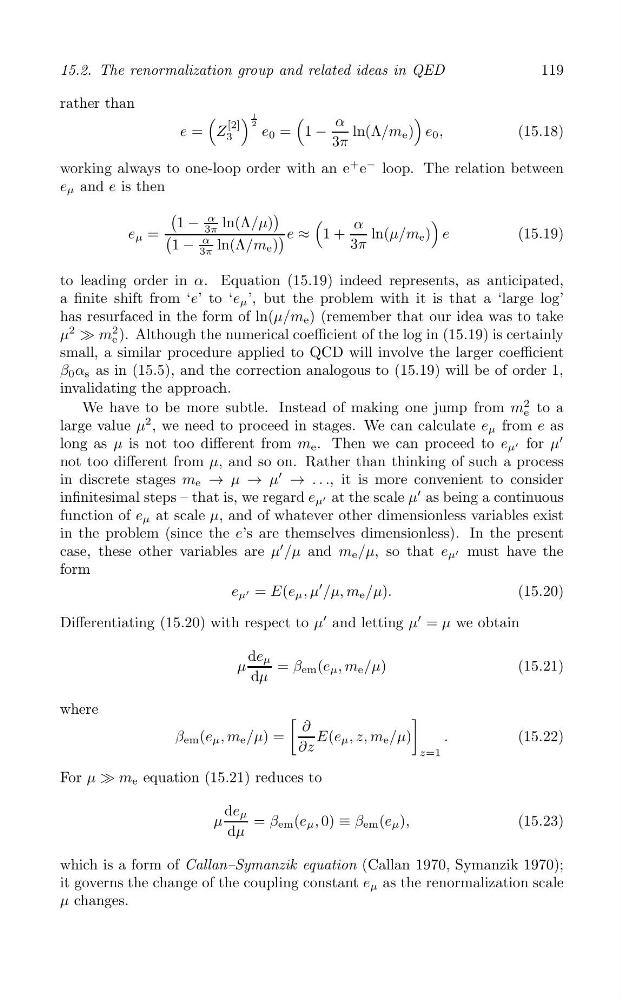
rather than
(
) 1
(
)
[2]
α
e = Z
2 e 0 = 1 −
ln(Λ/m e ) e 0 ,
(15.18)
3
3π
−
working always to one-loop order with an e
+ e loop. The relation between
e μ and e is then
(
)
(
)
1 −
α ln(Λ/μ)
α
3π
e μ = (
) e ≈ 1 +
ln(μ/m e ) e
(15.19)
1 −
α ln(Λ/m e )
3π
3π
to leading order in α. Equation (15.19) indeed represents, as anticipated,
a finite shift from ‘e’ to ‘e μ ’, but the problem with it is that a ‘large log’
has resurfaced in the form of ln(μ/m e ) (remember that our idea was to take
2
μ
2
≫ m ). Although the numerical coefficient of the log in (15.19) is certainly
e
small, a similar procedure applied to QCD will involve the larger coefficient
β 0 α s as in (15.5), and the correction analogous to (15.19) will be of order 1,
invalidating the approach.
2
We have to be more subtle. Instead of making one jump from m to a
e
large value μ
2 , we need to proceed in stages. We can calculate e μ from e as
long as μ is not too different from m e . Then we can proceed to e μ ′ for μ
′
not too different from μ, and so on. Rather than thinking of such a process
in discrete stages m e → μ → μ
′
→ . . ., it is more convenient to consider
infinitesimal steps – that is, we regard e μ ′ at the scale μ
′ as being a continuous
function of e μ at scale μ, and of whatever other dimensionless variables exist
in the problem (since the e’s are themselves dimensionless). In the present
case, these other variables are μ
′ /μ and m e /μ, so that e μ ′ must have the
form
e μ ′ = E(e μ , μ
′ /μ, m e /μ).
(15.20)
Differentiating (15.20) with respect to μ
′ and letting μ
′ = μ we obtain
de μ
μ
= β em (e μ , m e /μ)
(15.21)
dμ
where
[
]
∂
β em (e μ , m e /μ) =
E(e μ , z, m e /μ)
.
(15.22)
∂z
z=1
For μ ≫ m e equation (15.21) reduces to
de μ
μ
= β em (e μ , 0) ≡ β em (e μ ),
(15.23)
dμ
which is a form of Callan–Symanzik equation (Callan 1970, Symanzik 1970);
it governs the change of the coupling constant e μ as the renormalization scale
μ changes.