

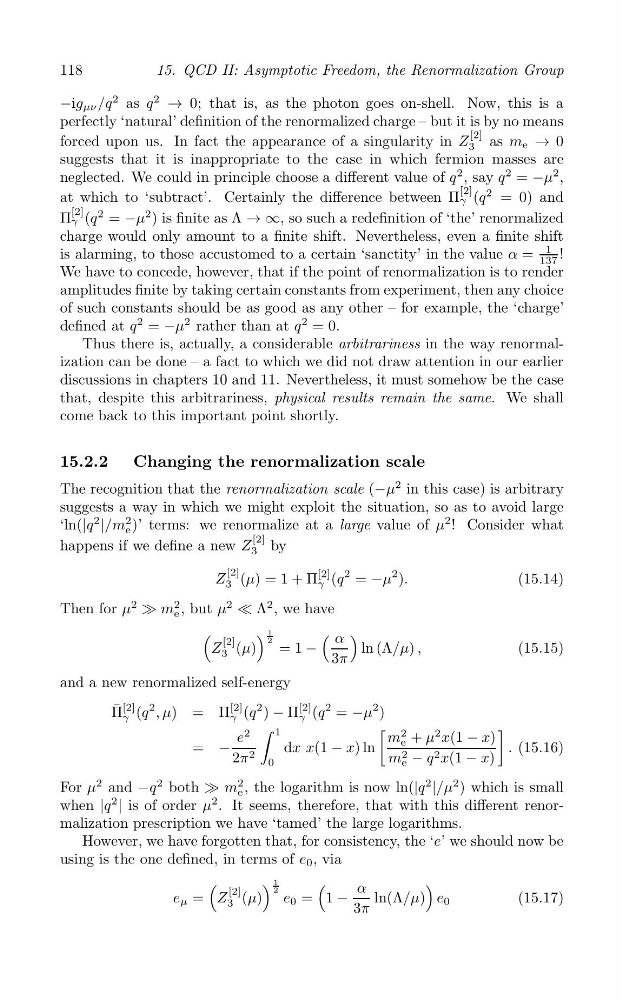
118
15. QCD II: Asymptotic Freedom, the Renormalization Group
2
−ig μν /q
2 as q → 0; that is, as the photon goes on-shell. Now, this is a
perfectly ‘natural’ definition of the renormalized charge – but it is by no means
[2]
forced upon us. In fact the appearance of a singularity in Z as m e → 0
3
suggests that it is inappropriate to the case in which fermion masses are
2
2
neglected. We could in principle choose a different value of q , say q = −μ
2 ,
[2] 2
at which to ‘subtract’. Certainly the difference between Π γ (q = 0) and
[2] 2
Π γ (q = −μ
2 ) is finite as Λ → ∞, so such a redefinition of ‘the’ renormalized
charge would only amount to a finite shift. Nevertheless, even a finite shift
1
is alarming, to those accustomed to a certain ‘sanctity’ in the value α =
!
137
We have to concede, however, that if the point of renormalization is to render
amplitudes finite by taking certain constants from experiment, then any choice
of such constants should be as good as any other – for example, the ‘charge’
2
defined at q = −μ
2 rather than at q
2 = 0.
Thus there is, actually, a considerable arbitrariness in the way renormalization can be done – a fact to which we did not draw attention in our earlier
discussions in chapters 10 and 11. Nevertheless, it must somehow be the case
that, despite this arbitrariness, physical results remain the same. We shall
come back to this important point shortly.
15.2.2
Changing the renormalization scale
The recognition that the renormalization scale (−μ
2 in this case) is arbitrary
suggests a way in which we might exploit the situation, so as to avoid large
‘ln(|q
2
|/m
2 )’ terms: we renormalize at a large value of μ
2 ! Consider what
e
[2]
happens if we define a new Z by
3
[2]
2
1 + Π
[2]
−μ
2 ).
Z 3 (μ) =
γ (q =
(15.14)
2
Then for μ
2
≫ m , but μ
2
≪ Λ
2 , we have
e
(
)
[2]
Z (μ)
3
1
2 = 1 −
( )
α
3π
ln (Λ/μ) ,
(15.15)
and a new renormalized self-energy
Π ¯ [2]
Π
[2] 2 ) − Π
[2] 2
(q
2 , μ) =
(q
(q = −μ
2 )
γ
γ
γ
∫
[
]
2
1
2
e
m + μ
2 x(1 − x)
e
= −
dx x(1 − x) ln
. (15.16)
2π 2
0
m 2
e − q 2 x(1 − x)
2
2
For μ
2 and −q both ≫ m , the logarithm is now ln(|q
2
|/μ
2 ) which is small
e
when |q
2
| is of order μ
2 . It seems, therefore, that with this different renormalization prescription we have ‘tamed’ the large logarithms.
However, we have forgotten that, for consistency, the ‘e’ we should now be
using is the one defined, in terms of e 0 , via
e μ =
(
)
[2]
Z (μ)
3
1
2 e 0 =
(
1 −
)
α ln(Λ/μ)
3π
e 0
(15.17)