

115
15.1. Higher-order QCD corrections to σ(e
+ e
−
→ hadrons)
section – that is, large Q
2 -dependent departures from the point-like Born cross
section, σ pt (Q
2 ). But the data actually follow the point-like prediction very
well.
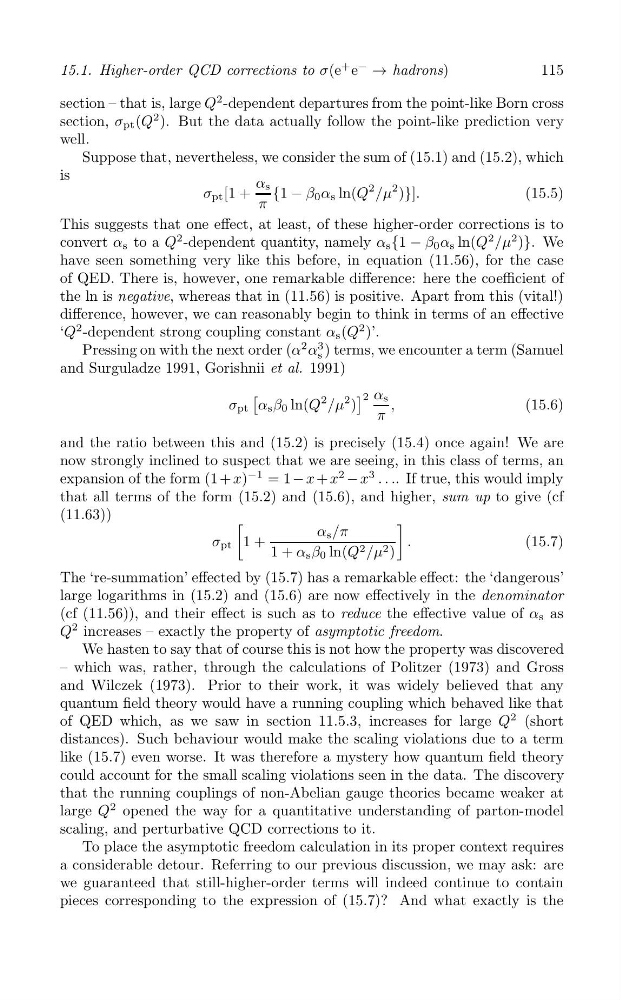
Suppose that, nevertheless, we consider the sum of (15.1) and (15.2), which
is
α s
σ pt [1 + {1 − β 0 α s ln(Q
2 /μ
2 )}].
(15.5)
π
This suggests that one effect, at least, of these higher-order corrections is to
convert α s to a Q
2 -dependent quantity, namely α s {1 − β 0 α s ln(Q
2 /μ
2 )}. We
have seen something very like this before, in equation (11.56), for the case
of QED. There is, however, one remarkable difference: here the coefficient of
the ln is negative, whereas that in (11.56) is positive. Apart from this (vital!)
difference, however, we can reasonably begin to think in terms of an effective
‘Q
2 -dependent strong coupling constant α s (Q
2 )’.
Pressing on with the next order (α
2 α
3 ) terms, we encounter a term (Samuel
s
and Surguladze 1991, Gorishnii et al. 1991)
[
] 2 α s
σ pt α s β 0 ln(Q
2 /μ
2 )
,
(15.6)
π
and the ratio between this and (15.2) is precisely (15.4) once again! We are
now strongly inclined to suspect that we are seeing, in this class of terms, an
expansion of the form (1 + x)
−1 = 1− x + x
2
− x
3 . . .. If true, this would imply
that all terms of the form (15.2) and (15.6), and higher, sum up to give (cf
(11.63))
[
]
α s /π
σ pt 1 +
.
(15.7)
1 + α s β 0 ln(Q 2 /μ 2 )
The ‘re-summation’ effected by (15.7) has a remarkable effect: the ‘dangerous’
large logarithms in (15.2) and (15.6) are now effectively in the denominator
(cf (11.56)), and their effect is such as to reduce the effective value of α s as
Q
2 increases – exactly the property of asymptotic freedom.
We hasten to say that of course this is not how the property was discovered
– which was, rather, through the calculations of Politzer (1973) and Gross
and Wilczek (1973). Prior to their work, it was widely believed that any
quantum field theory would have a running coupling which behaved like that
of QED which, as we saw in section 11.5.3, increases for large Q
2 (short
distances). Such behaviour would make the scaling violations due to a term
like (15.7) even worse. It was therefore a mystery how quantum field theory
could account for the small scaling violations seen in the data. The discovery
that the running couplings of non-Abelian gauge theories became weaker at
large Q
2 opened the way for a quantitative understanding of parton-model
scaling, and perturbative QCD corrections to it.
To place the asymptotic freedom calculation in its proper context requires
a considerable detour. Referring to our previous discussion, we may ask: are
we guaranteed that still-higher-order terms will indeed continue to contain
pieces corresponding to the expression of (15.7)? And what exactly is the