

116
15. QCD II: Asymptotic Freedom, the Renormalization Group
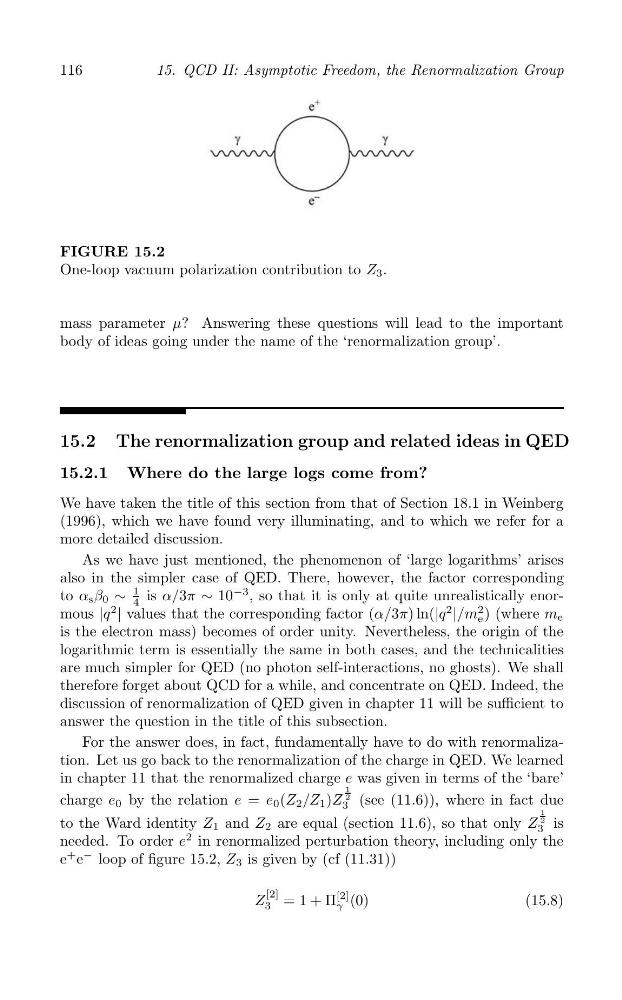
FIGURE 15.2
One-loop vacuum polarization contribution to Z 3 .
mass parameter μ? Answering these questions will lead to the important
body of ideas going under the name of the ‘renormalization group’.
15.2 The renormalization group and related ideas in QED
15.2.1 Where do the large logs come from?
We have taken the title of this section from that of Section 18.1 in Weinberg
(1996), which we have found very illuminating, and to which we refer for a
more detailed discussion.
As we have just mentioned, the phenomenon of ‘large logarithms’ arises
also in the simpler case of QED. There, however, the factor corresponding
to α s β 0 ∼ 4
1 is α/3π ∼ 10
−3 , so that it is only at quite unrealistically enormous |q
2
| values that the corresponding factor (α/3π) ln(|q
2
|/m
2 ) (where m e
e
is the electron mass) becomes of order unity. Nevertheless, the origin of the
logarithmic term is essentially the same in both cases, and the technicalities
are much simpler for QED (no photon self-interactions, no ghosts). We shall
therefore forget about QCD for a while, and concentrate on QED. Indeed, the
discussion of renormalization of QED given in chapter 11 will be sufficient to
answer the question in the title of this subsection.
For the answer does, in fact, fundamentally have to do with renormalization. Let us go back to the renormalization of the charge in QED. We learned
in chapter 11 that the renormalized charge e was given in terms of the ‘bare’
charge e 0 by the relation e = e 0 (Z 2 /Z 1 )Z
1
2
3 (see (11.6)), where in fact due
to the Ward identity Z 1 and Z 2 are equal (section 11.6), so that only Z
1
2
3 is
2
needed. To order e in renormalized perturbation theory, including only the
+
e e
− loop of figure 15.2, Z 3 is given by (cf (11.31))
[2]
1 + Π
[2]
Z 3 =
γ (0)
(15.8)