

114
15. QCD II: Asymptotic Freedom, the Renormalization Group
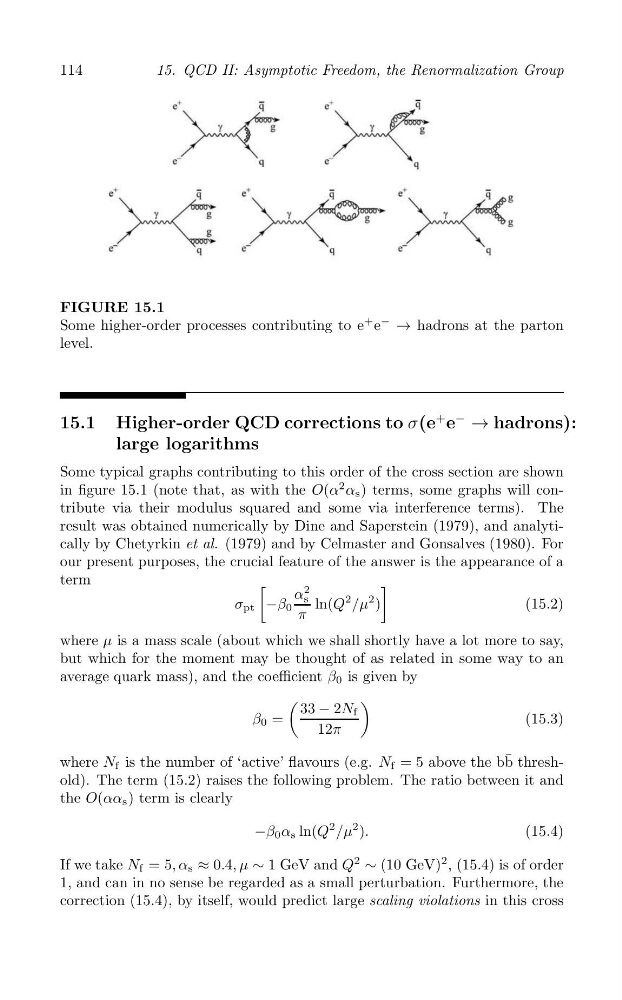
FIGURE 15.1
−
Some higher-order processes contributing to e
+ e → hadrons at the parton
level.
15.1 Higher-order QCD corrections to σ(e
+ e
−
→ hadrons):
large logarithms
Some typical graphs contributing to this order of the cross section are shown
in figure 15.1 (note that, as with the O(α
2 α s ) terms, some graphs will contribute via their modulus squared and some via interference terms). The
result was obtained numerically by Dine and Saperstein (1979), and analytically by Chetyrkin et al. (1979) and by Celmaster and Gonsalves (1980). For
our present purposes, the crucial feature of the answer is the appearance of a
term
[
]
α
2
s
σ pt −β 0
ln(Q
2 /μ
2 )
(15.2)
π
where μ is a mass scale (about which we shall shortly have a lot more to say,
but which for the moment may be thought of as related in some way to an
average quark mass), and the coefficient β 0 is given by
(
)
33 − 2N f
β 0 =
(15.3)
12π
where N f is the number of ‘active’ flavours (e.g. N f = 5 above the b ¯
b threshold). The term (15.2) raises the following problem. The ratio between it and
the O(αα s ) term is clearly
−β 0 α s ln(Q
2 /μ
2 ).
(15.4)
If we take N f = 5, α s ≈ 0.4, μ ∼ 1 GeV and Q
2
∼ (10 GeV)
2 , (15.4) is of order
1, and can in no sense be regarded as a small perturbation. Furthermore, the
correction (15.4), by itself, would predict large scaling violations in this cross