

104
14. QCD I: Introduction, Tree Graph Predictions, and Jets
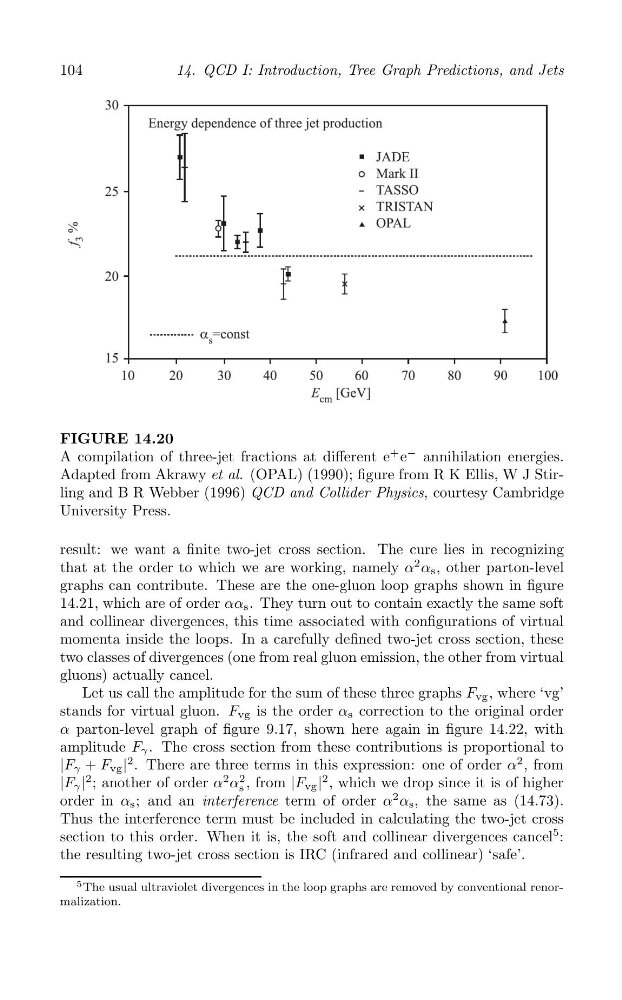
FIGURE 14.20
−
A compilation of three-jet fractions at different e
+ e annihilation energies.
Adapted from Akrawy et al. (OPAL) (1990); figure from R K Ellis, W J Stirling and B R Webber (1996) QCD and Collider Physics, courtesy Cambridge
University Press.
result: we want a finite two-jet cross section. The cure lies in recognizing
that at the order to which we are working, namely α
2 α s , other parton-level
graphs can contribute. These are the one-gluon loop graphs shown in figure
14.21, which are of order αα s . They turn out to contain exactly the same soft
and collinear divergences, this time associated with configurations of virtual
momenta inside the loops. In a carefully defined two-jet cross section, these
two classes of divergences (one from real gluon emission, the other from virtual
gluons) actually cancel.
Let us call the amplitude for the sum of these three graphs F vg , where ‘vg’
stands for virtual gluon. F vg is the order α s correction to the original order
α parton-level graph of figure 9.17, shown here again in figure 14.22, with
amplitude F γ . The cross section from these contributions is proportional to
|F γ + F vg |
2 . There are three terms in this expression: one of order α
2 , from
|F γ |
2 ; another of order α
2 α
2 , from |F vg |
2 , which we drop since it is of higher
s
order in α s ; and an interference term of order α
2 α s , the same as (14.73).
Thus the interference term must be included in calculating the two-jet cross
section to this order. When it is, the soft and collinear divergences cancel
5 :
the resulting two-jet cross section is IRC (infrared and collinear) ‘safe’.
5 The usual ultraviolet divergences in the loop graphs are removed by conventional renormalization.