

14.5. Definition of the two-jet cross section in e
+ e
− annihilation
103
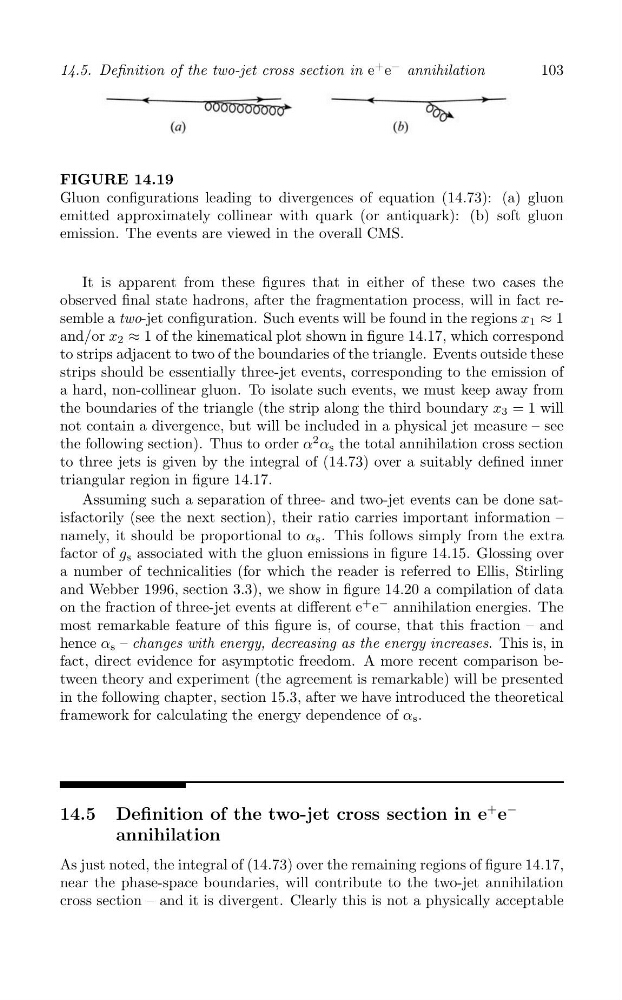
FIGURE 14.19
Gluon configurations leading to divergences of equation (14.73): (a) gluon
emitted approximately collinear with quark (or antiquark): (b) soft gluon
emission. The events are viewed in the overall CMS.
It is apparent from these figures that in either of these two cases the
observed final state hadrons, after the fragmentation process, will in fact resemble a two-jet configuration. Such events will be found in the regions x 1 ≈ 1
and/or x 2 ≈ 1 of the kinematical plot shown in figure 14.17, which correspond
to strips adjacent to two of the boundaries of the triangle. Events outside these
strips should be essentially three-jet events, corresponding to the emission of
a hard, non-collinear gluon. To isolate such events, we must keep away from
the boundaries of the triangle (the strip along the third boundary x 3 = 1 will
not contain a divergence, but will be included in a physical jet measure – see
the following section). Thus to order α
2 α s the total annihilation cross section
to three jets is given by the integral of (14.73) over a suitably defined inner
triangular region in figure 14.17.
Assuming such a separation of three- and two-jet events can be done satisfactorily (see the next section), their ratio carries important information –
namely, it should be proportional to α s . This follows simply from the extra
factor of g s associated with the gluon emissions in figure 14.15. Glossing over
a number of technicalities (for which the reader is referred to Ellis, Stirling
and Webber 1996, section 3.3), we show in figure 14.20 a compilation of data
+
on the fraction of three-jet events at different e e
− annihilation energies. The
most remarkable feature of this figure is, of course, that this fraction – and
hence α s – changes with energy, decreasing as the energy increases. This is, in
fact, direct evidence for asymptotic freedom. A more recent comparison between theory and experiment (the agreement is remarkable) will be presented
in the following chapter, section 15.3, after we have introduced the theoretical
framework for calculating the energy dependence of α s .
14.5 Definition of the two-jet cross section in e
+ e
−
annihilation
As just noted, the integral of (14.73) over the remaining regions of figure 14.17,
near the phase-space boundaries, will contribute to the two-jet annihilation
cross section – and it is divergent. Clearly this is not a physically acceptable
+ e
− annihilation
103
FIGURE 14.19
Gluon configurations leading to divergences of equation (14.73): (a) gluon
emitted approximately collinear with quark (or antiquark): (b) soft gluon
emission. The events are viewed in the overall CMS.
It is apparent from these figures that in either of these two cases the
observed final state hadrons, after the fragmentation process, will in fact resemble a two-jet configuration. Such events will be found in the regions x 1 ≈ 1
and/or x 2 ≈ 1 of the kinematical plot shown in figure 14.17, which correspond
to strips adjacent to two of the boundaries of the triangle. Events outside these
strips should be essentially three-jet events, corresponding to the emission of
a hard, non-collinear gluon. To isolate such events, we must keep away from
the boundaries of the triangle (the strip along the third boundary x 3 = 1 will
not contain a divergence, but will be included in a physical jet measure – see
the following section). Thus to order α
2 α s the total annihilation cross section
to three jets is given by the integral of (14.73) over a suitably defined inner
triangular region in figure 14.17.
Assuming such a separation of three- and two-jet events can be done satisfactorily (see the next section), their ratio carries important information –
namely, it should be proportional to α s . This follows simply from the extra
factor of g s associated with the gluon emissions in figure 14.15. Glossing over
a number of technicalities (for which the reader is referred to Ellis, Stirling
and Webber 1996, section 3.3), we show in figure 14.20 a compilation of data
+
on the fraction of three-jet events at different e e
− annihilation energies. The
most remarkable feature of this figure is, of course, that this fraction – and
hence α s – changes with energy, decreasing as the energy increases. This is, in
fact, direct evidence for asymptotic freedom. A more recent comparison between theory and experiment (the agreement is remarkable) will be presented
in the following chapter, section 15.3, after we have introduced the theoretical
framework for calculating the energy dependence of α s .
14.5 Definition of the two-jet cross section in e
+ e
−
annihilation
As just noted, the integral of (14.73) over the remaining regions of figure 14.17,
near the phase-space boundaries, will contribute to the two-jet annihilation
cross section – and it is divergent. Clearly this is not a physically acceptable