

102
14. QCD I: Introduction, Tree Graph Predictions, and Jets
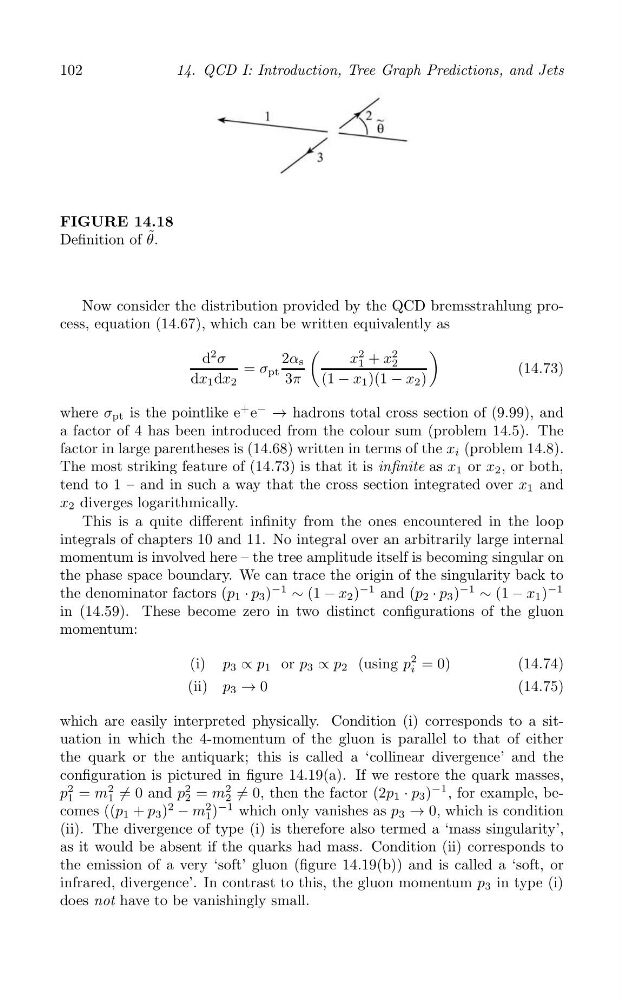
FIGURE 14.18
Definition of θ ˜ .
Now consider the distribution provided by the QCD bremsstrahlung process, equation (14.67), which can be written equivalently as
(
)
2
2
d
2 σ
2α s
x 1 + x 2
= σ pt
(14.73)
dx 1 dx 2
3π (1 − x 1 )(1 − x 2 )
where σ pt is the pointlike e
+ e
−
→ hadrons total cross section of (9.99), and
a factor of 4 has been introduced from the colour sum (problem 14.5). The
factor in large parentheses is (14.68) written in terms of the x i (problem 14.8).
The most striking feature of (14.73) is that it is infinite as x 1 or x 2 , or both,
tend to 1 – and in such a way that the cross section integrated over x 1 and
x 2 diverges logarithmically.
This is a quite different infinity from the ones encountered in the loop
integrals of chapters 10 and 11. No integral over an arbitrarily large internal
momentum is involved here – the tree amplitude itself is becoming singular on
the phase space boundary. We can trace the origin of the singularity back to
the denominator factors (p 1 · p 3 )
−1
∼ (1 − x 2 )
−1 and (p 2 · p 3 )
−1
∼ (1 − x 1 )
−1
in (14.59). These become zero in two distinct configurations of the gluon
momentum:
2
(i) p 3 ∝ p 1 or p 3 ∝ p 2 (using p = 0)
(14.74)
i
(ii) p 3 → 0
(14.75)
which are easily interpreted physically. Condition (i) corresponds to a situation in which the 4-momentum of the gluon is parallel to that of either
the quark or the antiquark; this is called a ‘collinear divergence’ and the
configuration is pictured in figure 14.19(a). If we restore the quark masses,
2
2
2
2
p = m /
= m / 0, then the factor (2p 1 · p 3 )
−1 , for example, be= 0 and p
=
1
1
2
2
2
comes ((p 1 + p 3 )
2
− m )
−1 which only vanishes as p 3 → 0, which is condition
1
(ii). The divergence of type (i) is therefore also termed a ‘mass singularity’,
as it would be absent if the quarks had mass. Condition (ii) corresponds to
the emission of a very ‘soft’ gluon (figure 14.19(b)) and is called a ‘soft, or
infrared, divergence’. In contrast to this, the gluon momentum p 3 in type (i)
does not have to be vanishingly small.