

14.4. 3-jet events in e
+ e
− annihilation
101
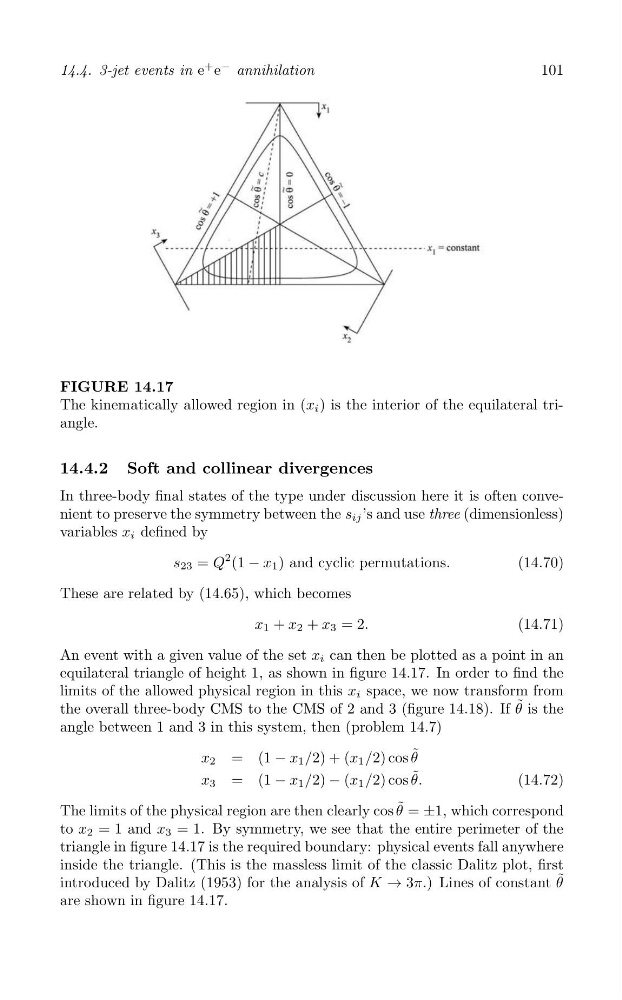
FIGURE 14.17
The kinematically allowed region in (x i ) is the interior of the equilateral triangle.
14.4.2 Soft and collinear divergences
In three-body final states of the type under discussion here it is often convenient to preserve the symmetry between the s ij ’s and use three (dimensionless)
variables x i defined by
s 23 = Q
2 (1 − x 1 ) and cyclic permutations.
(14.70)
These are related by (14.65), which becomes
x 1 + x 2 + x 3 = 2.
(14.71)
An event with a given value of the set x i can then be plotted as a point in an
equilateral triangle of height 1, as shown in figure 14.17. In order to find the
limits of the allowed physical region in this x i space, we now transform from
the overall three-body CMS to the CMS of 2 and 3 (figure 14.18). If θ ˜ is the
angle between 1 and 3 in this system, then (problem 14.7)
x 2 = (1 − x 1 /2) + (x 1 /2) cos θ ˜
x 3 = (1 − x 1 /2) − (x 1 /2) cos θ. ˜
(14.72)
˜
The limits of the physical region are then clearly cos θ = ±1, which correspond
to x 2 = 1 and x 3 = 1. By symmetry, we see that the entire perimeter of the
triangle in figure 14.17 is the required boundary: physical events fall anywhere
inside the triangle. (This is the massless limit of the classic Dalitz plot, first
introduced by Dalitz (1953) for the analysis of K → 3π.) Lines of constant θ ˜
are shown in figure 14.17.