

14.5. Definition of the two-jet cross section in e
+ e
− annihilation
105
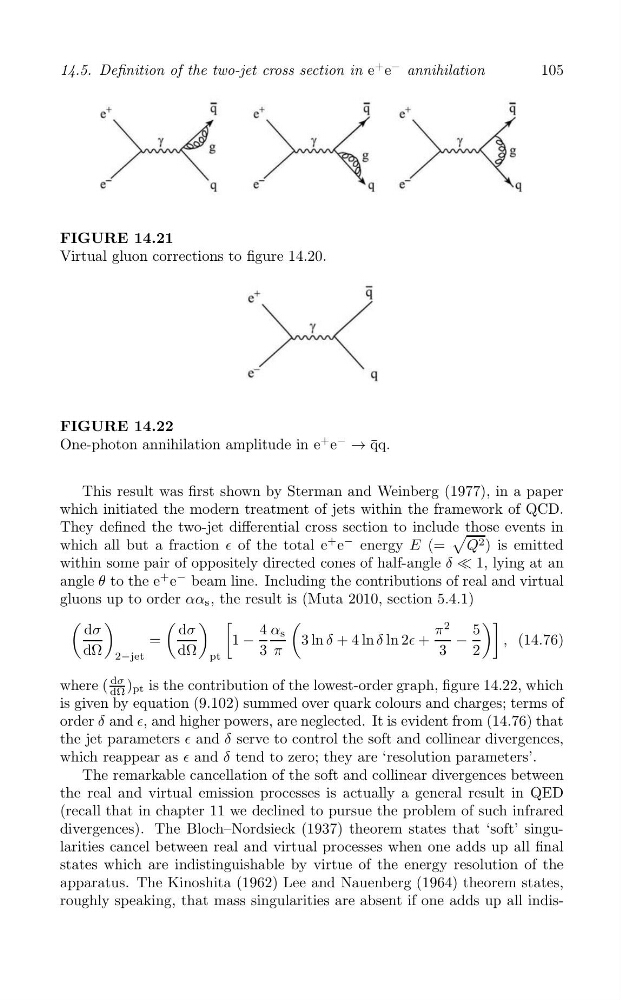
FIGURE 14.21
Virtual gluon corrections to figure 14.20.
FIGURE 14.22
One-photon annihilation amplitude in e
+ e
−
→ ¯
qq.
This result was first shown by Sterman and Weinberg (1977), in a paper
which initiated the modern treatment of jets within the framework of QCD.
They defined the two-jet differential cross section to include √ those events in
which all but a fraction ∈ of the total e
+ e
− energy E (= Q 2 ) is emitted
within some pair of oppositely directed cones of half-angle δ ≪ 1, lying at an
angle θ to the e
+ e
− beam line. Including the contributions of real and virtual
gluons up to order αα s , the result is (Muta 2010, section 5.4.1)
(
)
(
) [
(
dσ
dσ
4 α
2
)]
s
π
5
=
1
3 ln δ + 4 ln δ ln 2∈ +
, (14.76)
dΩ 2
dΩ pt
− 3 π
2
−jet
3
−
where (
dσ ) pt is the contribution of the lowest-order graph, figure 14.22, which
dΩ
is given by equation (9.102) summed over quark colours and charges; terms of
order δ and ∈, and higher powers, are neglected. It is evident from (14.76) that
the jet parameters ∈ and δ serve to control the soft and collinear divergences,
which reappear as ∈ and δ tend to zero; they are ‘resolution parameters’.
The remarkable cancellation of the soft and collinear divergences between
the real and virtual emission processes is actually a general result in QED
(recall that in chapter 11 we declined to pursue the problem of such infrared
divergences). The Bloch–Nordsieck (1937) theorem states that ‘soft’ singularities cancel between real and virtual processes when one adds up all final
states which are indistinguishable by virtue of the energy resolution of the
apparatus. The Kinoshita (1962) Lee and Nauenberg (1964) theorem states,
roughly speaking, that mass singularities are absent if one adds up all indis-
+ e
− annihilation
105
FIGURE 14.21
Virtual gluon corrections to figure 14.20.
FIGURE 14.22
One-photon annihilation amplitude in e
+ e
−
→ ¯
qq.
This result was first shown by Sterman and Weinberg (1977), in a paper
which initiated the modern treatment of jets within the framework of QCD.
They defined the two-jet differential cross section to include √ those events in
which all but a fraction ∈ of the total e
+ e
− energy E (= Q 2 ) is emitted
within some pair of oppositely directed cones of half-angle δ ≪ 1, lying at an
angle θ to the e
+ e
− beam line. Including the contributions of real and virtual
gluons up to order αα s , the result is (Muta 2010, section 5.4.1)
(
)
(
) [
(
dσ
dσ
4 α
2
)]
s
π
5
=
1
3 ln δ + 4 ln δ ln 2∈ +
, (14.76)
dΩ 2
dΩ pt
− 3 π
2
−jet
3
−
where (
dσ ) pt is the contribution of the lowest-order graph, figure 14.22, which
dΩ
is given by equation (9.102) summed over quark colours and charges; terms of
order δ and ∈, and higher powers, are neglected. It is evident from (14.76) that
the jet parameters ∈ and δ serve to control the soft and collinear divergences,
which reappear as ∈ and δ tend to zero; they are ‘resolution parameters’.
The remarkable cancellation of the soft and collinear divergences between
the real and virtual emission processes is actually a general result in QED
(recall that in chapter 11 we declined to pursue the problem of such infrared
divergences). The Bloch–Nordsieck (1937) theorem states that ‘soft’ singularities cancel between real and virtual processes when one adds up all final
states which are indistinguishable by virtue of the energy resolution of the
apparatus. The Kinoshita (1962) Lee and Nauenberg (1964) theorem states,
roughly speaking, that mass singularities are absent if one adds up all indis-