

14.4. 3-jet events in e
+ e
− annihilation
97
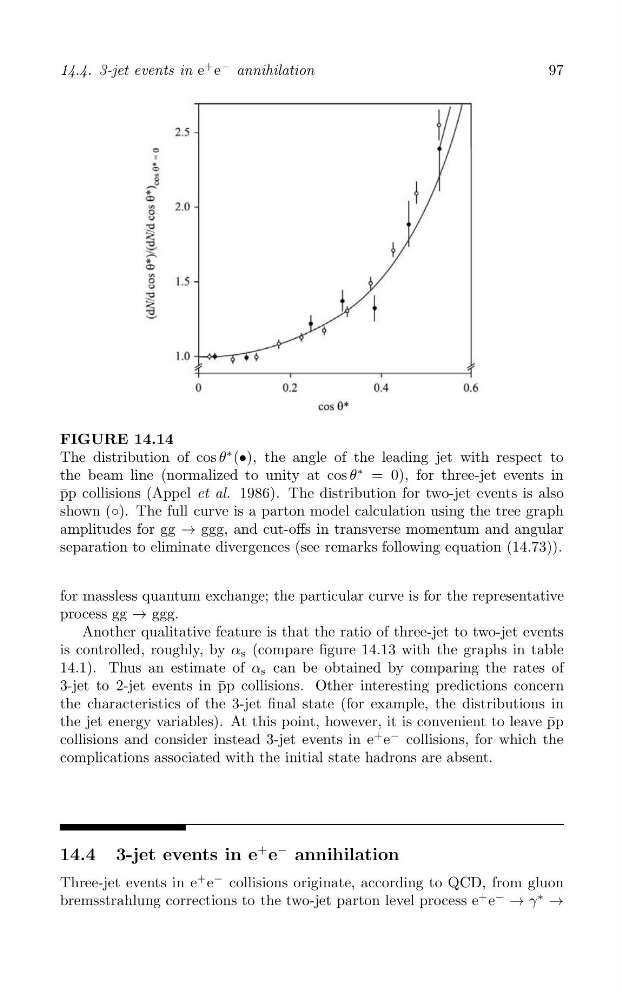
FIGURE 14.14
The distribution of cos θ
∗ (•), the angle of the leading jet with respect to
the beam line (normalized to unity at cos θ
∗ = 0), for three-jet events in
¯
1986). The distribution for two-jet events is also
pp collisions (Appel et al.
shown (◦). The full curve is a parton model calculation using the tree graph
amplitudes for gg → ggg, and cut-offs in transverse momentum and angular
separation to eliminate divergences (see remarks following equation (14.73)).
for massless quantum exchange; the particular curve is for the representative
process gg → ggg.
Another qualitative feature is that the ratio of three-jet to two-jet events
is controlled, roughly, by α s (compare figure 14.13 with the graphs in table
14.1). Thus an estimate of α s can be obtained by comparing the rates of
3-jet to 2-jet events in ¯
pp collisions. Other interesting predictions concern
the characteristics of the 3-jet final state (for example, the distributions in
the jet energy variables). At this point, however, it is convenient to leave ¯
pp
−
collisions and consider instead 3-jet events in e
+ e collisions, for which the
complications associated with the initial state hadrons are absent.
14.4 3-jet events in e
+ e
− annihilation
−
Three-jet events in e
+ e collisions originate, according to QCD, from gluon
bremsstrahlung corrections to the two-jet parton level process e
+ e
−
→ γ
∗
→
+ e
− annihilation
97
FIGURE 14.14
The distribution of cos θ
∗ (•), the angle of the leading jet with respect to
the beam line (normalized to unity at cos θ
∗ = 0), for three-jet events in
¯
1986). The distribution for two-jet events is also
pp collisions (Appel et al.
shown (◦). The full curve is a parton model calculation using the tree graph
amplitudes for gg → ggg, and cut-offs in transverse momentum and angular
separation to eliminate divergences (see remarks following equation (14.73)).
for massless quantum exchange; the particular curve is for the representative
process gg → ggg.
Another qualitative feature is that the ratio of three-jet to two-jet events
is controlled, roughly, by α s (compare figure 14.13 with the graphs in table
14.1). Thus an estimate of α s can be obtained by comparing the rates of
3-jet to 2-jet events in ¯
pp collisions. Other interesting predictions concern
the characteristics of the 3-jet final state (for example, the distributions in
the jet energy variables). At this point, however, it is convenient to leave ¯
pp
−
collisions and consider instead 3-jet events in e
+ e collisions, for which the
complications associated with the initial state hadrons are absent.
14.4 3-jet events in e
+ e
− annihilation
−
Three-jet events in e
+ e collisions originate, according to QCD, from gluon
bremsstrahlung corrections to the two-jet parton level process e
+ e
−
→ γ
∗
→