

98
14. QCD I: Introduction, Tree Graph Predictions, and Jets
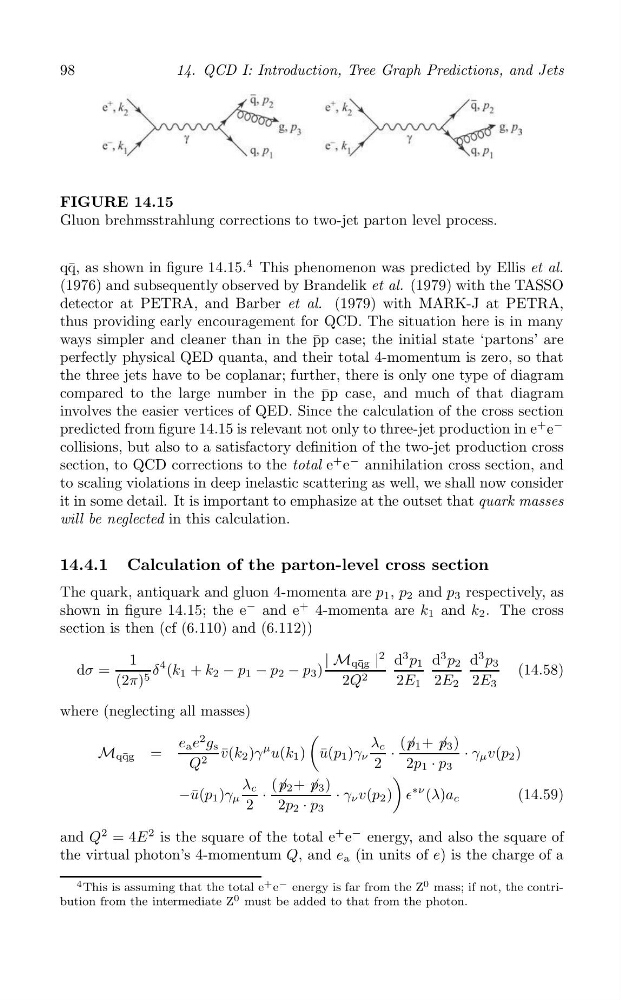
FIGURE 14.15
Gluon brehmsstrahlung corrections to two-jet parton level process.
q¯ q, as shown in figure 14.15.
4 This phenomenon was predicted by Ellis et al.
(1976) and subsequently observed by Brandelik et al. (1979) with the TASSO
detector at PETRA, and Barber et al. (1979) with MARK-J at PETRA,
thus providing early encouragement for QCD. The situation here is in many
ways simpler and cleaner than in the ¯
pp case; the initial state ‘partons’ are
perfectly physical QED quanta, and their total 4-momentum is zero, so that
the three jets have to be coplanar; further, there is only one type of diagram
compared to the large number in the ¯
pp case, and much of that diagram
involves the easier vertices of QED. Since the calculation of the cross section
predicted from figure 14.15 is relevant not only to three-jet production in e
+ e
−
collisions, but also to a satisfactory definition of the two-jet production cross
+
section, to QCD corrections to the total e e
− annihilation cross section, and
to scaling violations in deep inelastic scattering as well, we shall now consider
it in some detail. It is important to emphasize at the outset that quark masses
will be neglected in this calculation.
14.4.1 Calculation of the parton-level cross section
The quark, antiquark and gluon 4-momenta are p 1 , p 2 and p 3 respectively, as
shown in figure 14.15; the e
− and e
+ 4-momenta are k 1 and k 2 . The cross
section is then (cf (6.110) and (6.112))
dσ =
1
(2π) 5 δ
4 (k 1 + k 2 − p 1 − p 2 − p 3 )
| M q¯ qg |
2
2Q 2
d
3 p 1
2E 1
d
3 p 2
2E 2
d
3 p 3
2E 3
(14.58)
where (neglecting all masses)
(
2
e a e g s
λ c (/ p 1 + / p 3 )
M q¯ qg =
v ¯(k 2 )γ
μ u(k 1 ) u ¯(p 1 )γ ν
·
· γ μ v(p 2 )
Q 2
2
2p 1 · p 3
)
λ c (/ p 2 + / p 3 )
−u ¯(p 1 )γ μ
·
· γ ν v(p 2 ) ∈
∗ν (λ)a c
(14.59)
2
2p 2 · p 3
−
and Q
2 = 4E
2 is the square of the total e
+ e energy, and also the square of
the virtual photon’s 4-momentum Q, and e a (in units of e) is the charge of a
4 This is assuming that the total e + e − energy is far from the Z 0 mass; if not, the contribution from the intermediate Z 0 must be added to that from the photon.