

95
14.3. Hard scattering processes, QCD tree graphs, and jets
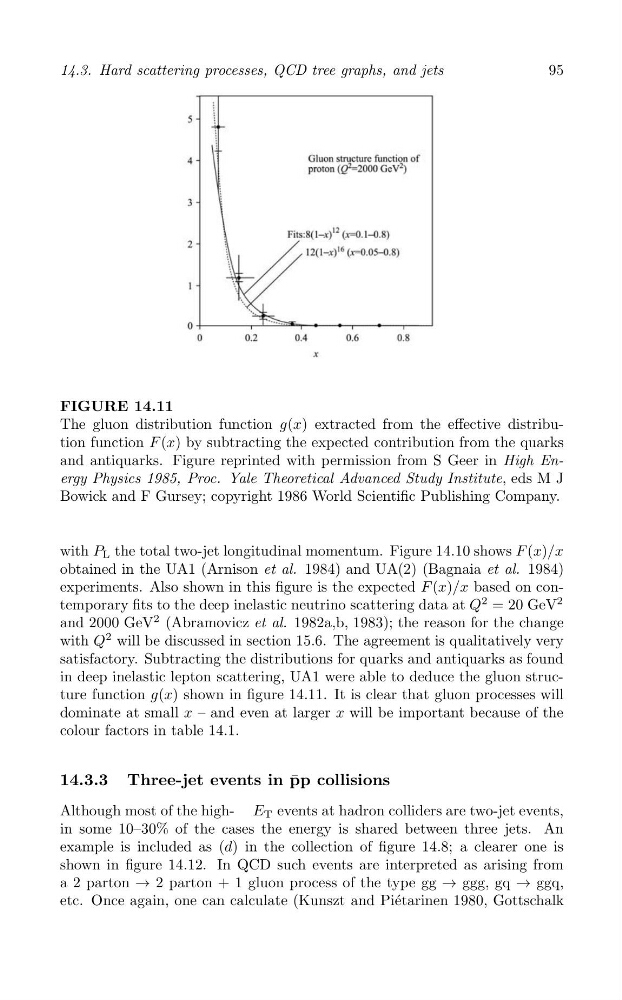
FIGURE 14.11
The gluon distribution function g(x) extracted from the effective distribution function F (x) by subtracting the expected contribution from the quarks
and antiquarks. Figure reprinted with permission from S Geer in High Energy Physics 1985, Proc. Yale Theoretical Advanced Study Institute, eds M J
Bowick and F Gursey; copyright 1986 World Scientific Publishing Company.
with P L the total two-jet longitudinal momentum. Figure 14.10 shows F (x)/x
obtained in the UA1 (Arnison et al. 1984) and UA(2) (Bagnaia et al. 1984)
experiments. Also shown in this figure is the expected F (x)/x based on contemporary fits to the deep inelastic neutrino scattering data at Q
2 = 20 GeV
2
and 2000 GeV
2 (Abramovicz et al. 1982a,b, 1983); the reason for the change
with Q
2 will be discussed in section 15.6. The agreement is qualitatively very
satisfactory. Subtracting the distributions for quarks and antiquarks as found
in deep inelastic lepton scattering, UA1 were able to deduce the gluon structure function g(x) shown in figure 14.11. It is clear that gluon processes will
dominate at small x – and even at larger x will be important because of the
colour factors in table 14.1.
¯
14.3.3 Three-jet events in pp collisions
Although most of the high- E T events at hadron colliders are two-jet events,
in some 10–30% of the cases the energy is shared between three jets. An
example is included as (d) in the collection of figure 14.8; a clearer one is
shown in figure 14.12. In QCD such events are interpreted as arising from
a 2 parton → 2 parton + 1 gluon process of the type gg → ggg, gq → ggq,
etc. Once again, one can calculate (Kunszt and Pi´ etarinen 1980, Gottschalk