

68
13. Local Non-Abelian (Gauge) Symmetries
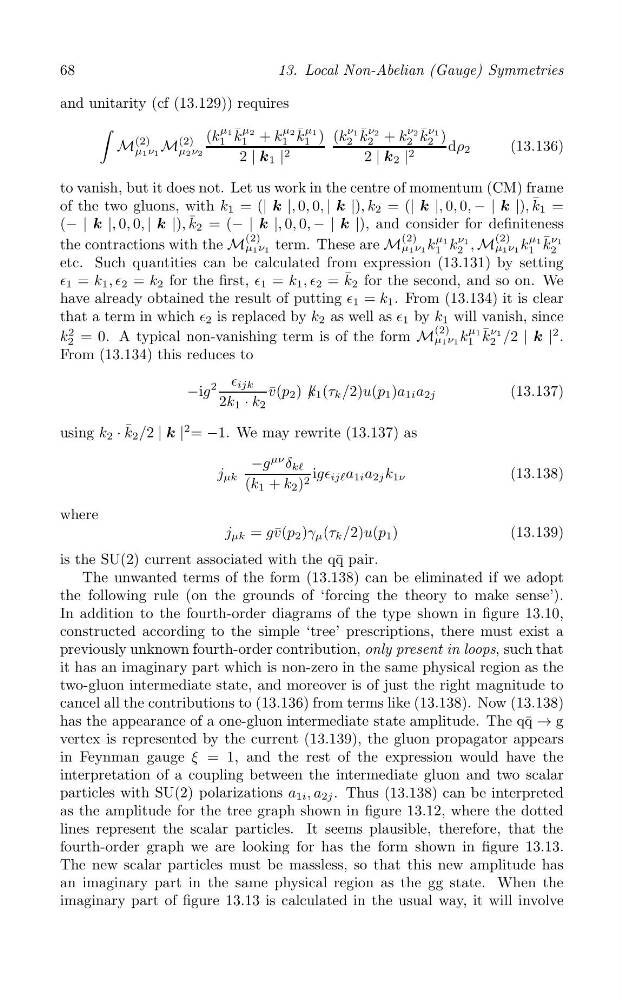
and unitarity (cf (13.129)) requires
∫
μ
2
μ2 ¯ μ1
ν1 ¯
(k
1 ¯ μ
k + k k ) (k k
ν2
M
(2)
M
(2)
1
1
2 2
k
ν2 ¯ ν1
1
1
+ 2 k 2 )
μ1ν1
μ2ν2
dρ
(13.136)
2 | k | 2
1
2 | k 2 |
2
2
to vanish, but it does not. Let us work in the centre of momentum (CM) frame
¯
of the two gluons, with k 1 = ( k , 0, 0, k ), k 2 = ( k , 0, 0,
k ), k 1 =
− | |
| | ¯
| |
| |
| |
− | |
(
k , 0, 0, k ), k 2 = (− | k |, 0, 0, − | k |), and consider for definiteness
(2)
(2)
(2)
¯
the contractions with the M μ1 1 term. These are M
μ1 ν1
μ1 ν1
ν
μ1ν1 k 1 k 2 , M μ1ν1 k 1 k 2
etc. Such quantities can be calculated from expression (13.131) by setting
¯
∈ 1 = k 1 , ∈ 2 = k 2 for the first, ∈ 1 = k 1 , ∈ 2 = k 2 for the second, and so on. We
have already obtained the result of putting ∈ 1 = k 1 . From (13.134) it is clear
that a term in which ∈ 2 is replaced by k 2 as well as ∈ 1 by k 1 will vanish, since
k
2
(2)
μ ¯
2 = 0. A typical non-vanishing term is of the form M
k
1 k
ν1
2
μ1ν1 1
2 /2 | k | .
From (13.134) this reduces to
−ig
2 ∈ ijk v ¯(p 2 ) k 1 (τ k /2)u(p
2k 1 ·
1 )a 1i a 2j
(13.137)
k 2
using k 2 · ¯
k 2 /2 | k |
2 = −1. We may rewrite (13.137) as
−g
μν δ ke
j μk
ig∈ ije a 1i a 2j k 1ν
(13.138)
(k + k ) 2
1
2
where
j μk = gv ¯(p 2 )γ μ (τ k /2)u(p 1 )
(13.139)
is the SU(2) current associated with the qq p
¯ air.
The unwanted terms of the form (13.138) can be eliminated if we adopt
the following rule (on the grounds of ‘forcing the theory to make sense’).
In addition to the fourth-order diagrams of the type shown in figure 13.10,
constructed according to the simple ‘tree’ prescriptions, there must exist a
previously unknown fourth-order contribution, only present in loops, such that
it has an imaginary part which is non-zero in the same physical region as the
two-gluon intermediate state, and moreover is of just the right magnitude to
cancel all the contributions to (13.136) from terms like (13.138). Now (13.138)
has the appearance of a one-gluon intermediate state amplitude. The qq ¯ → g
vertex is represented by the current (13.139), the gluon propagator appears
in Feynman gauge ξ = 1, and the rest of the expression would have the
interpretation of a coupling between the intermediate gluon and two scalar
particles with SU(2) polarizations a 1i , a 2j . Thus (13.138) can be interpreted
as the amplitude for the tree graph shown in figure 13.12, where the dotted
lines represent the scalar particles. It seems plausible, therefore, that the
fourth-order graph we are looking for has the form shown in figure 13.13.
The new scalar particles must be massless, so that this new amplitude has
an imaginary part in the same physical region as the gg state. When the
imaginary part of figure 13.13 is calculated in the usual way, it will involve
/
13. Local Non-Abelian (Gauge) Symmetries
and unitarity (cf (13.129)) requires
∫
μ
2
μ2 ¯ μ1
ν1 ¯
(k
1 ¯ μ
k + k k ) (k k
ν2
M
(2)
M
(2)
1
1
2 2
k
ν2 ¯ ν1
1
1
+ 2 k 2 )
μ1ν1
μ2ν2
dρ
(13.136)
2 | k | 2
1
2 | k 2 |
2
2
to vanish, but it does not. Let us work in the centre of momentum (CM) frame
¯
of the two gluons, with k 1 = ( k , 0, 0, k ), k 2 = ( k , 0, 0,
k ), k 1 =
− | |
| | ¯
| |
| |
| |
− | |
(
k , 0, 0, k ), k 2 = (− | k |, 0, 0, − | k |), and consider for definiteness
(2)
(2)
(2)
¯
the contractions with the M μ1 1 term. These are M
μ1 ν1
μ1 ν1
ν
μ1ν1 k 1 k 2 , M μ1ν1 k 1 k 2
etc. Such quantities can be calculated from expression (13.131) by setting
¯
∈ 1 = k 1 , ∈ 2 = k 2 for the first, ∈ 1 = k 1 , ∈ 2 = k 2 for the second, and so on. We
have already obtained the result of putting ∈ 1 = k 1 . From (13.134) it is clear
that a term in which ∈ 2 is replaced by k 2 as well as ∈ 1 by k 1 will vanish, since
k
2
(2)
μ ¯
2 = 0. A typical non-vanishing term is of the form M
k
1 k
ν1
2
μ1ν1 1
2 /2 | k | .
From (13.134) this reduces to
−ig
2 ∈ ijk v ¯(p 2 ) k 1 (τ k /2)u(p
2k 1 ·
1 )a 1i a 2j
(13.137)
k 2
using k 2 · ¯
k 2 /2 | k |
2 = −1. We may rewrite (13.137) as
−g
μν δ ke
j μk
ig∈ ije a 1i a 2j k 1ν
(13.138)
(k + k ) 2
1
2
where
j μk = gv ¯(p 2 )γ μ (τ k /2)u(p 1 )
(13.139)
is the SU(2) current associated with the qq p
¯ air.
The unwanted terms of the form (13.138) can be eliminated if we adopt
the following rule (on the grounds of ‘forcing the theory to make sense’).
In addition to the fourth-order diagrams of the type shown in figure 13.10,
constructed according to the simple ‘tree’ prescriptions, there must exist a
previously unknown fourth-order contribution, only present in loops, such that
it has an imaginary part which is non-zero in the same physical region as the
two-gluon intermediate state, and moreover is of just the right magnitude to
cancel all the contributions to (13.136) from terms like (13.138). Now (13.138)
has the appearance of a one-gluon intermediate state amplitude. The qq ¯ → g
vertex is represented by the current (13.139), the gluon propagator appears
in Feynman gauge ξ = 1, and the rest of the expression would have the
interpretation of a coupling between the intermediate gluon and two scalar
particles with SU(2) polarizations a 1i , a 2j . Thus (13.138) can be interpreted
as the amplitude for the tree graph shown in figure 13.12, where the dotted
lines represent the scalar particles. It seems plausible, therefore, that the
fourth-order graph we are looking for has the form shown in figure 13.13.
The new scalar particles must be massless, so that this new amplitude has
an imaginary part in the same physical region as the gg state. When the
imaginary part of figure 13.13 is calculated in the usual way, it will involve
/