

13.3. Local non-Abelian symmetries in Lagrangian quantum field theory 69
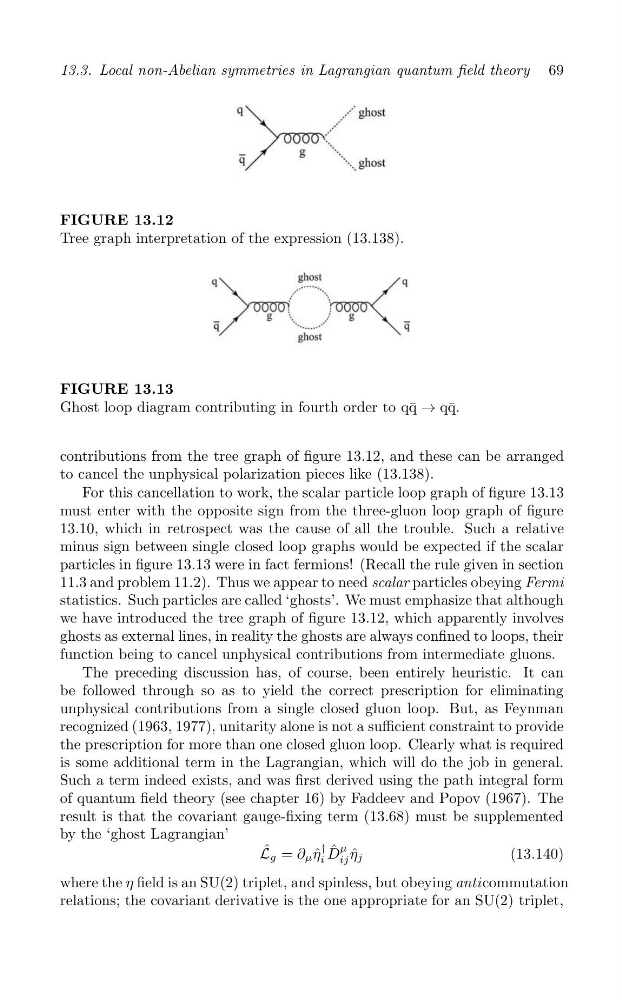
FIGURE 13.12
Tree graph interpretation of the expression (13.138).
FIGURE 13.13
Ghost loop diagram contributing in fourth order to q¯ q → q¯ q.
contributions from the tree graph of figure 13.12, and these can be arranged
to cancel the unphysical polarization pieces like (13.138).
For this cancellation to work, the scalar particle loop graph of figure 13.13
must enter with the opposite sign from the three-gluon loop graph of figure
13.10, which in retrospect was the cause of all the trouble. Such a relative
minus sign between single closed loop graphs would be expected if the scalar
particles in figure 13.13 were in fact fermions! (Recall the rule given in section
11.3 and problem 11.2). Thus we appear to need scalar particles obeying Fermi
statistics. Such particles are called ‘ghosts’. We must emphasize that although
we have introduced the tree graph of figure 13.12, which apparently involves
ghosts as external lines, in reality the ghosts are always confined to loops, their
function being to cancel unphysical contributions from intermediate gluons.
The preceding discussion has, of course, been entirely heuristic. It can
be followed through so as to yield the correct prescription for eliminating
unphysical contributions from a single closed gluon loop. But, as Feynman
recognized (1963, 1977), unitarity alone is not a sufficient constraint to provide
the prescription for more than one closed gluon loop. Clearly what is required
is some additional term in the Lagrangian, which will do the job in general.
Such a term indeed exists, and was first derived using the path integral form
of quantum field theory (see chapter 16) by Faddeev and Popov (1967). The
result is that the covariant gauge-fixing term (13.68) must be supplemented
by the ‘ghost Lagrangian’
†
ˆ
D ˆ μ
L g = ∂ μ η ˆ
η ˆ j
(13.140)
i ij
where the η field is an SU(2) triplet, and spinless, but obeying anticommutation
relations; the covariant derivative is the one appropriate for an SU(2) triplet,
FIGURE 13.12
Tree graph interpretation of the expression (13.138).
FIGURE 13.13
Ghost loop diagram contributing in fourth order to q¯ q → q¯ q.
contributions from the tree graph of figure 13.12, and these can be arranged
to cancel the unphysical polarization pieces like (13.138).
For this cancellation to work, the scalar particle loop graph of figure 13.13
must enter with the opposite sign from the three-gluon loop graph of figure
13.10, which in retrospect was the cause of all the trouble. Such a relative
minus sign between single closed loop graphs would be expected if the scalar
particles in figure 13.13 were in fact fermions! (Recall the rule given in section
11.3 and problem 11.2). Thus we appear to need scalar particles obeying Fermi
statistics. Such particles are called ‘ghosts’. We must emphasize that although
we have introduced the tree graph of figure 13.12, which apparently involves
ghosts as external lines, in reality the ghosts are always confined to loops, their
function being to cancel unphysical contributions from intermediate gluons.
The preceding discussion has, of course, been entirely heuristic. It can
be followed through so as to yield the correct prescription for eliminating
unphysical contributions from a single closed gluon loop. But, as Feynman
recognized (1963, 1977), unitarity alone is not a sufficient constraint to provide
the prescription for more than one closed gluon loop. Clearly what is required
is some additional term in the Lagrangian, which will do the job in general.
Such a term indeed exists, and was first derived using the path integral form
of quantum field theory (see chapter 16) by Faddeev and Popov (1967). The
result is that the covariant gauge-fixing term (13.68) must be supplemented
by the ‘ghost Lagrangian’
†
ˆ
D ˆ μ
L g = ∂ μ η ˆ
η ˆ j
(13.140)
i ij
where the η field is an SU(2) triplet, and spinless, but obeying anticommutation
relations; the covariant derivative is the one appropriate for an SU(2) triplet,