

13.3. Local non-Abelian symmetries in Lagrangian quantum field theory 67
(13.129), satisfies ∈ · k = 0 – see the sentence following (13.128). Thus the
crucial point is that (13.130) must be true for each gluon, even when the other
gluon has ∈ · k / = 0. And, in fact, we shall now see that whereas the (crossed)
version of (13.130) did hold for our dX → dX amplitudes of section 13.3.2,
(13.130) fails for states with ∈ · k = 0.
/
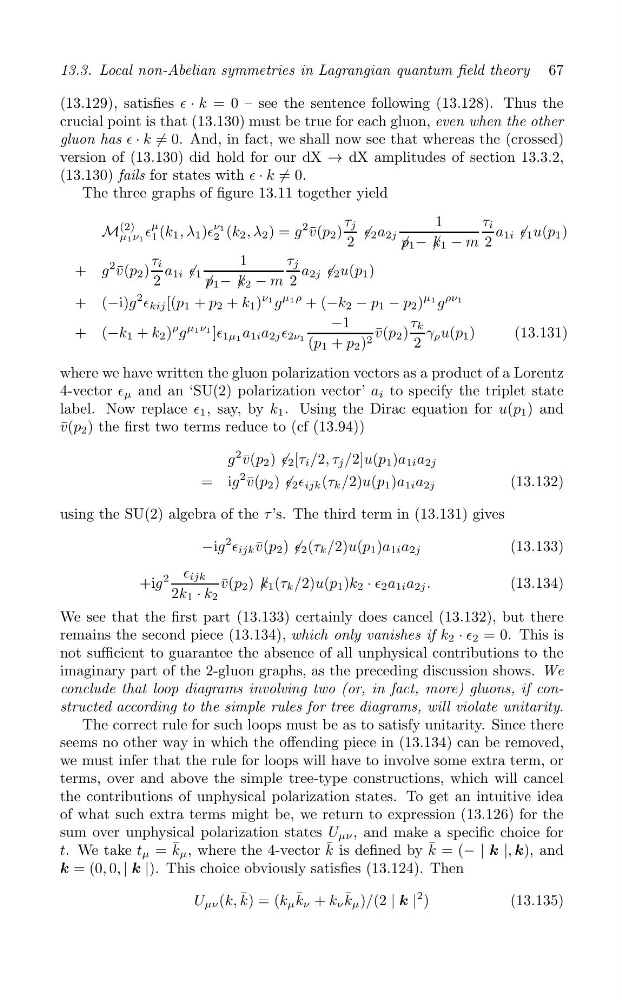
The three graphs of figure 13.11 together yield
1
M
(2) ∈
μ (k 1 , λ 1 )∈
ν1 (k 2 , λ 2 ) = g
2 v ¯(p 2 )
τ j / ∈ 2 a 2j
τ i a 1i / ∈ 1 u(p 1 )
μ1ν1 1
2
2
/ p 1 − / k 1 − m 2
τ i
1
τ j
2 ¯
+ g v(p 2 ) a 1i / ∈ 1
a 2j / ∈ 2 u(p 1 )
2
/ p 1 − / k 2 − m 2
ρν1
+ (−i)g
2 ∈ kij [(p 1 + p 2 + k 1 )
ν1 g
μ1 ρ + (−k 2 − p 1 − p 2 )
μ1 g
−1
τ k
+ (−k 1 + k 2 )
ρ g
μ1ν1 ]∈ 1μ1 a 1i a 2j ∈ 2ν1
v ¯(p 2 ) γ ρ u(p 1 )
(13.131)
(p 1 + p 2 ) 2
2
where we have written the gluon polarization vectors as a product of a Lorentz
4-vector ∈ μ and an ‘SU(2) polarization vector’ a i to specify the triplet state
label. Now replace ∈ 1 , say, by k 1 . Using the Dirac equation for u(p 1 ) and
v ¯(p 2 ) the first two terms reduce to (cf (13.94))
2 ¯
2 ¯
g v(p 2 ) / ∈ 2 [τ i /2, τ j /2]u(p 1 )a 1i a 2j
= ig v(p 2 ) / ∈ 2 ∈ ijk (τ k /2)u(p 1 )a 1i a 2j
(13.132)
using the SU(2) algebra of the τ ’s. The third term in (13.131) gives
−ig
2 ∈ ijk v ¯(p 2 ) / ∈ 2 (τ k /2)u(p 1 )a 1i a 2j
(13.133)
2 ∈ ijk
+ig
v ¯(p 2 ) / k 1 (τ k /2)u(p 1 )k 2 · ∈ 2 a 1i a 2j .
(13.134)
2k 1 · k 2
We see that the first part (13.133) certainly does cancel (13.132), but there
remains the second piece (13.134), which only vanishes if k 2 · ∈ 2 = 0. This is
not sufficient to guarantee the absence of all unphysical contributions to the
imaginary part of the 2-gluon graphs, as the preceding discussion shows. We
conclude that loop diagrams involving two (or, in fact, more) gluons, if constructed according to the simple rules for tree diagrams, will violate unitarity.
The correct rule for such loops must be as to satisfy unitarity. Since there
seems no other way in which the offending piece in (13.134) can be removed,
we must infer that the rule for loops will have to involve some extra term, or
terms, over and above the simple tree-type constructions, which will cancel
the contributions of unphysical polarization states. To get an intuitive idea
of what such extra terms might be, we return to expression (13.126) for the
sum over unphysical polarization states U μν , and make a specific choice for
¯
t. We take t μ = k μ , where the 4-vector k ¯ is defined by k ¯ = (− | k |, k), and
k = (0, 0, | k |). This choice obviously satisfies (13.124). Then
¯
¯
U μν (k, k ¯ ) = (k μ k ν + k ν k μ )/(2 | k |
2 )
(13.135)
(13.129), satisfies ∈ · k = 0 – see the sentence following (13.128). Thus the
crucial point is that (13.130) must be true for each gluon, even when the other
gluon has ∈ · k / = 0. And, in fact, we shall now see that whereas the (crossed)
version of (13.130) did hold for our dX → dX amplitudes of section 13.3.2,
(13.130) fails for states with ∈ · k = 0.
/
The three graphs of figure 13.11 together yield
1
M
(2) ∈
μ (k 1 , λ 1 )∈
ν1 (k 2 , λ 2 ) = g
2 v ¯(p 2 )
τ j / ∈ 2 a 2j
τ i a 1i / ∈ 1 u(p 1 )
μ1ν1 1
2
2
/ p 1 − / k 1 − m 2
τ i
1
τ j
2 ¯
+ g v(p 2 ) a 1i / ∈ 1
a 2j / ∈ 2 u(p 1 )
2
/ p 1 − / k 2 − m 2
ρν1
+ (−i)g
2 ∈ kij [(p 1 + p 2 + k 1 )
ν1 g
μ1 ρ + (−k 2 − p 1 − p 2 )
μ1 g
−1
τ k
+ (−k 1 + k 2 )
ρ g
μ1ν1 ]∈ 1μ1 a 1i a 2j ∈ 2ν1
v ¯(p 2 ) γ ρ u(p 1 )
(13.131)
(p 1 + p 2 ) 2
2
where we have written the gluon polarization vectors as a product of a Lorentz
4-vector ∈ μ and an ‘SU(2) polarization vector’ a i to specify the triplet state
label. Now replace ∈ 1 , say, by k 1 . Using the Dirac equation for u(p 1 ) and
v ¯(p 2 ) the first two terms reduce to (cf (13.94))
2 ¯
2 ¯
g v(p 2 ) / ∈ 2 [τ i /2, τ j /2]u(p 1 )a 1i a 2j
= ig v(p 2 ) / ∈ 2 ∈ ijk (τ k /2)u(p 1 )a 1i a 2j
(13.132)
using the SU(2) algebra of the τ ’s. The third term in (13.131) gives
−ig
2 ∈ ijk v ¯(p 2 ) / ∈ 2 (τ k /2)u(p 1 )a 1i a 2j
(13.133)
2 ∈ ijk
+ig
v ¯(p 2 ) / k 1 (τ k /2)u(p 1 )k 2 · ∈ 2 a 1i a 2j .
(13.134)
2k 1 · k 2
We see that the first part (13.133) certainly does cancel (13.132), but there
remains the second piece (13.134), which only vanishes if k 2 · ∈ 2 = 0. This is
not sufficient to guarantee the absence of all unphysical contributions to the
imaginary part of the 2-gluon graphs, as the preceding discussion shows. We
conclude that loop diagrams involving two (or, in fact, more) gluons, if constructed according to the simple rules for tree diagrams, will violate unitarity.
The correct rule for such loops must be as to satisfy unitarity. Since there
seems no other way in which the offending piece in (13.134) can be removed,
we must infer that the rule for loops will have to involve some extra term, or
terms, over and above the simple tree-type constructions, which will cancel
the contributions of unphysical polarization states. To get an intuitive idea
of what such extra terms might be, we return to expression (13.126) for the
sum over unphysical polarization states U μν , and make a specific choice for
¯
t. We take t μ = k μ , where the 4-vector k ¯ is defined by k ¯ = (− | k |, k), and
k = (0, 0, | k |). This choice obviously satisfies (13.124). Then
¯
¯
U μν (k, k ¯ ) = (k μ k ν + k ν k μ )/(2 | k |
2 )
(13.135)