

12.4. Non-Abelian global symmetries in Lagrangian quantum field theory 29
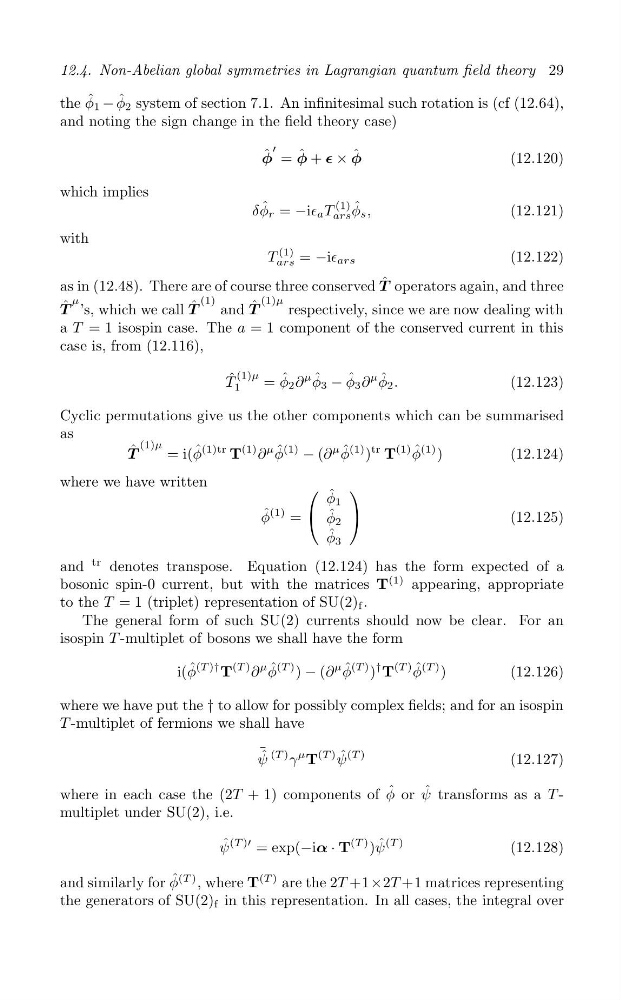
the φ ˆ 1 − φ ˆ 2 system of section 7.1. An infinitesimal such rotation is (cf (12.64),
and noting the sign change in the field theory case)
′
ˆ
ˆ
φ = φ + ∊ × φ ˆ
(12.120)
which implies
T
(1)
δφ ˆ r = −i∈ a
φ ˆ s ,
(12.121)
ars
with
T
(1) =
(12.122)
ars
−i∈ ars
as in (12.48). There are of course three conserved T ˆ operators again, and three
μ
(1)
(1)μ
ˆ
T ’s, which we call T ˆ and T ˆ
respectively, since we are now dealing with
a T = 1 isospin case. The a = 1 component of the conserved current in this
case is, from (12.116),
T ˆ (1)μ = φ ˆ 2 ∂
μ φ ˆ 3 − φ ˆ 3 ∂
μ φ ˆ 2 .
(12.123)
1
Cyclic permutations give us the other components which can be summarised
as
(1)μ
φ
(1)tr T
(1) ∂
μ φ ˆ (1) − (∂
μ φ ˆ (1) )
tr T
(1) φ ˆ (1) )
T ˆ
= i( ˆ
(12.124)
where we have written
(
)
ˆ
φ 1
φ ˆ (1)
ˆ
(
)
=
φ 2
(12.125)
ˆ
φ 3
and
tr denotes transpose. Equation (12.124) has the form expected of a
bosonic spin-0 current, but with the matrices T
(1) appearing, appropriate
to the T = 1 (triplet) representation of SU(2) f .
The general form of such SU(2) currents should now be clear. For an
isospin T -multiplet of bosons we shall have the form
φ
(T )† T
(T ) ∂
μ ˆ
φ
(T ) )
i( ˆ
φ
(T ) ) − (∂
μ φ ˆ (T ) )
† T
(T ) ˆ
(12.126)
where we have put the † to allow for possibly complex fields; and for an isospin
T -multiplet of fermions we shall have
¯
ψ ˆ (T ) γ
μ T
(T ) ψ ˆ (T )
(12.127)
where in each case the (2T + 1) components of φ ˆ or ψ ˆ transforms as a T -
multiplet under SU(2), i.e.
ψ ˆ (T )′ = exp(−iα · T
(T ) )ψ ˆ (T )
(12.128)
and similarly for φ ˆ (T ) , where T
(T ) are the 2T +1×2T +1 matrices representing
the generators of SU(2) f in this representation. In all cases, the integral over
the φ ˆ 1 − φ ˆ 2 system of section 7.1. An infinitesimal such rotation is (cf (12.64),
and noting the sign change in the field theory case)
′
ˆ
ˆ
φ = φ + ∊ × φ ˆ
(12.120)
which implies
T
(1)
δφ ˆ r = −i∈ a
φ ˆ s ,
(12.121)
ars
with
T
(1) =
(12.122)
ars
−i∈ ars
as in (12.48). There are of course three conserved T ˆ operators again, and three
μ
(1)
(1)μ
ˆ
T ’s, which we call T ˆ and T ˆ
respectively, since we are now dealing with
a T = 1 isospin case. The a = 1 component of the conserved current in this
case is, from (12.116),
T ˆ (1)μ = φ ˆ 2 ∂
μ φ ˆ 3 − φ ˆ 3 ∂
μ φ ˆ 2 .
(12.123)
1
Cyclic permutations give us the other components which can be summarised
as
(1)μ
φ
(1)tr T
(1) ∂
μ φ ˆ (1) − (∂
μ φ ˆ (1) )
tr T
(1) φ ˆ (1) )
T ˆ
= i( ˆ
(12.124)
where we have written
(
)
ˆ
φ 1
φ ˆ (1)
ˆ
(
)
=
φ 2
(12.125)
ˆ
φ 3
and
tr denotes transpose. Equation (12.124) has the form expected of a
bosonic spin-0 current, but with the matrices T
(1) appearing, appropriate
to the T = 1 (triplet) representation of SU(2) f .
The general form of such SU(2) currents should now be clear. For an
isospin T -multiplet of bosons we shall have the form
φ
(T )† T
(T ) ∂
μ ˆ
φ
(T ) )
i( ˆ
φ
(T ) ) − (∂
μ φ ˆ (T ) )
† T
(T ) ˆ
(12.126)
where we have put the † to allow for possibly complex fields; and for an isospin
T -multiplet of fermions we shall have
¯
ψ ˆ (T ) γ
μ T
(T ) ψ ˆ (T )
(12.127)
where in each case the (2T + 1) components of φ ˆ or ψ ˆ transforms as a T -
multiplet under SU(2), i.e.
ψ ˆ (T )′ = exp(−iα · T
(T ) )ψ ˆ (T )
(12.128)
and similarly for φ ˆ (T ) , where T
(T ) are the 2T +1×2T +1 matrices representing
the generators of SU(2) f in this representation. In all cases, the integral over