

28
12. Global Non-Abelian Symmetries
But
(
)
∂L ˆ
∂L ˆ
∂
μ
∂ψ ˆ r
∂(∂ μ ψ ˆ r )
=
(12.113)
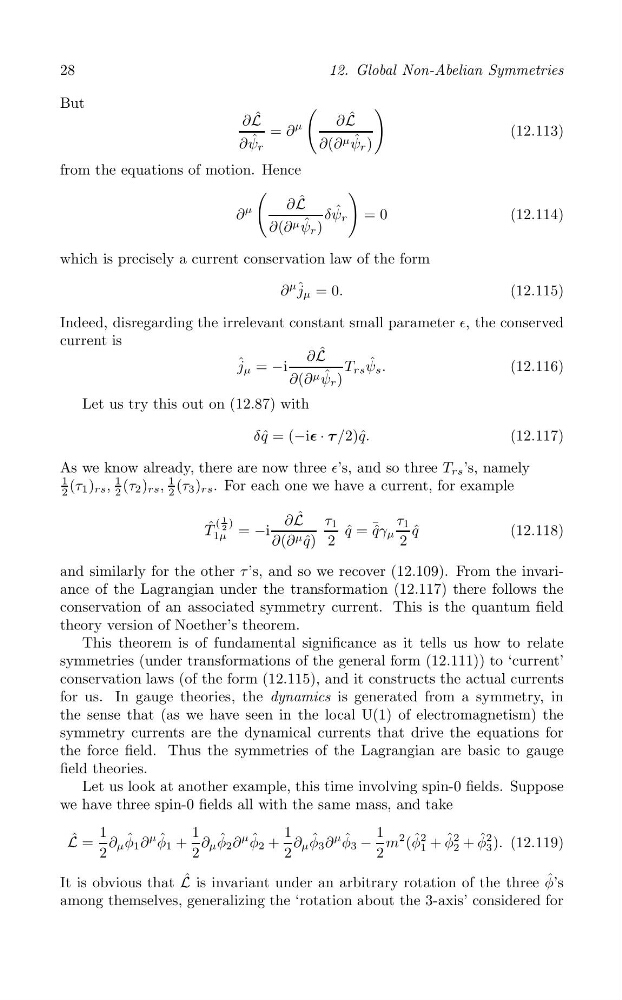
from the equations of motion. Hence
(
)
∂L ˆ
∂
μ
δψ ˆ r = 0
(12.114)
∂(∂ μ ψ ˆ r )
which is precisely a current conservation law of the form
∂
μ ˆ j μ = 0.
(12.115)
Indeed, disregarding the irrelevant constant small parameter ∈, the conserved
current is
∂L ˆ
ˆ
ˆ
j μ = −i
T rs ψ s .
(12.116)
∂(∂ μ ψ ˆ r )
Let us try this out on (12.87) with
δq ˆ = (−i∊ · τ /2)ˆ q.
(12.117)
As we know already, there are now three ∈’s, and so three T rs ’s, namely
1
1
1 (τ 3 ) rs . For each one we have a current, for example
(τ 1 ) rs , (τ 2 ) rs ,
2
2
2
ˆ (
1 )
∂L ˆ τ 1
τ 1
¯
T
2
= −i
q ˆ = qγ μ q ˆ
ˆ
(12.118)
1μ
∂(∂ μ q ˆ) 2
2
and similarly for the other τ ’s, and so we recover (12.109). From the invariance of the Lagrangian under the transformation (12.117) there follows the
conservation of an associated symmetry current. This is the quantum field
theory version of Noether’s theorem.
This theorem is of fundamental significance as it tells us how to relate
symmetries (under transformations of the general form (12.111)) to ‘current’
conservation laws (of the form (12.115), and it constructs the actual currents
for us. In gauge theories, the dynamics is generated from a symmetry, in
the sense that (as we have seen in the local U(1) of electromagnetism) the
symmetry currents are the dynamical currents that drive the equations for
the force field. Thus the symmetries of the Lagrangian are basic to gauge
field theories.
Let us look at another example, this time involving spin-0 fields. Suppose
we have three spin-0 fields all with the same mass, and take
1
1
1
1
L ˆ = ∂ μ φ ˆ 1 ∂
μ φ ˆ 1 + ∂ μ φ ˆ 2 ∂
μ φ ˆ 2 + ∂ μ φ ˆ 3 ∂
μ φ ˆ 3 − m
2 (φ ˆ
1
2 + φ ˆ
2
2 + φ ˆ
3
2 ). (12.119)
2
2
2
2
It is obvious that L ˆ is invariant under an arbitrary rotation of the three φ ˆ ’s
among themselves, generalizing the ‘rotation about the 3-axis’ considered for
12. Global Non-Abelian Symmetries
But
(
)
∂L ˆ
∂L ˆ
∂
μ
∂ψ ˆ r
∂(∂ μ ψ ˆ r )
=
(12.113)
from the equations of motion. Hence
(
)
∂L ˆ
∂
μ
δψ ˆ r = 0
(12.114)
∂(∂ μ ψ ˆ r )
which is precisely a current conservation law of the form
∂
μ ˆ j μ = 0.
(12.115)
Indeed, disregarding the irrelevant constant small parameter ∈, the conserved
current is
∂L ˆ
ˆ
ˆ
j μ = −i
T rs ψ s .
(12.116)
∂(∂ μ ψ ˆ r )
Let us try this out on (12.87) with
δq ˆ = (−i∊ · τ /2)ˆ q.
(12.117)
As we know already, there are now three ∈’s, and so three T rs ’s, namely
1
1
1 (τ 3 ) rs . For each one we have a current, for example
(τ 1 ) rs , (τ 2 ) rs ,
2
2
2
ˆ (
1 )
∂L ˆ τ 1
τ 1
¯
T
2
= −i
q ˆ = qγ μ q ˆ
ˆ
(12.118)
1μ
∂(∂ μ q ˆ) 2
2
and similarly for the other τ ’s, and so we recover (12.109). From the invariance of the Lagrangian under the transformation (12.117) there follows the
conservation of an associated symmetry current. This is the quantum field
theory version of Noether’s theorem.
This theorem is of fundamental significance as it tells us how to relate
symmetries (under transformations of the general form (12.111)) to ‘current’
conservation laws (of the form (12.115), and it constructs the actual currents
for us. In gauge theories, the dynamics is generated from a symmetry, in
the sense that (as we have seen in the local U(1) of electromagnetism) the
symmetry currents are the dynamical currents that drive the equations for
the force field. Thus the symmetries of the Lagrangian are basic to gauge
field theories.
Let us look at another example, this time involving spin-0 fields. Suppose
we have three spin-0 fields all with the same mass, and take
1
1
1
1
L ˆ = ∂ μ φ ˆ 1 ∂
μ φ ˆ 1 + ∂ μ φ ˆ 2 ∂
μ φ ˆ 2 + ∂ μ φ ˆ 3 ∂
μ φ ˆ 3 − m
2 (φ ˆ
1
2 + φ ˆ
2
2 + φ ˆ
3
2 ). (12.119)
2
2
2
2
It is obvious that L ˆ is invariant under an arbitrary rotation of the three φ ˆ ’s
among themselves, generalizing the ‘rotation about the 3-axis’ considered for