

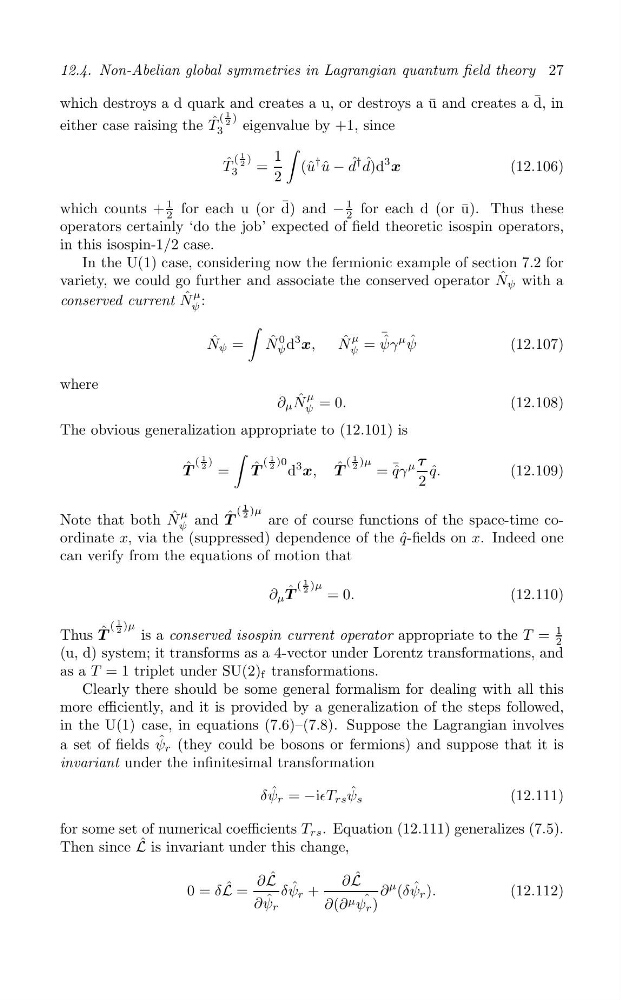
12.4. Non-Abelian global symmetries in Lagrangian quantum field theory 27
¯
which destroys a d quark and creates a u, or destroys a u ¯ and creates a d, in
ˆ (
1 )
either case raising the T
2
3
eigenvalue by +1, since
∫
(
1 )
2
1
ˆ
T 3 =
(ˆ u
† u ˆ
2
− ˆ
d
† ˆ
d)d
3
x
(12.106)
¯
which counts +
1 for each u (or d) and −
1 for each d (or u) ¯ . Thus these
2
2
operators certainly ‘do the job’ expected of field theoretic isospin operators,
in this isospin-1/2 case.
In the U(1) case, considering now the fermionic example of section 7.2 for
ˆ
variety, we could go further and associate the conserved operator N ψ with a
ˆ μ
conserved current N ψ :
∫
ˆ
ˆ
N ψ = N
0
ψ d
3
ˆ μ ¯ ˆ
x,
N ψ = ψγ
μ ˆ
ψ
(12.107)
where
ˆ μ
∂ μ N ψ = 0.
(12.108)
The obvious generalization appropriate to (12.101) is
1
ˆ
(
1
∫
)
1
2
τ
ˆ
( )0
=
2
d
3
ˆ
( )μ
T
x, T
2
¯
T
= qγ ˆ
μ q. ˆ
(12.109)
2
ˆ μ
ˆ
(
1 )μ
Note that both N ψ and T
2
are of course functions of the space-time coordinate x, via the (suppressed) dependence of the q ˆ-fields on x. Indeed one
can verify from the equations of motion that
ˆ
(
1 )μ
∂ μ T
2
= 0.
(12.110)
1
ˆ
( )μ
Thus T
2
is a conserved isospin current operator appropriate to the T =
1
2
(u, d) system; it transforms as a 4-vector under Lorentz transformations, and
as a T = 1 triplet under SU(2) f transformations.
Clearly there should be some general formalism for dealing with all this
more efficiently, and it is provided by a generalization of the steps followed,
in the U(1) case, in equations (7.6)–(7.8). Suppose the Lagrangian involves
ˆ
a set of fields ψ r (they could be bosons or fermions) and suppose that it is
invariant under the infinitesimal transformation
ˆ
ˆ
δψ r = −i∈T rs ψ s
(12.111)
for some set of numerical coefficients T rs . Equation (12.111) generalizes (7.5).
Then since L ˆ is invariant under this change,
ˆ
∂
ˆ
0 = δL =
L
ˆ
∂
ˆ
ˆ
δψ r +
L ∂
μ (δψ
112)
ˆ
ψ
∂(∂ μ ˆ
r ).
(12.
∂ r
ψ r )
¯
which destroys a d quark and creates a u, or destroys a u ¯ and creates a d, in
ˆ (
1 )
either case raising the T
2
3
eigenvalue by +1, since
∫
(
1 )
2
1
ˆ
T 3 =
(ˆ u
† u ˆ
2
− ˆ
d
† ˆ
d)d
3
x
(12.106)
¯
which counts +
1 for each u (or d) and −
1 for each d (or u) ¯ . Thus these
2
2
operators certainly ‘do the job’ expected of field theoretic isospin operators,
in this isospin-1/2 case.
In the U(1) case, considering now the fermionic example of section 7.2 for
ˆ
variety, we could go further and associate the conserved operator N ψ with a
ˆ μ
conserved current N ψ :
∫
ˆ
ˆ
N ψ = N
0
ψ d
3
ˆ μ ¯ ˆ
x,
N ψ = ψγ
μ ˆ
ψ
(12.107)
where
ˆ μ
∂ μ N ψ = 0.
(12.108)
The obvious generalization appropriate to (12.101) is
1
ˆ
(
1
∫
)
1
2
τ
ˆ
( )0
=
2
d
3
ˆ
( )μ
T
x, T
2
¯
T
= qγ ˆ
μ q. ˆ
(12.109)
2
ˆ μ
ˆ
(
1 )μ
Note that both N ψ and T
2
are of course functions of the space-time coordinate x, via the (suppressed) dependence of the q ˆ-fields on x. Indeed one
can verify from the equations of motion that
ˆ
(
1 )μ
∂ μ T
2
= 0.
(12.110)
1
ˆ
( )μ
Thus T
2
is a conserved isospin current operator appropriate to the T =
1
2
(u, d) system; it transforms as a 4-vector under Lorentz transformations, and
as a T = 1 triplet under SU(2) f transformations.
Clearly there should be some general formalism for dealing with all this
more efficiently, and it is provided by a generalization of the steps followed,
in the U(1) case, in equations (7.6)–(7.8). Suppose the Lagrangian involves
ˆ
a set of fields ψ r (they could be bosons or fermions) and suppose that it is
invariant under the infinitesimal transformation
ˆ
ˆ
δψ r = −i∈T rs ψ s
(12.111)
for some set of numerical coefficients T rs . Equation (12.111) generalizes (7.5).
Then since L ˆ is invariant under this change,
ˆ
∂
ˆ
0 = δL =
L
ˆ
∂
ˆ
ˆ
δψ r +
L ∂
μ (δψ
112)
ˆ
ψ
∂(∂ μ ˆ
r ).
(12.
∂ r
ψ r )