

30
12. Global Non-Abelian Symmetries
all space of the μ = 0 component of these currents results in a triplet of isospin
operators obeying the SU(2) algebra (12.47), as in (12.103).
The cases considered so far have all been free field theories, but SU(2)invariant interactions can be easily formed. For example, the interaction
¯ ˆ ˆ
g 1 ψτ ψ · ˆ
φ describes SU(2)-invariant interactions between a T =
1 isospinor
2
(spin1
ˆ
ˆ
) field ψ, and a T = 1 isotriplet (Lorentz scalar) φ. An effective inter2
¯ ˆ
ˆ ˆ
action between pions and nucleons could take the form g π ψτ γ 5 ψ · φ, allowing
for the pseudoscalar nature of the pions (we shall see in the following section
¯ ˆ ˆ
that ψγ 5 ψ is a pseudoscalar, so the product is a true scalar as is required for a
parity-conserving strong interaction). In these examples the ‘vector’ analogy
for the T = 1 states allows us to see that the ‘dot product’ will be invariant.
ˆ
A similar dot product occurs in the interaction between the isospinor ψ
(
1 )
2
ˆ
and the weak SU(2) gauge field W μ , which has the form
μ τ
¯
gqγ ˆ
q ˆ
2
· ˆ
W μ
(12.129)
as will be discussed in the following chapter. This is just the SU(2) dot product
of the symmetry current (12.109) and the gauge field triplet, both of which
are in the adjoint (T = 1) representation of SU(2).
All of the foregoing can be generalized straightforwardly to SU(3) f . For
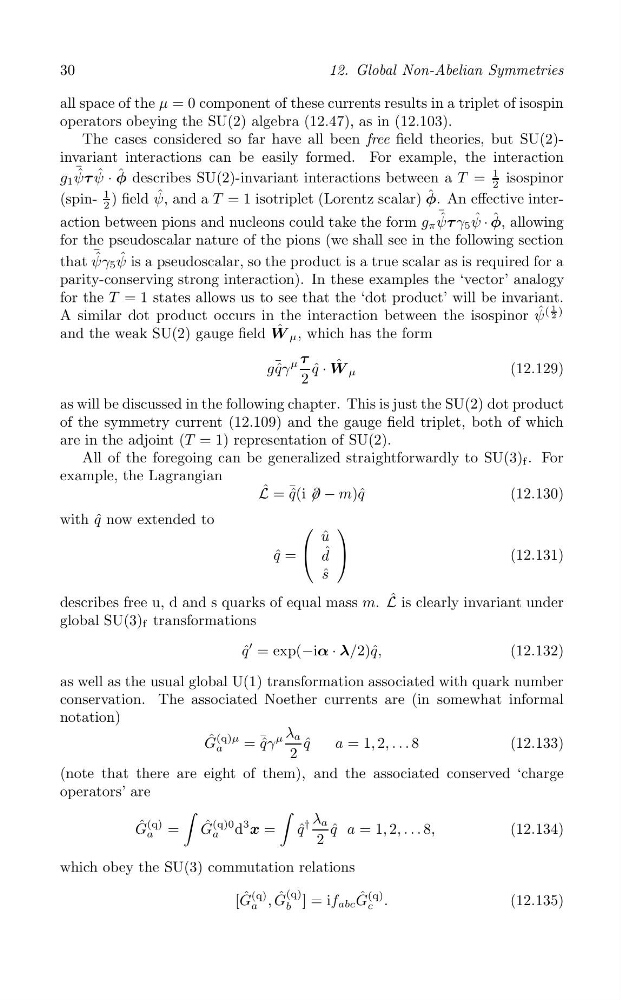
example, the Lagrangian
L ˆ ¯
= q ˆ(i ∂ − m)ˆ q
(12.130)
with q ˆ now extended to
(
)
u ˆ
q ˆ = ( ˆ
d )
(12.131)
s ˆ
ˆ
describes free u, d and s quarks of equal mass m. L is clearly invariant under
global SU(3) f transformations
q ˆ
′ = exp(−iα · λ/2)q, ˆ
(12.132)
as well as the usual global U(1) transformation associated with quark number
conservation. The associated Noether currents are (in somewhat informal
notation)
ˆ
G
(q)μ
¯
a
= qγ ˆ
μ λ a q
a
ˆ
= 1, 2, . . . 8
(12.133)
2
(note that there are eight of them), and the associated conserved ‘charge
operators’ are
∫
∫
ˆ
G
(q)
ˆ
a = G
(q)0
a
d
3
λ a
x = q ˆ
†
q a
ˆ = 1, 2, . . . 8,
(12.134)
2
which obey the SU(3) commutation relations
ˆ
[G
(q) ˆ (q)
ˆ
a , G b ] = if abc G
(q)
c .
(12.135)
/
12. Global Non-Abelian Symmetries
all space of the μ = 0 component of these currents results in a triplet of isospin
operators obeying the SU(2) algebra (12.47), as in (12.103).
The cases considered so far have all been free field theories, but SU(2)invariant interactions can be easily formed. For example, the interaction
¯ ˆ ˆ
g 1 ψτ ψ · ˆ
φ describes SU(2)-invariant interactions between a T =
1 isospinor
2
(spin1
ˆ
ˆ
) field ψ, and a T = 1 isotriplet (Lorentz scalar) φ. An effective inter2
¯ ˆ
ˆ ˆ
action between pions and nucleons could take the form g π ψτ γ 5 ψ · φ, allowing
for the pseudoscalar nature of the pions (we shall see in the following section
¯ ˆ ˆ
that ψγ 5 ψ is a pseudoscalar, so the product is a true scalar as is required for a
parity-conserving strong interaction). In these examples the ‘vector’ analogy
for the T = 1 states allows us to see that the ‘dot product’ will be invariant.
ˆ
A similar dot product occurs in the interaction between the isospinor ψ
(
1 )
2
ˆ
and the weak SU(2) gauge field W μ , which has the form
μ τ
¯
gqγ ˆ
q ˆ
2
· ˆ
W μ
(12.129)
as will be discussed in the following chapter. This is just the SU(2) dot product
of the symmetry current (12.109) and the gauge field triplet, both of which
are in the adjoint (T = 1) representation of SU(2).
All of the foregoing can be generalized straightforwardly to SU(3) f . For
example, the Lagrangian
L ˆ ¯
= q ˆ(i ∂ − m)ˆ q
(12.130)
with q ˆ now extended to
(
)
u ˆ
q ˆ = ( ˆ
d )
(12.131)
s ˆ
ˆ
describes free u, d and s quarks of equal mass m. L is clearly invariant under
global SU(3) f transformations
q ˆ
′ = exp(−iα · λ/2)q, ˆ
(12.132)
as well as the usual global U(1) transformation associated with quark number
conservation. The associated Noether currents are (in somewhat informal
notation)
ˆ
G
(q)μ
¯
a
= qγ ˆ
μ λ a q
a
ˆ
= 1, 2, . . . 8
(12.133)
2
(note that there are eight of them), and the associated conserved ‘charge
operators’ are
∫
∫
ˆ
G
(q)
ˆ
a = G
(q)0
a
d
3
λ a
x = q ˆ
†
q a
ˆ = 1, 2, . . . 8,
(12.134)
2
which obey the SU(3) commutation relations
ˆ
[G
(q) ˆ (q)
ˆ
a , G b ] = if abc G
(q)
c .
(12.135)
/