

22
12. Global Non-Abelian Symmetries
dimensional (‘triplet’) representation obtained by combining the 2* and 2
representations of SU(2).
¯
Consider first the quantity uu ¯ + dd + ¯
ss. As in the SU(2) case, this can
be written equivalently as q
† q, which is invariant under q → q
′ = Wq since
W
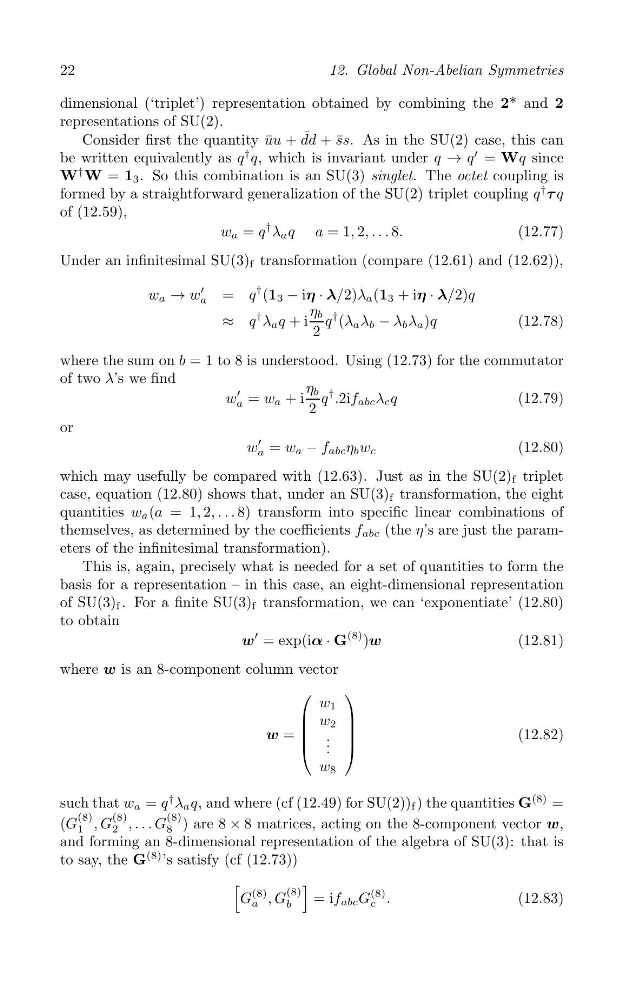
† W = 1 3 . So this combination is an SU(3) singlet. The octet coupling is
formed by a straightforward generalization of the SU(2) triplet coupling q
†
τ q
of (12.59),
w a = q
† λ a q a = 1, 2, . . . 8.
(12.77)
Under an infinitesimal SU(3) f transformation (compare (12.61) and (12.62)),
w a → w a
′
= q
† (1 3 − iη · λ/2)λ a (1 3 + iη · λ/2)q
η
≈ q
†
b
λ a q + i q
† (λ a λ b − λ b λ a )q
(12.78)
2
where the sum on b = 1 to 8 is understood. Using (12.73) for the commutator
of two λ’s we find
η
w a
′
b
= w a + i q
† .2if abc λ c q
(12.79)
2
or
w a
′ = w a − f abc η b w c
(12.80)
which may usefully be compared with (12.63). Just as in the SU(2) f triplet
case, equation (12.80) shows that, under an SU(3) f transformation, the eight
quantities w a (a = 1, 2, . . . 8) transform into specific linear combinations of
themselves, as determined by the coefficients f abc (the η’s are just the parameters of the infinitesimal transformation).
This is, again, precisely what is needed for a set of quantities to form the
basis for a representation – in this case, an eight-dimensional representation
of SU(3) f . For a finite SU(3) f transformation, we can ‘exponentiate’ (12.80)
to obtain
w
′ = exp(iα · G
(8) )w
(12.81)
where w is an 8-component column vector
(
)
w 1
|
| w 2 |
|
w = | . |
(12.82)
( . . )
w 8
such that w a = q
† λ a q, and where (cf (12.49) for SU(2)) f ) the quantities G
(8) =
(8)
(8)
(8)
(G 1 , G 2 , . . . G 8 ) are 8 × 8 matrices, acting on the 8-component vector w,
and forming an 8-dimensional representation of the algebra of SU(3): that is
to say, the G
(8) ’s satisfy (cf (12.73))
[
]
G
(8)
(8)
a , G b = if abc G
(8)
c .
(12.83)
12. Global Non-Abelian Symmetries
dimensional (‘triplet’) representation obtained by combining the 2* and 2
representations of SU(2).
¯
Consider first the quantity uu ¯ + dd + ¯
ss. As in the SU(2) case, this can
be written equivalently as q
† q, which is invariant under q → q
′ = Wq since
W
† W = 1 3 . So this combination is an SU(3) singlet. The octet coupling is
formed by a straightforward generalization of the SU(2) triplet coupling q
†
τ q
of (12.59),
w a = q
† λ a q a = 1, 2, . . . 8.
(12.77)
Under an infinitesimal SU(3) f transformation (compare (12.61) and (12.62)),
w a → w a
′
= q
† (1 3 − iη · λ/2)λ a (1 3 + iη · λ/2)q
η
≈ q
†
b
λ a q + i q
† (λ a λ b − λ b λ a )q
(12.78)
2
where the sum on b = 1 to 8 is understood. Using (12.73) for the commutator
of two λ’s we find
η
w a
′
b
= w a + i q
† .2if abc λ c q
(12.79)
2
or
w a
′ = w a − f abc η b w c
(12.80)
which may usefully be compared with (12.63). Just as in the SU(2) f triplet
case, equation (12.80) shows that, under an SU(3) f transformation, the eight
quantities w a (a = 1, 2, . . . 8) transform into specific linear combinations of
themselves, as determined by the coefficients f abc (the η’s are just the parameters of the infinitesimal transformation).
This is, again, precisely what is needed for a set of quantities to form the
basis for a representation – in this case, an eight-dimensional representation
of SU(3) f . For a finite SU(3) f transformation, we can ‘exponentiate’ (12.80)
to obtain
w
′ = exp(iα · G
(8) )w
(12.81)
where w is an 8-component column vector
(
)
w 1
|
| w 2 |
|
w = | . |
(12.82)
( . . )
w 8
such that w a = q
† λ a q, and where (cf (12.49) for SU(2)) f ) the quantities G
(8) =
(8)
(8)
(8)
(G 1 , G 2 , . . . G 8 ) are 8 × 8 matrices, acting on the 8-component vector w,
and forming an 8-dimensional representation of the algebra of SU(3): that is
to say, the G
(8) ’s satisfy (cf (12.73))
[
]
G
(8)
(8)
a , G b = if abc G
(8)
c .
(12.83)