

23
12.3. Flavour SU(3) f
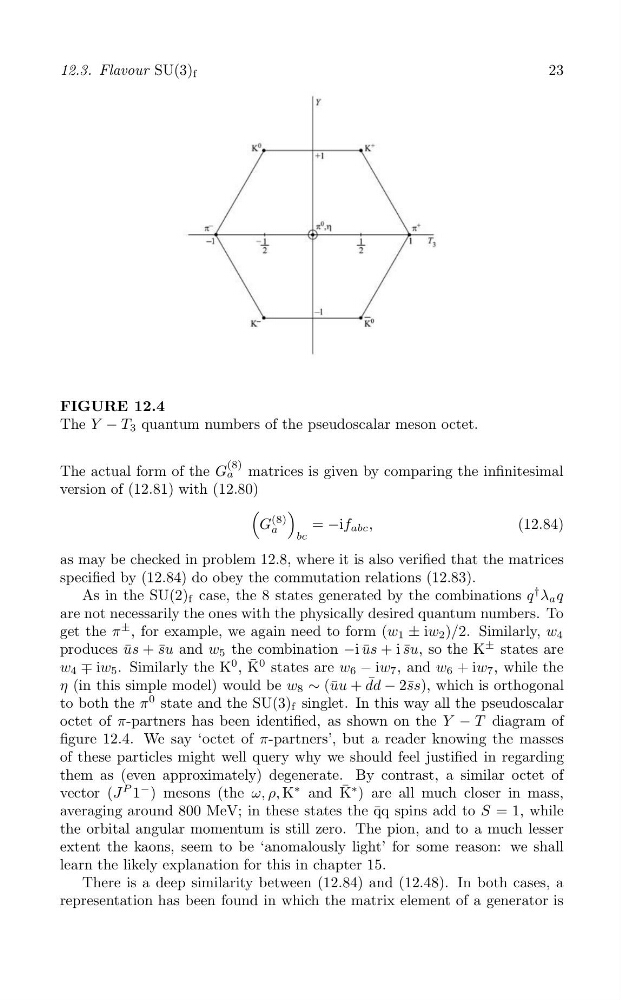
FIGURE 12.4
The Y − T 3 quantum numbers of the pseudoscalar meson octet.
(8)
The actual form of the G a matrices is given by comparing the infinitesimal
version of (12.81) with (12.80)
(
)
G
(8)
a
= −if abc ,
(12.84)
bc
as may be checked in problem 12.8, where it is also verified that the matrices
specified by (12.84) do obey the commutation relations (12.83).
As in the SU(2) f case, the 8 states generated by the combinations q
† λ a q
are not necessarily the ones with the physically desired quantum numbers. To
get the π
± , for example, we again need to form (w 1 ± iw 2 )/2. Similarly, w 4
produces ¯
us su and w 5
us + i ¯
states are
+ ¯
the combination −i ¯
su, so the K
±
w 4 ∓ iw 5 . Similarly the K
0 , K ¯ 0 states are w 6 − iw 7 , and w 6 + iw 7 , while the
η (in this simple model) would be w 8 ∼ (¯ uu dd − 2¯
+ ¯
ss), which is orthogonal
to both the π
0 state and the SU(3) f singlet. In this way all the pseudoscalar
octet of π-partners has been identified, as shown on the Y − T diagram of
figure 12.4. We say ‘octet of π-partners’, but a reader knowing the masses
of these particles might well query why we should feel justified in regarding
them as (even approximately) degenerate. By contrast, a similar octet of
vector (J
P 1
− ) mesons (the ω, ρ, K
∗ and K ¯ ∗ ) are all much closer in mass,
averaging around 800 MeV; in these states the ¯
qq spins add to S = 1, while
the orbital angular momentum is still zero. The pion, and to a much lesser
extent the kaons, seem to be ‘anomalously light’ for some reason: we shall
learn the likely explanation for this in chapter 15.
There is a deep similarity between (12.84) and (12.48). In both cases, a
representation has been found in which the matrix element of a generator is
12.3. Flavour SU(3) f
FIGURE 12.4
The Y − T 3 quantum numbers of the pseudoscalar meson octet.
(8)
The actual form of the G a matrices is given by comparing the infinitesimal
version of (12.81) with (12.80)
(
)
G
(8)
a
= −if abc ,
(12.84)
bc
as may be checked in problem 12.8, where it is also verified that the matrices
specified by (12.84) do obey the commutation relations (12.83).
As in the SU(2) f case, the 8 states generated by the combinations q
† λ a q
are not necessarily the ones with the physically desired quantum numbers. To
get the π
± , for example, we again need to form (w 1 ± iw 2 )/2. Similarly, w 4
produces ¯
us su and w 5
us + i ¯
states are
+ ¯
the combination −i ¯
su, so the K
±
w 4 ∓ iw 5 . Similarly the K
0 , K ¯ 0 states are w 6 − iw 7 , and w 6 + iw 7 , while the
η (in this simple model) would be w 8 ∼ (¯ uu dd − 2¯
+ ¯
ss), which is orthogonal
to both the π
0 state and the SU(3) f singlet. In this way all the pseudoscalar
octet of π-partners has been identified, as shown on the Y − T diagram of
figure 12.4. We say ‘octet of π-partners’, but a reader knowing the masses
of these particles might well query why we should feel justified in regarding
them as (even approximately) degenerate. By contrast, a similar octet of
vector (J
P 1
− ) mesons (the ω, ρ, K
∗ and K ¯ ∗ ) are all much closer in mass,
averaging around 800 MeV; in these states the ¯
qq spins add to S = 1, while
the orbital angular momentum is still zero. The pion, and to a much lesser
extent the kaons, seem to be ‘anomalously light’ for some reason: we shall
learn the likely explanation for this in chapter 15.
There is a deep similarity between (12.84) and (12.48). In both cases, a
representation has been found in which the matrix element of a generator is