

14
12. Global Non-Abelian Symmetries
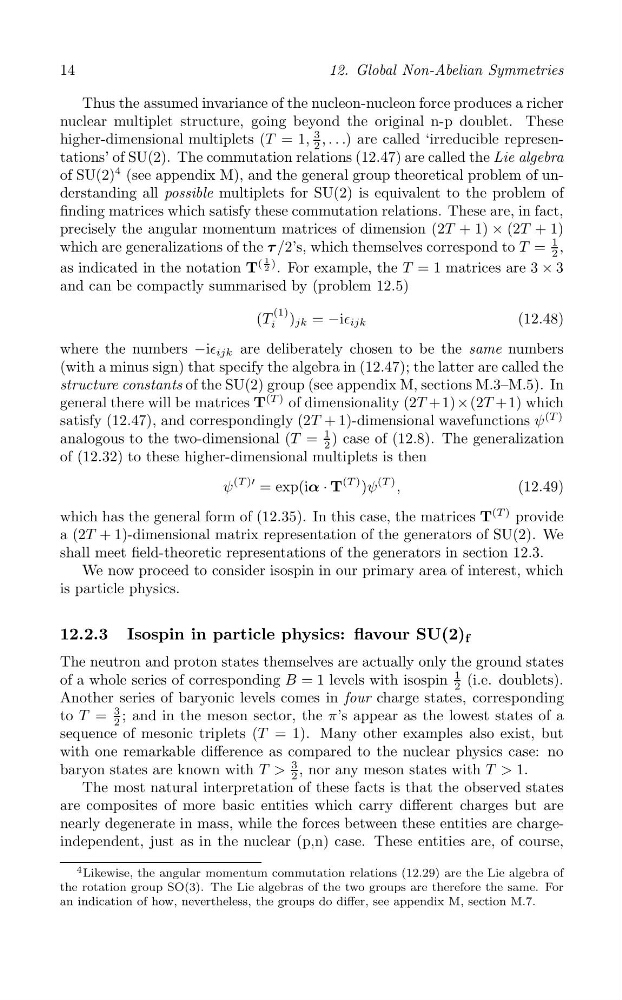
Thus the assumed invariance of the nucleon-nucleon force produces a richer
nuclear multiplet structure, going beyond the original n-p doublet. These
3
higher-dimensional multiplets (T = 1, , . . .) are called ‘irreducible represen2
tations’ of SU(2). The commutation relations (12.47) are called the Lie algebra
of SU(2)
4 (see appendix M), and the general group theoretical problem of understanding all possible multiplets for SU(2) is equivalent to the problem of
finding matrices which satisfy these commutation relations. These are, in fact,
precisely the angular momentum matrices of dimension (2T + 1) × (2T + 1)
1
which are generalizations of the τ /2’s, which themselves correspond to T = ,
2
as indicated in the notation T
(
1 ) . For example, the T = 1 matrices are 3 × 3
2
and can be compactly summarised by (problem 12.5)
(T
(1) ) jk = −i∈ ijk
(12.48)
i
where the numbers −i∈ ijk are deliberately chosen to be the same numbers
(with a minus sign) that specify the algebra in (12.47); the latter are called the
structure constants of the SU(2) group (see appendix M, sections M.3–M.5). In
general there will be matrices T
(T ) of dimensionality (2T +1)× (2T +1) which
satisfy (12.47), and correspondingly (2T + 1)-dimensional wavefunctions ψ
(T )
1
analogous to the two-dimensional (T = ) case of (12.8). The generalization
2
of (12.32) to these higher-dimensional multiplets is then
ψ
(T )′
T
(T ) )ψ
(T )
= exp(iα ·
,
(12.49)
which has the general form of (12.35). In this case, the matrices T
(T ) provide
a (2T + 1)-dimensional matrix representation of the generators of SU(2). We
shall meet field-theoretic representations of the generators in section 12.3.
We now proceed to consider isospin in our primary area of interest, which
is particle physics.
12.2.3 Isospin in particle physics: flavour SU(2) f
The neutron and proton states themselves are actually only the ground states
of a whole series of corresponding B = 1 levels with isospin
1 (i.e. doublets).
2
Another series of baryonic levels comes in four charge states, corresponding
3
to T = ; and in the meson sector, the π’s appear as the lowest states of a
2
sequence of mesonic triplets (T = 1). Many other examples also exist, but
with one remarkable difference as compared to the nuclear physics case: no
3
baryon states are known with T > , nor any meson states with T > 1.
2
The most natural interpretation of these facts is that the observed states
are composites of more basic entities which carry different charges but are
nearly degenerate in mass, while the forces between these entities are chargeindependent, just as in the nuclear (p,n) case. These entities are, of course,
4 Likewise, the angular momentum commutation relations (12.29) are the Lie algebra of
the rotation group SO(3). The Lie algebras of the two groups are therefore the same. For
an indication of how, nevertheless, the groups do differ, see appendix M, section M.7.
12. Global Non-Abelian Symmetries
Thus the assumed invariance of the nucleon-nucleon force produces a richer
nuclear multiplet structure, going beyond the original n-p doublet. These
3
higher-dimensional multiplets (T = 1, , . . .) are called ‘irreducible represen2
tations’ of SU(2). The commutation relations (12.47) are called the Lie algebra
of SU(2)
4 (see appendix M), and the general group theoretical problem of understanding all possible multiplets for SU(2) is equivalent to the problem of
finding matrices which satisfy these commutation relations. These are, in fact,
precisely the angular momentum matrices of dimension (2T + 1) × (2T + 1)
1
which are generalizations of the τ /2’s, which themselves correspond to T = ,
2
as indicated in the notation T
(
1 ) . For example, the T = 1 matrices are 3 × 3
2
and can be compactly summarised by (problem 12.5)
(T
(1) ) jk = −i∈ ijk
(12.48)
i
where the numbers −i∈ ijk are deliberately chosen to be the same numbers
(with a minus sign) that specify the algebra in (12.47); the latter are called the
structure constants of the SU(2) group (see appendix M, sections M.3–M.5). In
general there will be matrices T
(T ) of dimensionality (2T +1)× (2T +1) which
satisfy (12.47), and correspondingly (2T + 1)-dimensional wavefunctions ψ
(T )
1
analogous to the two-dimensional (T = ) case of (12.8). The generalization
2
of (12.32) to these higher-dimensional multiplets is then
ψ
(T )′
T
(T ) )ψ
(T )
= exp(iα ·
,
(12.49)
which has the general form of (12.35). In this case, the matrices T
(T ) provide
a (2T + 1)-dimensional matrix representation of the generators of SU(2). We
shall meet field-theoretic representations of the generators in section 12.3.
We now proceed to consider isospin in our primary area of interest, which
is particle physics.
12.2.3 Isospin in particle physics: flavour SU(2) f
The neutron and proton states themselves are actually only the ground states
of a whole series of corresponding B = 1 levels with isospin
1 (i.e. doublets).
2
Another series of baryonic levels comes in four charge states, corresponding
3
to T = ; and in the meson sector, the π’s appear as the lowest states of a
2
sequence of mesonic triplets (T = 1). Many other examples also exist, but
with one remarkable difference as compared to the nuclear physics case: no
3
baryon states are known with T > , nor any meson states with T > 1.
2
The most natural interpretation of these facts is that the observed states
are composites of more basic entities which carry different charges but are
nearly degenerate in mass, while the forces between these entities are chargeindependent, just as in the nuclear (p,n) case. These entities are, of course,
4 Likewise, the angular momentum commutation relations (12.29) are the Lie algebra of
the rotation group SO(3). The Lie algebras of the two groups are therefore the same. For
an indication of how, nevertheless, the groups do differ, see appendix M, section M.7.