

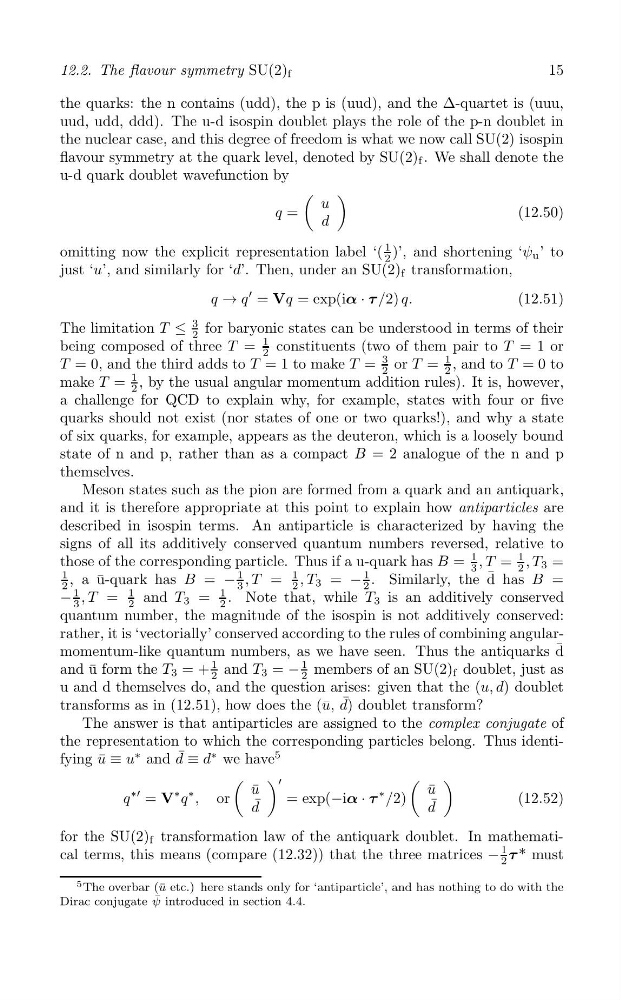
15
12.2. The flavour symmetry SU(2) f
the quarks: the n contains (udd), the p is (uud), and the Δ-quartet is (uuu,
uud, udd, ddd). The u-d isospin doublet plays the role of the p-n doublet in
the nuclear case, and this degree of freedom is what we now call SU(2) isospin
flavour symmetry at the quark level, denoted by SU(2) f . We shall denote the
u-d quark doublet wavefunction by
(
)
u
q =
(12.50)
d
1
2
omitting now the explicit representation label ‘( )’, and shortening ‘ψ u ’ to
just ‘u’, and similarly for ‘d’. Then, under an SU(2) f transformation,
′
q → q = Vq = exp(iα · τ /2) q.
(12.51)
3
2
The limitation T ≤ for baryonic states can be understood in terms of their
1
2
being composed of three T
constituents (two of them pair to T = 1 or
=
3
2
1
2
T = 0, and the third adds to T = 1 to make T = or T = , and to T = 0 to
1
2
make T = , by the usual angular momentum addition rules). It is, however,
a challenge for QCD to explain why, for example, states with four or five
quarks should not exist (nor states of one or two quarks!), and why a state
of six quarks, for example, appears as the deuteron, which is a loosely bound
state of n and p, rather than as a compact B = 2 analogue of the n and p
themselves.
Meson states such as the pion are formed from a quark and an antiquark,
and it is therefore appropriate at this point to explain how antiparticles are
described in isospin terms. An antiparticle is characterized by having the
signs of all its additively conserved quantum numbers reversed, relative to
1
3
1
2
those of the corresponding particle. Thus if a u-quark has B = , T
, T 3
=
=
Similarly, the ¯
d has B
1
2
1
3
1
2
1
2
= −
, T 3 = −
, a ¯
u-quark has B
, T =
=
.
1
3
1
2
1
2
− , T =
and T 3
Note that, while T 3 is an additively conserved
= .
quantum number, the magnitude of the isospin is not additively conserved:
rather, it is ‘vectorially’ conserved according to the rules of combining angularmomentum-like quantum numbers, as we have seen. Thus the antiquarks d ¯
1
2
1
2
and T 3 = −
and ¯
u form the T 3 = +
members of an SU(2) f doublet, just as
u and d themselves do, and the question arises: given that the (u, d) doublet
¯
transforms as in (12.51), how does the (¯ u, d) doublet transform?
The answer is that antiparticles are assigned to the complex conjugate of
the representation to which the corresponding particles belong. Thus identi∗
∗
fying ¯
u ≡ u and d ¯ ≡ d we have
5
(
) ′
(
)
∗′
∗
u ¯
u ¯
q = V
∗ q , or
= exp(−iα · τ
∗ /2)
(12.52)
d ¯
d ¯
for the SU(2) f transformation law of the antiquark doublet. In mathematical terms, this means (compare (12.32)) that the three matrices −
1
2 τ * must
5 The overbar (¯ u etc.) here stands only for ‘antiparticle’, and has nothing to do with the
Dirac conjugate ψ introduced in section 4.4.
¯
12.2. The flavour symmetry SU(2) f
the quarks: the n contains (udd), the p is (uud), and the Δ-quartet is (uuu,
uud, udd, ddd). The u-d isospin doublet plays the role of the p-n doublet in
the nuclear case, and this degree of freedom is what we now call SU(2) isospin
flavour symmetry at the quark level, denoted by SU(2) f . We shall denote the
u-d quark doublet wavefunction by
(
)
u
q =
(12.50)
d
1
2
omitting now the explicit representation label ‘( )’, and shortening ‘ψ u ’ to
just ‘u’, and similarly for ‘d’. Then, under an SU(2) f transformation,
′
q → q = Vq = exp(iα · τ /2) q.
(12.51)
3
2
The limitation T ≤ for baryonic states can be understood in terms of their
1
2
being composed of three T
constituents (two of them pair to T = 1 or
=
3
2
1
2
T = 0, and the third adds to T = 1 to make T = or T = , and to T = 0 to
1
2
make T = , by the usual angular momentum addition rules). It is, however,
a challenge for QCD to explain why, for example, states with four or five
quarks should not exist (nor states of one or two quarks!), and why a state
of six quarks, for example, appears as the deuteron, which is a loosely bound
state of n and p, rather than as a compact B = 2 analogue of the n and p
themselves.
Meson states such as the pion are formed from a quark and an antiquark,
and it is therefore appropriate at this point to explain how antiparticles are
described in isospin terms. An antiparticle is characterized by having the
signs of all its additively conserved quantum numbers reversed, relative to
1
3
1
2
those of the corresponding particle. Thus if a u-quark has B = , T
, T 3
=
=
Similarly, the ¯
d has B
1
2
1
3
1
2
1
2
= −
, T 3 = −
, a ¯
u-quark has B
, T =
=
.
1
3
1
2
1
2
− , T =
and T 3
Note that, while T 3 is an additively conserved
= .
quantum number, the magnitude of the isospin is not additively conserved:
rather, it is ‘vectorially’ conserved according to the rules of combining angularmomentum-like quantum numbers, as we have seen. Thus the antiquarks d ¯
1
2
1
2
and T 3 = −
and ¯
u form the T 3 = +
members of an SU(2) f doublet, just as
u and d themselves do, and the question arises: given that the (u, d) doublet
¯
transforms as in (12.51), how does the (¯ u, d) doublet transform?
The answer is that antiparticles are assigned to the complex conjugate of
the representation to which the corresponding particles belong. Thus identi∗
∗
fying ¯
u ≡ u and d ¯ ≡ d we have
5
(
) ′
(
)
∗′
∗
u ¯
u ¯
q = V
∗ q , or
= exp(−iα · τ
∗ /2)
(12.52)
d ¯
d ¯
for the SU(2) f transformation law of the antiquark doublet. In mathematical terms, this means (compare (12.32)) that the three matrices −
1
2 τ * must
5 The overbar (¯ u etc.) here stands only for ‘antiparticle’, and has nothing to do with the
Dirac conjugate ψ introduced in section 4.4.
¯