

13
12.2. The flavour symmetry SU(2) f
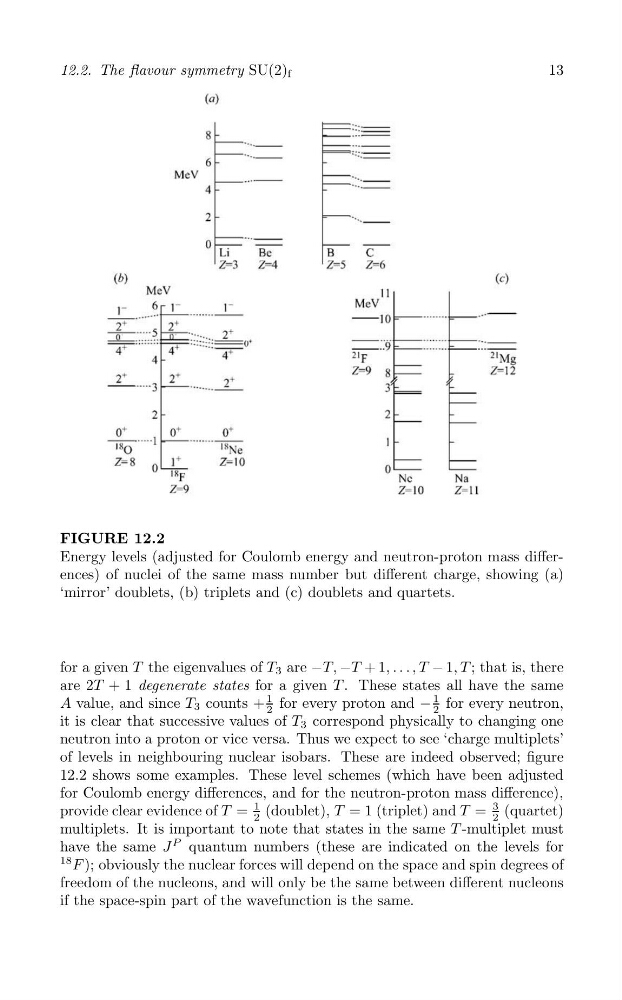
FIGURE 12.2
Energy levels (adjusted for Coulomb energy and neutron-proton mass differences) of nuclei of the same mass number but different charge, showing (a)
‘mirror’ doublets, (b) triplets and (c) doublets and quartets.
for a given T the eigenvalues of T 3 are −T, −T + 1, . . . , T − 1, T ; that is, there
are 2T + 1 degenerate states for a given T . These states all have the same
A value, and since T 3 counts +
1 for every proton and −
1 for every neutron,
2
2
it is clear that successive values of T 3 correspond physically to changing one
neutron into a proton or vice versa. Thus we expect to see ‘charge multiplets’
of levels in neighbouring nuclear isobars. These are indeed observed; figure
12.2 shows some examples. These level schemes (which have been adjusted
for Coulomb energy differences, and for the neutron-proton mass difference),
1
3
provide clear evidence of T = (doublet), T = 1 (triplet) and T = (quartet)
2
2
multiplets. It is important to note that states in the same T -multiplet must
have the same J
P quantum numbers (these are indicated on the levels for
18 F ); obviously the nuclear forces will depend on the space and spin degrees of
freedom of the nucleons, and will only be the same between different nucleons
if the space-spin part of the wavefunction is the same.
12.2. The flavour symmetry SU(2) f
FIGURE 12.2
Energy levels (adjusted for Coulomb energy and neutron-proton mass differences) of nuclei of the same mass number but different charge, showing (a)
‘mirror’ doublets, (b) triplets and (c) doublets and quartets.
for a given T the eigenvalues of T 3 are −T, −T + 1, . . . , T − 1, T ; that is, there
are 2T + 1 degenerate states for a given T . These states all have the same
A value, and since T 3 counts +
1 for every proton and −
1 for every neutron,
2
2
it is clear that successive values of T 3 correspond physically to changing one
neutron into a proton or vice versa. Thus we expect to see ‘charge multiplets’
of levels in neighbouring nuclear isobars. These are indeed observed; figure
12.2 shows some examples. These level schemes (which have been adjusted
for Coulomb energy differences, and for the neutron-proton mass difference),
1
3
provide clear evidence of T = (doublet), T = 1 (triplet) and T = (quartet)
2
2
multiplets. It is important to note that states in the same T -multiplet must
have the same J
P quantum numbers (these are indicated on the levels for
18 F ); obviously the nuclear forces will depend on the space and spin degrees of
freedom of the nucleons, and will only be the same between different nucleons
if the space-spin part of the wavefunction is the same.