

10
12. Global Non-Abelian Symmetries
so that
(
)
(
)
ψ
(1/2)
′
ψ p
′
ψ p
τ /2)ψ
(1/2)
≡
= exp(iα · τ /2)
= exp(iα ·
. (12.32)
ψ
′
ψ n
n
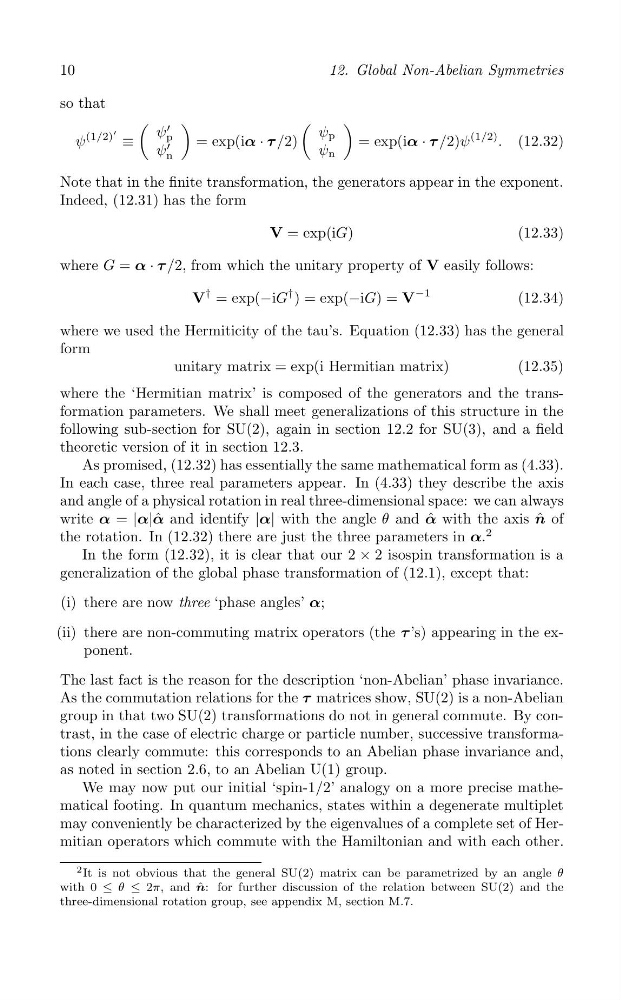
Note that in the finite transformation, the generators appear in the exponent.
Indeed, (12.31) has the form
V = exp(iG)
(12.33)
where G = α · τ /2, from which the unitary property of V easily follows:
V
† = exp(−iG
† ) = exp(−iG) = V
−1
(12.34)
where we used the Hermiticity of the tau’s. Equation (12.33) has the general
form
unitary matrix = exp(i Hermitian matrix)
(12.35)
where the ‘Hermitian matrix’ is composed of the generators and the transformation parameters. We shall meet generalizations of this structure in the
following sub-section for SU(2), again in section 12.2 for SU(3), and a field
theoretic version of it in section 12.3.
As promised, (12.32) has essentially the same mathematical form as (4.33).
In each case, three real parameters appear. In (4.33) they describe the axis
and angle of a physical rotation in real three-dimensional space: we can always
write α = |α|α ˆ and identify |α| with the angle θ and α ˆ with the axis n ˆ of
2
the rotation. In (12.32) there are just the three parameters in α.
In the form (12.32), it is clear that our 2 × 2 isospin transformation is a
generalization of the global phase transformation of (12.1), except that:
(i) there are now three ‘phase angles’ α;
(ii) there are non-commuting matrix operators (the τ ’s) appearing in the exponent.
The last fact is the reason for the description ‘non-Abelian’ phase invariance.
As the commutation relations for the τ matrices show, SU(2) is a non-Abelian
group in that two SU(2) transformations do not in general commute. By contrast, in the case of electric charge or particle number, successive transformations clearly commute: this corresponds to an Abelian phase invariance and,
as noted in section 2.6, to an Abelian U(1) group.
We may now put our initial ‘spin-1/2’ analogy on a more precise mathematical footing. In quantum mechanics, states within a degenerate multiplet
may conveniently be characterized by the eigenvalues of a complete set of Hermitian operators which commute with the Hamiltonian and with each other.
2 It is not obvious that the general SU(2) matrix can be parametrized by an angle θ
with 0 ≤ θ ≤ 2π, and n ˆ : for further discussion of the relation between SU(2) and the
three-dimensional rotation group, see appendix M, section M.7.
12. Global Non-Abelian Symmetries
so that
(
)
(
)
ψ
(1/2)
′
ψ p
′
ψ p
τ /2)ψ
(1/2)
≡
= exp(iα · τ /2)
= exp(iα ·
. (12.32)
ψ
′
ψ n
n
Note that in the finite transformation, the generators appear in the exponent.
Indeed, (12.31) has the form
V = exp(iG)
(12.33)
where G = α · τ /2, from which the unitary property of V easily follows:
V
† = exp(−iG
† ) = exp(−iG) = V
−1
(12.34)
where we used the Hermiticity of the tau’s. Equation (12.33) has the general
form
unitary matrix = exp(i Hermitian matrix)
(12.35)
where the ‘Hermitian matrix’ is composed of the generators and the transformation parameters. We shall meet generalizations of this structure in the
following sub-section for SU(2), again in section 12.2 for SU(3), and a field
theoretic version of it in section 12.3.
As promised, (12.32) has essentially the same mathematical form as (4.33).
In each case, three real parameters appear. In (4.33) they describe the axis
and angle of a physical rotation in real three-dimensional space: we can always
write α = |α|α ˆ and identify |α| with the angle θ and α ˆ with the axis n ˆ of
2
the rotation. In (12.32) there are just the three parameters in α.
In the form (12.32), it is clear that our 2 × 2 isospin transformation is a
generalization of the global phase transformation of (12.1), except that:
(i) there are now three ‘phase angles’ α;
(ii) there are non-commuting matrix operators (the τ ’s) appearing in the exponent.
The last fact is the reason for the description ‘non-Abelian’ phase invariance.
As the commutation relations for the τ matrices show, SU(2) is a non-Abelian
group in that two SU(2) transformations do not in general commute. By contrast, in the case of electric charge or particle number, successive transformations clearly commute: this corresponds to an Abelian phase invariance and,
as noted in section 2.6, to an Abelian U(1) group.
We may now put our initial ‘spin-1/2’ analogy on a more precise mathematical footing. In quantum mechanics, states within a degenerate multiplet
may conveniently be characterized by the eigenvalues of a complete set of Hermitian operators which commute with the Hamiltonian and with each other.
2 It is not obvious that the general SU(2) matrix can be parametrized by an angle θ
with 0 ≤ θ ≤ 2π, and n ˆ : for further discussion of the relation between SU(2) and the
three-dimensional rotation group, see appendix M, section M.7.