

12.2. The flavour symmetry SU(2) f
9
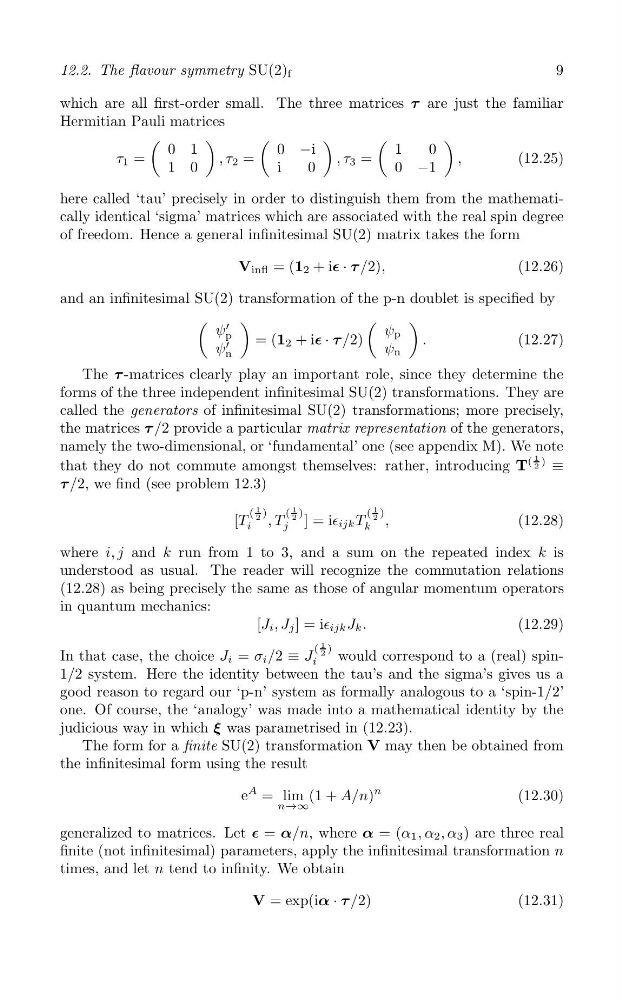
which are all first-order small. The three matrices τ are just the familiar
Hermitian Pauli matrices
(
)
(
)
(
)
0 1
0
1 =
, τ
1 0
2 =
−i
1
0
τ
, τ
i
0
3 =
,
(12.25)
0 −1
here called ‘tau’ precisely in order to distinguish them from the mathematically identical ‘sigma’ matrices which are associated with the real spin degree
of freedom. Hence a general infinitesimal SU(2) matrix takes the form
V infl = (1 2 + i∊ · τ /2),
(12.26)
and an infinitesimal SU(2) transformation of the p-n doublet is specified by
(
)
(
)
ψ p
′
ψ
= (1
n
′
2 + i∊ · τ /2)
p
.
(12.27)
ψ
ψ n
The τ -matrices clearly play an important role, since they determine the
forms of the three independent infinitesimal SU(2) transformations. They are
called the generators of infinitesimal SU(2) transformations; more precisely,
the matrices τ /2 provide a particular matrix representation of the generators,
namely the two-dimensional, or ‘fundamental’ one (see appendix M). We note
1
that they do not commute amongst themselves: rather, introducing T
( )
2
≡
τ /2, we find (see problem 12.3)
(
1 )
(
1 )
(
1 )
[T
2 , T
2 ] = i∈ T
2
i
j
ijk k ,
(12.28)
where i, j and k run from 1 to 3, and a sum on the repeated index k is
understood as usual. The reader will recognize the commutation relations
(12.28) as being precisely the same as those of angular momentum operators
in quantum mechanics:
[J i , J j ] = i∈ ijk J k .
(12.29)
(
1 )
In that case, the choice J i = σ i /2 ≡ J
2
i
would correspond to a (real) spin1/2 system. Here the identity between the tau’s and the sigma’s gives us a
good reason to regard our ‘p-n’ system as formally analogous to a ‘spin-1/2’
one. Of course, the ‘analogy’ was made into a mathematical identity by the
judicious way in which ξ was parametrised in (12.23).
The form for a finite SU(2) transformation V may then be obtained from
the infinitesimal form using the result
e
A = lim (1 + A/n)
n
(12.30)
n→∞
generalized to matrices. Let ∊ = α/n, where α = (α 1 , α 2 , α 3 ) are three real
finite (not infinitesimal) parameters, apply the infinitesimal transformation n
times, and let n tend to infinity. We obtain
V = exp(iα · τ /2)
(12.31)
9
which are all first-order small. The three matrices τ are just the familiar
Hermitian Pauli matrices
(
)
(
)
(
)
0 1
0
1 =
, τ
1 0
2 =
−i
1
0
τ
, τ
i
0
3 =
,
(12.25)
0 −1
here called ‘tau’ precisely in order to distinguish them from the mathematically identical ‘sigma’ matrices which are associated with the real spin degree
of freedom. Hence a general infinitesimal SU(2) matrix takes the form
V infl = (1 2 + i∊ · τ /2),
(12.26)
and an infinitesimal SU(2) transformation of the p-n doublet is specified by
(
)
(
)
ψ p
′
ψ
= (1
n
′
2 + i∊ · τ /2)
p
.
(12.27)
ψ
ψ n
The τ -matrices clearly play an important role, since they determine the
forms of the three independent infinitesimal SU(2) transformations. They are
called the generators of infinitesimal SU(2) transformations; more precisely,
the matrices τ /2 provide a particular matrix representation of the generators,
namely the two-dimensional, or ‘fundamental’ one (see appendix M). We note
1
that they do not commute amongst themselves: rather, introducing T
( )
2
≡
τ /2, we find (see problem 12.3)
(
1 )
(
1 )
(
1 )
[T
2 , T
2 ] = i∈ T
2
i
j
ijk k ,
(12.28)
where i, j and k run from 1 to 3, and a sum on the repeated index k is
understood as usual. The reader will recognize the commutation relations
(12.28) as being precisely the same as those of angular momentum operators
in quantum mechanics:
[J i , J j ] = i∈ ijk J k .
(12.29)
(
1 )
In that case, the choice J i = σ i /2 ≡ J
2
i
would correspond to a (real) spin1/2 system. Here the identity between the tau’s and the sigma’s gives us a
good reason to regard our ‘p-n’ system as formally analogous to a ‘spin-1/2’
one. Of course, the ‘analogy’ was made into a mathematical identity by the
judicious way in which ξ was parametrised in (12.23).
The form for a finite SU(2) transformation V may then be obtained from
the infinitesimal form using the result
e
A = lim (1 + A/n)
n
(12.30)
n→∞
generalized to matrices. Let ∊ = α/n, where α = (α 1 , α 2 , α 3 ) are three real
finite (not infinitesimal) parameters, apply the infinitesimal transformation n
times, and let n tend to infinity. We obtain
V = exp(iα · τ /2)
(12.31)