

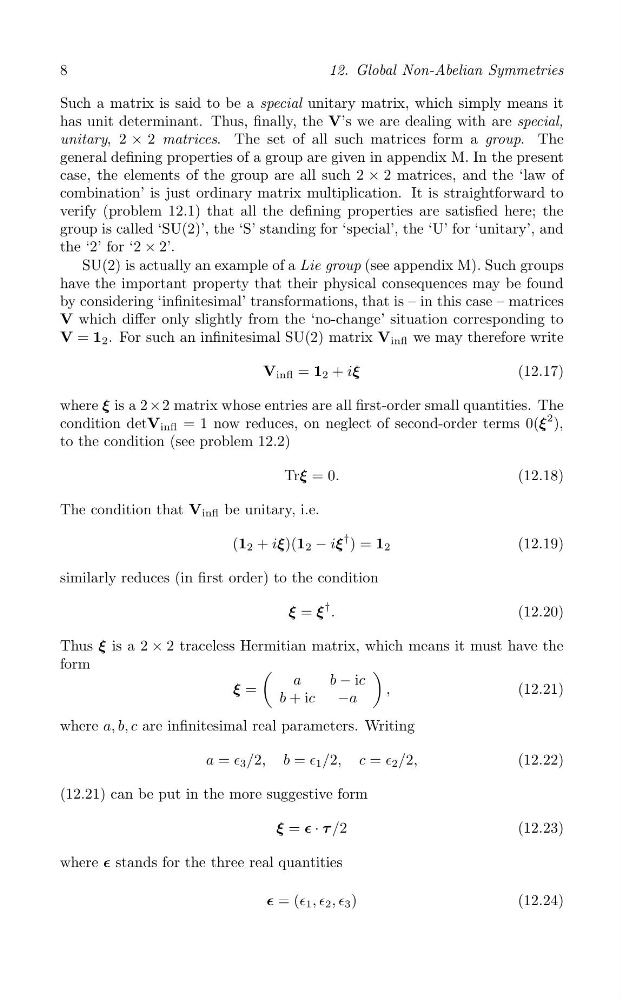
8
12. Global Non-Abelian Symmetries
Such a matrix is said to be a special unitary matrix, which simply means it
has unit determinant. Thus, finally, the V’s we are dealing with are special,
unitary, 2 × 2 matrices. The set of all such matrices form a group. The
general defining properties of a group are given in appendix M. In the present
case, the elements of the group are all such 2 × 2 matrices, and the ‘law of
combination’ is just ordinary matrix multiplication. It is straightforward to
verify (problem 12.1) that all the defining properties are satisfied here; the
group is called ‘SU(2)’, the ‘S’ standing for ‘special’, the ‘U’ for ‘unitary’, and
the ‘2’ for ‘2 × 2’.
SU(2) is actually an example of a Lie group (see appendix M). Such groups
have the important property that their physical consequences may be found
by considering ‘infinitesimal’ transformations, that is – in this case – matrices
V which differ only slightly from the ‘no-change’ situation corresponding to
V = 1 2 . For such an infinitesimal SU(2) matrix V infl we may therefore write
V infl = 1 2 + iξ
(12.17)
where ξ is a 2 × 2 matrix whose entries are all first-order small quantities. The
condition detV infl = 1 now reduces, on neglect of second-order terms 0(ξ
2 ),
to the condition (see problem 12.2)
Trξ = 0.
(12.18)
The condition that V infl be unitary, i.e.
(1 2 + iξ)(1 2 − iξ
† ) = 1 2
(12.19)
similarly reduces (in first order) to the condition
ξ = ξ
† .
(12.20)
Thus ξ is a 2 × 2 traceless Hermitian matrix, which means it must have the
form
(
)
a
b − ic
ξ =
,
(12.21)
b + ic
−a
where a, b, c are infinitesimal real parameters. Writing
a = ∈ 3 /2, b = ∈ 1 /2, c = ∈ 2 /2,
(12.22)
(12.21) can be put in the more suggestive form
ξ = ∊ · τ /2
(12.23)
where ∊ stands for the three real quantities
∊ = (∈ 1 , ∈ 2 , ∈ 3 )
(12.24)
12. Global Non-Abelian Symmetries
Such a matrix is said to be a special unitary matrix, which simply means it
has unit determinant. Thus, finally, the V’s we are dealing with are special,
unitary, 2 × 2 matrices. The set of all such matrices form a group. The
general defining properties of a group are given in appendix M. In the present
case, the elements of the group are all such 2 × 2 matrices, and the ‘law of
combination’ is just ordinary matrix multiplication. It is straightforward to
verify (problem 12.1) that all the defining properties are satisfied here; the
group is called ‘SU(2)’, the ‘S’ standing for ‘special’, the ‘U’ for ‘unitary’, and
the ‘2’ for ‘2 × 2’.
SU(2) is actually an example of a Lie group (see appendix M). Such groups
have the important property that their physical consequences may be found
by considering ‘infinitesimal’ transformations, that is – in this case – matrices
V which differ only slightly from the ‘no-change’ situation corresponding to
V = 1 2 . For such an infinitesimal SU(2) matrix V infl we may therefore write
V infl = 1 2 + iξ
(12.17)
where ξ is a 2 × 2 matrix whose entries are all first-order small quantities. The
condition detV infl = 1 now reduces, on neglect of second-order terms 0(ξ
2 ),
to the condition (see problem 12.2)
Trξ = 0.
(12.18)
The condition that V infl be unitary, i.e.
(1 2 + iξ)(1 2 − iξ
† ) = 1 2
(12.19)
similarly reduces (in first order) to the condition
ξ = ξ
† .
(12.20)
Thus ξ is a 2 × 2 traceless Hermitian matrix, which means it must have the
form
(
)
a
b − ic
ξ =
,
(12.21)
b + ic
−a
where a, b, c are infinitesimal real parameters. Writing
a = ∈ 3 /2, b = ∈ 1 /2, c = ∈ 2 /2,
(12.22)
(12.21) can be put in the more suggestive form
ξ = ∊ · τ /2
(12.23)
where ∊ stands for the three real quantities
∊ = (∈ 1 , ∈ 2 , ∈ 3 )
(12.24)