

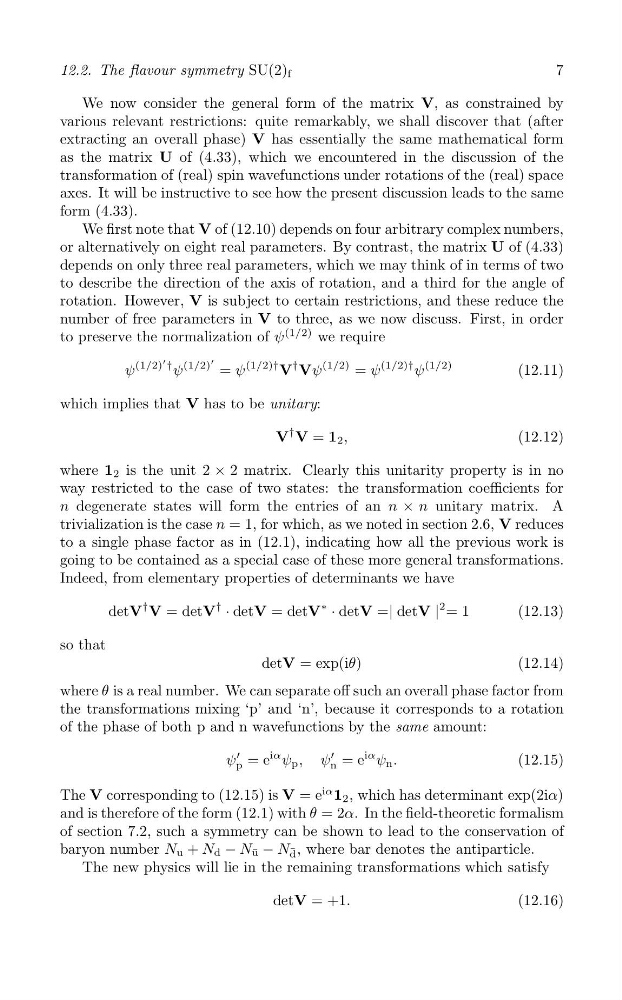
7
12.2. The flavour symmetry SU(2) f
We now consider the general form of the matrix V, as constrained by
various relevant restrictions: quite remarkably, we shall discover that (after
extracting an overall phase) V has essentially the same mathematical form
as the matrix U of (4.33), which we encountered in the discussion of the
transformation of (real) spin wavefunctions under rotations of the (real) space
axes. It will be instructive to see how the present discussion leads to the same
form (4.33).
We first note that V of (12.10) depends on four arbitrary complex numbers,
or alternatively on eight real parameters. By contrast, the matrix U of (4.33)
depends on only three real parameters, which we may think of in terms of two
to describe the direction of the axis of rotation, and a third for the angle of
rotation. However, V is subject to certain restrictions, and these reduce the
number of free parameters in V to three, as we now discuss. First, in order
to preserve the normalization of ψ
(1/2) we require
(1/2)
′ † ψ
(1/2)
′
(1/2)† V
† Vψ
(1/2)
(1/2)† ψ
(1/2)
ψ
= ψ
= ψ
(12.11)
which implies that V has to be unitary:
V
† V = 1 2 ,
(12.12)
where 1 2 is the unit 2 × 2 matrix. Clearly this unitarity property is in no
way restricted to the case of two states: the transformation coefficients for
n degenerate states will form the entries of an n × n unitary matrix. A
trivialization is the case n = 1, for which, as we noted in section 2.6, V reduces
to a single phase factor as in (12.1), indicating how all the previous work is
going to be contained as a special case of these more general transformations.
Indeed, from elementary properties of determinants we have
detV
† V = detV
†
· detV = detV
∗
· detV =| detV |
2 = 1
(12.13)
so that
detV = exp(iθ)
(12.14)
where θ is a real number. We can separate off such an overall phase factor from
the transformations mixing ‘p’ and ‘n’, because it corresponds to a rotation
of the phase of both p and n wavefunctions by the same amount:
′
′
iα ψ
iα ψ
ψ p = e
, ψ = e n .
(12.15)
p
n
The V corresponding to (12.15) is V = e
iα 1 2 , which has determinant exp(2iα)
and is therefore of the form (12.1) with θ = 2α. In the field-theoretic formalism
of section 7.2, such a symmetry can be shown to lead to the conservation of
baryon number N u + N d − N u ¯ − N d ¯ , where bar denotes the antiparticle.
The new physics will lie in the remaining transformations which satisfy
detV = +1.
(12.16)
12.2. The flavour symmetry SU(2) f
We now consider the general form of the matrix V, as constrained by
various relevant restrictions: quite remarkably, we shall discover that (after
extracting an overall phase) V has essentially the same mathematical form
as the matrix U of (4.33), which we encountered in the discussion of the
transformation of (real) spin wavefunctions under rotations of the (real) space
axes. It will be instructive to see how the present discussion leads to the same
form (4.33).
We first note that V of (12.10) depends on four arbitrary complex numbers,
or alternatively on eight real parameters. By contrast, the matrix U of (4.33)
depends on only three real parameters, which we may think of in terms of two
to describe the direction of the axis of rotation, and a third for the angle of
rotation. However, V is subject to certain restrictions, and these reduce the
number of free parameters in V to three, as we now discuss. First, in order
to preserve the normalization of ψ
(1/2) we require
(1/2)
′ † ψ
(1/2)
′
(1/2)† V
† Vψ
(1/2)
(1/2)† ψ
(1/2)
ψ
= ψ
= ψ
(12.11)
which implies that V has to be unitary:
V
† V = 1 2 ,
(12.12)
where 1 2 is the unit 2 × 2 matrix. Clearly this unitarity property is in no
way restricted to the case of two states: the transformation coefficients for
n degenerate states will form the entries of an n × n unitary matrix. A
trivialization is the case n = 1, for which, as we noted in section 2.6, V reduces
to a single phase factor as in (12.1), indicating how all the previous work is
going to be contained as a special case of these more general transformations.
Indeed, from elementary properties of determinants we have
detV
† V = detV
†
· detV = detV
∗
· detV =| detV |
2 = 1
(12.13)
so that
detV = exp(iθ)
(12.14)
where θ is a real number. We can separate off such an overall phase factor from
the transformations mixing ‘p’ and ‘n’, because it corresponds to a rotation
of the phase of both p and n wavefunctions by the same amount:
′
′
iα ψ
iα ψ
ψ p = e
, ψ = e n .
(12.15)
p
n
The V corresponding to (12.15) is V = e
iα 1 2 , which has determinant exp(2iα)
and is therefore of the form (12.1) with θ = 2α. In the field-theoretic formalism
of section 7.2, such a symmetry can be shown to lead to the conservation of
baryon number N u + N d − N u ¯ − N d ¯ , where bar denotes the antiparticle.
The new physics will lie in the remaining transformations which satisfy
detV = +1.
(12.16)