

6
12. Global Non-Abelian Symmetries
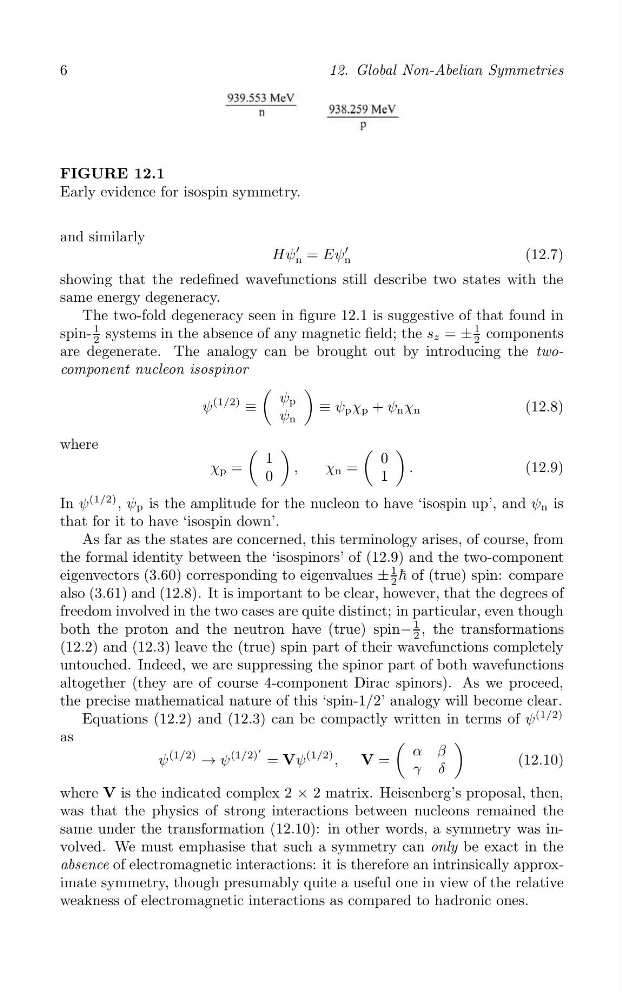
FIGURE 12.1
Early evidence for isospin symmetry.
and similarly
Hψ
′ = Eψ
′
(12.7)
n
n
showing that the redefined wavefunctions still describe two states with the
same energy degeneracy.
The two-fold degeneracy seen in figure 12.1 is suggestive of that found in
spin1 systems in the absence of any magnetic field; the s z = ±
1 components
2
2
are degenerate. The analogy can be brought out by introducing the twocomponent nucleon isospinor
(
)
ψ
(1/2)
≡
ψ p
≡ ψ p χ p + ψ n χ n
(12.8)
ψ n
where
(
)
(
)
1
0
χ p =
,
χ n =
.
(12.9)
0
1
In ψ
(1/2) , ψ p is the amplitude for the nucleon to have ‘isospin up’, and ψ n is
that for it to have ‘isospin down’.
As far as the states are concerned, this terminology arises, of course, from
the formal identity between the ‘isospinors’ of (12.9) and the two-component
eigenvectors (3.60) corresponding to eigenvalues ±
1
ħ of (true) spin: compare
2
also (3.61) and (12.8). It is important to be clear, however, that the degrees of
freedom involved in the two cases are quite distinct; in particular, even though
both the proton and the neutron have (true) spin−
1 , the transformations
2
(12.2) and (12.3) leave the (true) spin part of their wavefunctions completely
untouched. Indeed, we are suppressing the spinor part of both wavefunctions
altogether (they are of course 4-component Dirac spinors). As we proceed,
the precise mathematical nature of this ‘spin-1/2’ analogy will become clear.
Equations (12.2) and (12.3) can be compactly written in terms of ψ
(1/2)
as
(
)
ψ
(1/2)
→ ψ
(1/2)
′
Vψ
(1/2)
α β
=
,
V =
(12.10)
γ δ
where V is the indicated complex 2 × 2 matrix. Heisenberg’s proposal, then,
was that the physics of strong interactions between nucleons remained the
same under the transformation (12.10): in other words, a symmetry was involved. We must emphasise that such a symmetry can only be exact in the
absence of electromagnetic interactions: it is therefore an intrinsically approximate symmetry, though presumably quite a useful one in view of the relative
weakness of electromagnetic interactions as compared to hadronic ones.
12. Global Non-Abelian Symmetries
FIGURE 12.1
Early evidence for isospin symmetry.
and similarly
Hψ
′ = Eψ
′
(12.7)
n
n
showing that the redefined wavefunctions still describe two states with the
same energy degeneracy.
The two-fold degeneracy seen in figure 12.1 is suggestive of that found in
spin1 systems in the absence of any magnetic field; the s z = ±
1 components
2
2
are degenerate. The analogy can be brought out by introducing the twocomponent nucleon isospinor
(
)
ψ
(1/2)
≡
ψ p
≡ ψ p χ p + ψ n χ n
(12.8)
ψ n
where
(
)
(
)
1
0
χ p =
,
χ n =
.
(12.9)
0
1
In ψ
(1/2) , ψ p is the amplitude for the nucleon to have ‘isospin up’, and ψ n is
that for it to have ‘isospin down’.
As far as the states are concerned, this terminology arises, of course, from
the formal identity between the ‘isospinors’ of (12.9) and the two-component
eigenvectors (3.60) corresponding to eigenvalues ±
1
ħ of (true) spin: compare
2
also (3.61) and (12.8). It is important to be clear, however, that the degrees of
freedom involved in the two cases are quite distinct; in particular, even though
both the proton and the neutron have (true) spin−
1 , the transformations
2
(12.2) and (12.3) leave the (true) spin part of their wavefunctions completely
untouched. Indeed, we are suppressing the spinor part of both wavefunctions
altogether (they are of course 4-component Dirac spinors). As we proceed,
the precise mathematical nature of this ‘spin-1/2’ analogy will become clear.
Equations (12.2) and (12.3) can be compactly written in terms of ψ
(1/2)
as
(
)
ψ
(1/2)
→ ψ
(1/2)
′
Vψ
(1/2)
α β
=
,
V =
(12.10)
γ δ
where V is the indicated complex 2 × 2 matrix. Heisenberg’s proposal, then,
was that the physics of strong interactions between nucleons remained the
same under the transformation (12.10): in other words, a symmetry was involved. We must emphasise that such a symmetry can only be exact in the
absence of electromagnetic interactions: it is therefore an intrinsically approximate symmetry, though presumably quite a useful one in view of the relative
weakness of electromagnetic interactions as compared to hadronic ones.