

394
G. Green Functions
Now
( )
1
1
1
∇
= − r ˆ = − r ˆ
r
r 2
R 2
on the surface S, while n ˆ = r ˆ and dS = R
2 dΩ with dΩ the element of solid
angle on the sphere. So
∫
( )
∫
1
∇
2
d
3
r = − dΩ = −4π
(G.9)
r
V
S
which using (G.4) is precisely the integral of the right-hand side of (G.7), as
required.
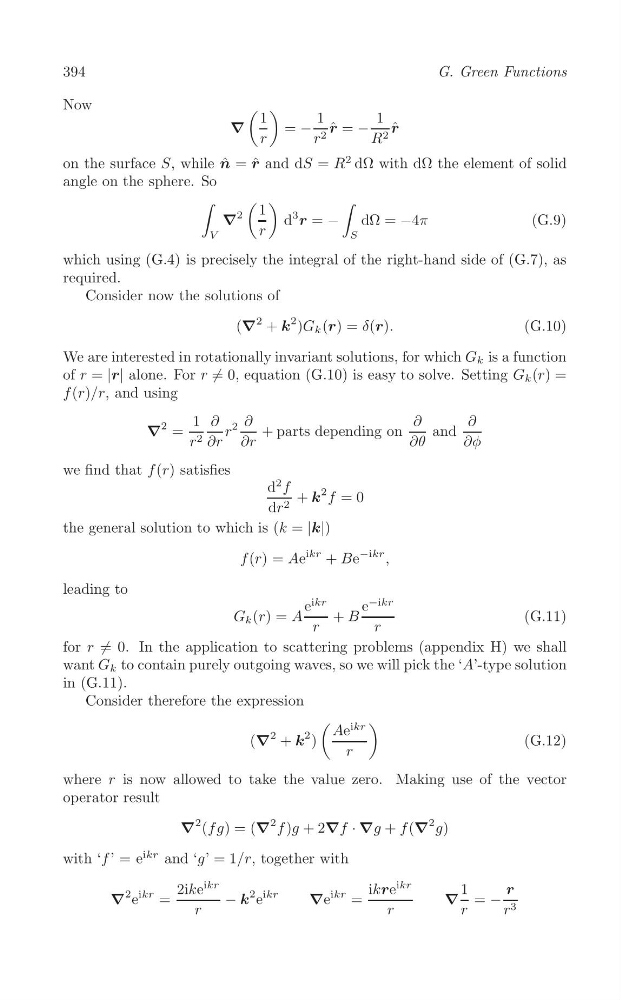
Consider now the solutions of
(∇
2 + k
2 )G k (r) = δ(r).
(G.10)
We are interested in rotationally invariant solutions, for which G k is a function
of r = |r| alone. For r / 0, equation (G.10) is easy to solve. Setting G k (r) =
=
f (r)/r, and using
1 ∂
∂
∂
∂
2
∇
2 =
r
+ parts depending on
and
r 2 ∂r ∂r
∂θ
∂φ
we find that f (r) satisfies
d
2 f + k
2 f = 0
dr 2
the general solution to which is (k = |k|)
ikr
−ikr
f (r) = Ae + Be
,
leading to
ikr
−ikr
e
e
G k (r) = A
+ B
(G.11)
r
r
for r / 0. In the application to scattering problems (appendix H) we shall
=
want G k to contain purely outgoing waves, so we will pick the ‘A’-type solution
in (G.11).
Consider therefore the expression
(
)
ikr
(∇
2 + k
2 )
Ae
(G.12)
r
where r is now allowed to take the value zero. Making use of the vector
operator result
∇
2 (f g) = (∇
2 f )g + 2∇f · ∇g + f (∇
2 g)
ikr
with ‘f ’ = e and ‘g’ = 1/r, together with
ikr
ikr
2ike
ikre
1
r
ikr
ikr
ikr
∇
2
− k
2
e =
e
∇e =
∇ = −
r
r
r
r 3
G. Green Functions
Now
( )
1
1
1
∇
= − r ˆ = − r ˆ
r
r 2
R 2
on the surface S, while n ˆ = r ˆ and dS = R
2 dΩ with dΩ the element of solid
angle on the sphere. So
∫
( )
∫
1
∇
2
d
3
r = − dΩ = −4π
(G.9)
r
V
S
which using (G.4) is precisely the integral of the right-hand side of (G.7), as
required.
Consider now the solutions of
(∇
2 + k
2 )G k (r) = δ(r).
(G.10)
We are interested in rotationally invariant solutions, for which G k is a function
of r = |r| alone. For r / 0, equation (G.10) is easy to solve. Setting G k (r) =
=
f (r)/r, and using
1 ∂
∂
∂
∂
2
∇
2 =
r
+ parts depending on
and
r 2 ∂r ∂r
∂θ
∂φ
we find that f (r) satisfies
d
2 f + k
2 f = 0
dr 2
the general solution to which is (k = |k|)
ikr
−ikr
f (r) = Ae + Be
,
leading to
ikr
−ikr
e
e
G k (r) = A
+ B
(G.11)
r
r
for r / 0. In the application to scattering problems (appendix H) we shall
=
want G k to contain purely outgoing waves, so we will pick the ‘A’-type solution
in (G.11).
Consider therefore the expression
(
)
ikr
(∇
2 + k
2 )
Ae
(G.12)
r
where r is now allowed to take the value zero. Making use of the vector
operator result
∇
2 (f g) = (∇
2 f )g + 2∇f · ∇g + f (∇
2 g)
ikr
with ‘f ’ = e and ‘g’ = 1/r, together with
ikr
ikr
2ike
ikre
1
r
ikr
ikr
ikr
∇
2
− k
2
e =
e
∇e =
∇ = −
r
r
r
r 3