

395
G. Green Functions
we find
(
)
( )
ikr
ikr
∇
2
(∇
2 + k
2 )
Ae
= Ae
1
r
r
ikr δ(r)
= −4πAe
= −4πAδ(r)
(G.13)
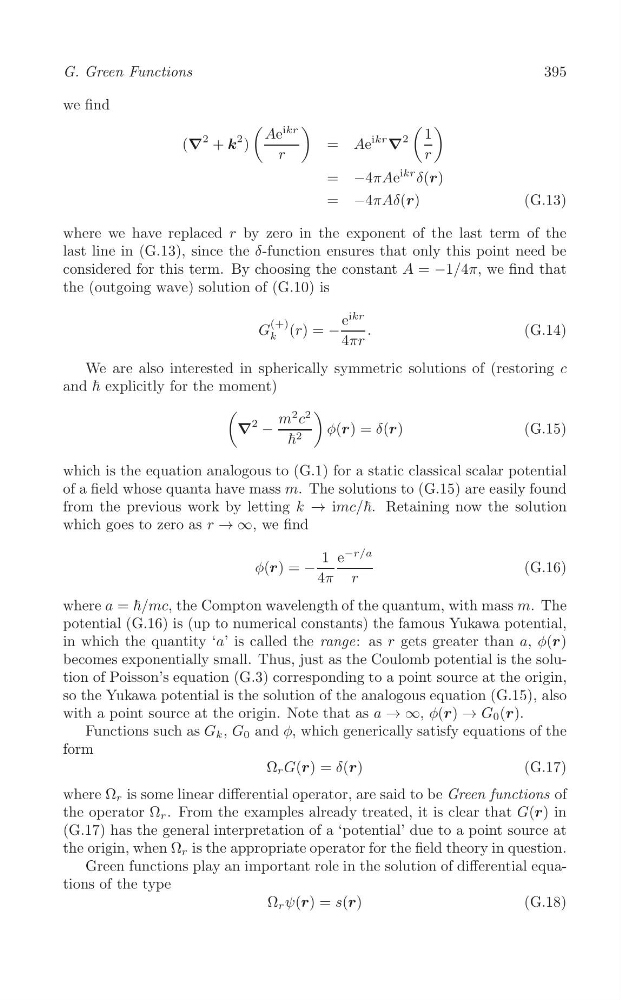
where we have replaced r by zero in the exponent of the last term of the
last line in (G.13), since the δ-function ensures that only this point need be
considered for this term. By choosing the constant A = −1/4π, we find that
the (outgoing wave) solution of (G.10) is
ikr
e
(+)
G (r) = −
.
(G.14)
k
4πr
We are also interested in spherically symmetric solutions of (restoring c
and ħ explicitly for the moment)
(
)
2 2
m c
∇
2
− ħ 2
φ(r) = δ(r)
(G.15)
which is the equation analogous to (G.1) for a static classical scalar potential
of a field whose quanta have mass m. The solutions to (G.15) are easily found
from the previous work by letting k → imc/ħ. Retaining now the solution
which goes to zero as r → ∞, we find
−r/a
1 e
φ(r) = −
(G.16)
4π r
where a = ħ/mc, the Compton wavelength of the quantum, with mass m. The
potential (G.16) is (up to numerical constants) the famous Yukawa potential,
in which the quantity ‘a’ is called the range: as r gets greater than a, φ(r)
becomes exponentially small. Thus, just as the Coulomb potential is the solution of Poisson’s equation (G.3) corresponding to a point source at the origin,
so the Yukawa potential is the solution of the analogous equation (G.15), also
with a point source at the origin. Note that as a → ∞, φ(r) → G 0 (r).
Functions such as G k , G 0 and φ, which generically satisfy equations of the
form
Ω r G(r) = δ(r)
(G.17)
where Ω r is some linear differential operator, are said to be Green functions of
the operator Ω r . From the examples already treated, it is clear that G(r) in
(G.17) has the general interpretation of a ‘potential’ due to a point source at
the origin, when Ω r is the appropriate operator for the field theory in question.
Green functions play an important role in the solution of differential equations of the type
Ω r ψ(r) = s(r)
(G.18)
G. Green Functions
we find
(
)
( )
ikr
ikr
∇
2
(∇
2 + k
2 )
Ae
= Ae
1
r
r
ikr δ(r)
= −4πAe
= −4πAδ(r)
(G.13)
where we have replaced r by zero in the exponent of the last term of the
last line in (G.13), since the δ-function ensures that only this point need be
considered for this term. By choosing the constant A = −1/4π, we find that
the (outgoing wave) solution of (G.10) is
ikr
e
(+)
G (r) = −
.
(G.14)
k
4πr
We are also interested in spherically symmetric solutions of (restoring c
and ħ explicitly for the moment)
(
)
2 2
m c
∇
2
− ħ 2
φ(r) = δ(r)
(G.15)
which is the equation analogous to (G.1) for a static classical scalar potential
of a field whose quanta have mass m. The solutions to (G.15) are easily found
from the previous work by letting k → imc/ħ. Retaining now the solution
which goes to zero as r → ∞, we find
−r/a
1 e
φ(r) = −
(G.16)
4π r
where a = ħ/mc, the Compton wavelength of the quantum, with mass m. The
potential (G.16) is (up to numerical constants) the famous Yukawa potential,
in which the quantity ‘a’ is called the range: as r gets greater than a, φ(r)
becomes exponentially small. Thus, just as the Coulomb potential is the solution of Poisson’s equation (G.3) corresponding to a point source at the origin,
so the Yukawa potential is the solution of the analogous equation (G.15), also
with a point source at the origin. Note that as a → ∞, φ(r) → G 0 (r).
Functions such as G k , G 0 and φ, which generically satisfy equations of the
form
Ω r G(r) = δ(r)
(G.17)
where Ω r is some linear differential operator, are said to be Green functions of
the operator Ω r . From the examples already treated, it is clear that G(r) in
(G.17) has the general interpretation of a ‘potential’ due to a point source at
the origin, when Ω r is the appropriate operator for the field theory in question.
Green functions play an important role in the solution of differential equations of the type
Ω r ψ(r) = s(r)
(G.18)