

G
Green Functions
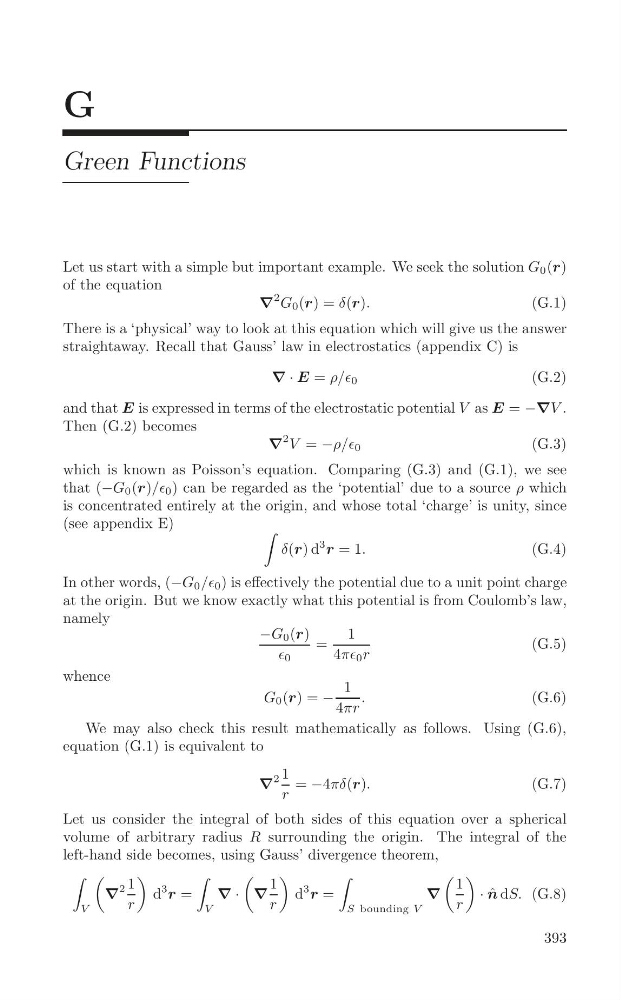
Let us start with a simple but important example. We seek the solution G 0 (r)
of the equation
∇
2 G 0 (r) = δ(r).
(G.1)
There is a ‘physical’ way to look at this equation which will give us the answer
straightaway. Recall that Gauss’ law in electrostatics (appendix C) is
∇ · E = ρ/∈ 0
(G.2)
and that E is expressed in terms of the electrostatic potential V as E = −∇V .
Then (G.2) becomes
∇
2 V = −ρ/∈ 0
(G.3)
which is known as Poisson’s equation. Comparing (G.3) and (G.1), we see
that (−G 0 (r)/∈ 0 ) can be regarded as the ‘potential’ due to a source ρ which
is concentrated entirely at the origin, and whose total ‘charge’ is unity, since
(see appendix E)
∫
δ(r) d
3
r = 1.
(G.4)
In other words, (−G 0 /∈ 0 ) is effectively the potential due to a unit point charge
at the origin. But we know exactly what this potential is from Coulomb’s law,
namely
−G 0 (r)
1
=
(G.5)
∈ 0
4π∈ 0 r
whence
1
G 0 (r) = −
.
(G.6)
4πr
We may also check this result mathematically as follows. Using (G.6),
equation (G.1) is equivalent to
∇
2 1 = −4πδ(r).
(G.7)
r
Let us consider the integral of both sides of this equation over a spherical
volume of arbitrary radius R surrounding the origin. The integral of the
left-hand side becomes, using Gauss’ divergence theorem,
∫ (
)
∫
(
)
∫
( )
∇
2 1 d
3
r =
∇ · ∇
1 d
3
r =
∇
1 · n ˆ dS. (G.8)
r
r
r
V
V
S bounding V
393
Green Functions
Let us start with a simple but important example. We seek the solution G 0 (r)
of the equation
∇
2 G 0 (r) = δ(r).
(G.1)
There is a ‘physical’ way to look at this equation which will give us the answer
straightaway. Recall that Gauss’ law in electrostatics (appendix C) is
∇ · E = ρ/∈ 0
(G.2)
and that E is expressed in terms of the electrostatic potential V as E = −∇V .
Then (G.2) becomes
∇
2 V = −ρ/∈ 0
(G.3)
which is known as Poisson’s equation. Comparing (G.3) and (G.1), we see
that (−G 0 (r)/∈ 0 ) can be regarded as the ‘potential’ due to a source ρ which
is concentrated entirely at the origin, and whose total ‘charge’ is unity, since
(see appendix E)
∫
δ(r) d
3
r = 1.
(G.4)
In other words, (−G 0 /∈ 0 ) is effectively the potential due to a unit point charge
at the origin. But we know exactly what this potential is from Coulomb’s law,
namely
−G 0 (r)
1
=
(G.5)
∈ 0
4π∈ 0 r
whence
1
G 0 (r) = −
.
(G.6)
4πr
We may also check this result mathematically as follows. Using (G.6),
equation (G.1) is equivalent to
∇
2 1 = −4πδ(r).
(G.7)
r
Let us consider the integral of both sides of this equation over a spherical
volume of arbitrary radius R surrounding the origin. The integral of the
left-hand side becomes, using Gauss’ divergence theorem,
∫ (
)
∫
(
)
∫
( )
∇
2 1 d
3
r =
∇ · ∇
1 d
3
r =
∇
1 · n ˆ dS. (G.8)
r
r
r
V
V
S bounding V
393