

390
F. Contour Integration
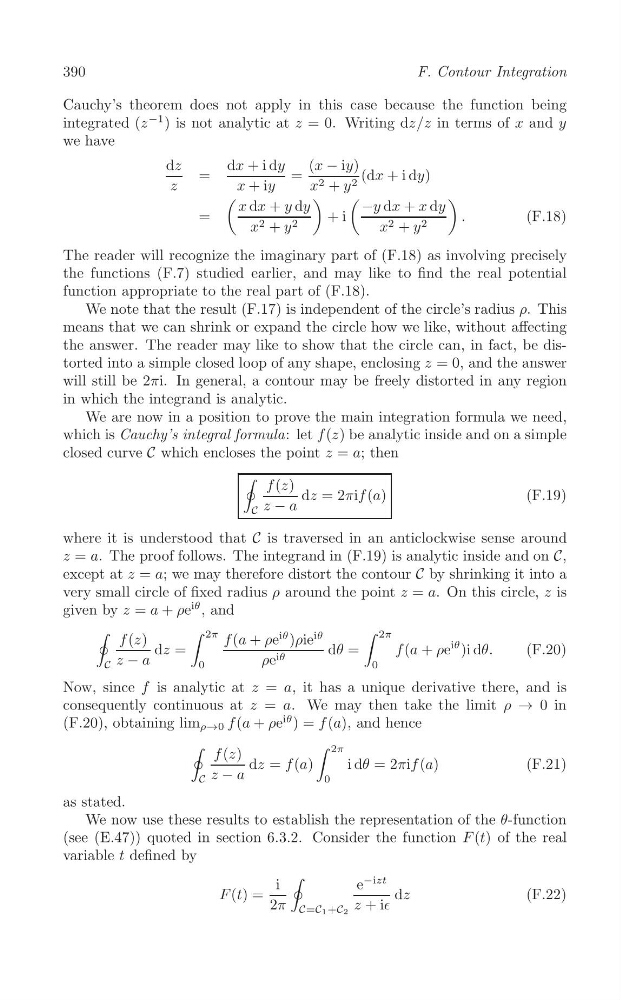
Cauchy’s theorem does not apply in this case because the function being
integrated (z
−1 ) is not analytic at z = 0. Writing dz/z in terms of x and y
we have
dz
dx + i dy
(x − iy)
=
=
(dx + i dy)
z
x + iy
x 2 + y 2
(
)
(
)
x dx + y dy
−y dx + x dy
=
+ i
.
(F.18)
x 2 + y 2
x 2 + y 2
The reader will recognize the imaginary part of (F.18) as involving precisely
the functions (F.7) studied earlier, and may like to find the real potential
function appropriate to the real part of (F.18).
We note that the result (F.17) is independent of the circle’s radius ρ. This
means that we can shrink or expand the circle how we like, without affecting
the answer. The reader may like to show that the circle can, in fact, be distorted into a simple closed loop of any shape, enclosing z = 0, and the answer
will still be 2πi. In general, a contour may be freely distorted in any region
in which the integrand is analytic.
We are now in a position to prove the main integration formula we need,
which is Cauchy’s integral formula: let f (z) be analytic inside and on a simple
closed curve C which encloses the point z = a; then
∮ f (z) dz = 2πif (a)
(F.19)
z − a
C
where it is understood that C is traversed in an anticlockwise sense around
z = a. The proof follows. The integrand in (F.19) is analytic inside and on C,
except at z = a; we may therefore distort the contour C by shrinking it into a
very small circle of fixed radius ρ around the point z = a. On this circle, z is
given by z = a + ρe
iθ , and
∮
∫
∫
2π
2π
f (z)
f (a + ρe
iθ )ρie
iθ
dz =
dθ =
f (a + ρe
iθ )i dθ.
(F.20)
z − a
ρe iθ
C
0
0
Now, since f is analytic at z = a, it has a unique derivative there, and is
consequently continuous at z = a. We may then take the limit ρ → 0 in
(F.20), obtaining lim ρ→0 f (a + ρe
iθ ) = f (a), and hence
∮
∫ 2π
f (z) dz = f (a)
i dθ = 2πif (a)
(F.21)
z − a
C
0
as stated.
We now use these results to establish the representation of the θ-function
(see (E.47)) quoted in section 6.3.2. Consider the function F (t) of the real
variable t defined by
∮
−izt
i
e
F (t) =
dz
(F.22)
2π
z + i∈
C=C1+C2
F. Contour Integration
Cauchy’s theorem does not apply in this case because the function being
integrated (z
−1 ) is not analytic at z = 0. Writing dz/z in terms of x and y
we have
dz
dx + i dy
(x − iy)
=
=
(dx + i dy)
z
x + iy
x 2 + y 2
(
)
(
)
x dx + y dy
−y dx + x dy
=
+ i
.
(F.18)
x 2 + y 2
x 2 + y 2
The reader will recognize the imaginary part of (F.18) as involving precisely
the functions (F.7) studied earlier, and may like to find the real potential
function appropriate to the real part of (F.18).
We note that the result (F.17) is independent of the circle’s radius ρ. This
means that we can shrink or expand the circle how we like, without affecting
the answer. The reader may like to show that the circle can, in fact, be distorted into a simple closed loop of any shape, enclosing z = 0, and the answer
will still be 2πi. In general, a contour may be freely distorted in any region
in which the integrand is analytic.
We are now in a position to prove the main integration formula we need,
which is Cauchy’s integral formula: let f (z) be analytic inside and on a simple
closed curve C which encloses the point z = a; then
∮ f (z) dz = 2πif (a)
(F.19)
z − a
C
where it is understood that C is traversed in an anticlockwise sense around
z = a. The proof follows. The integrand in (F.19) is analytic inside and on C,
except at z = a; we may therefore distort the contour C by shrinking it into a
very small circle of fixed radius ρ around the point z = a. On this circle, z is
given by z = a + ρe
iθ , and
∮
∫
∫
2π
2π
f (z)
f (a + ρe
iθ )ρie
iθ
dz =
dθ =
f (a + ρe
iθ )i dθ.
(F.20)
z − a
ρe iθ
C
0
0
Now, since f is analytic at z = a, it has a unique derivative there, and is
consequently continuous at z = a. We may then take the limit ρ → 0 in
(F.20), obtaining lim ρ→0 f (a + ρe
iθ ) = f (a), and hence
∮
∫ 2π
f (z) dz = f (a)
i dθ = 2πif (a)
(F.21)
z − a
C
0
as stated.
We now use these results to establish the representation of the θ-function
(see (E.47)) quoted in section 6.3.2. Consider the function F (t) of the real
variable t defined by
∮
−izt
i
e
F (t) =
dz
(F.22)
2π
z + i∈
C=C1+C2