

389
F. Contour Integration
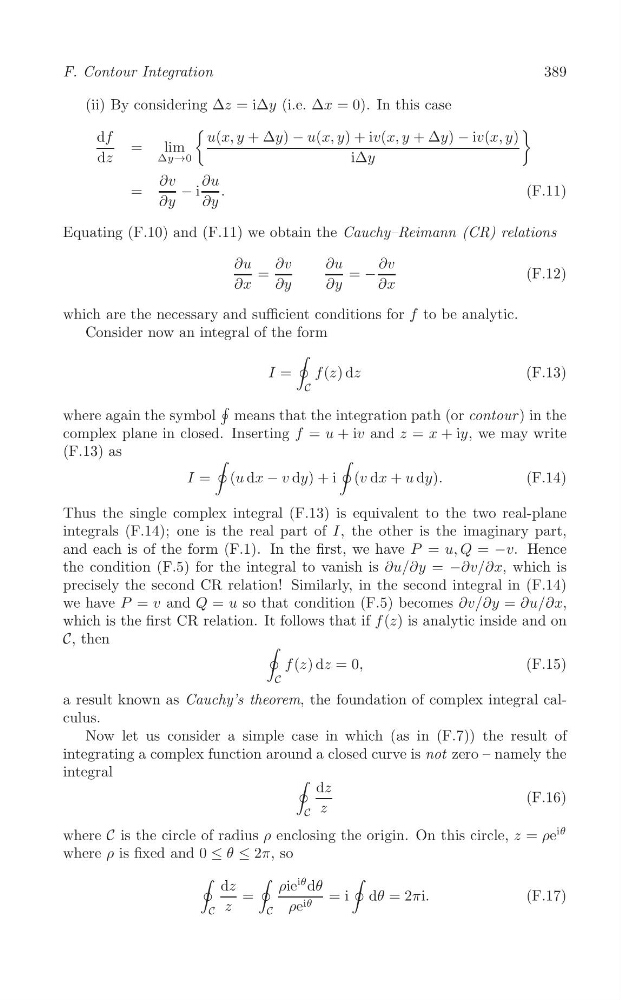
(ii) By considering Δz = iΔy (i.e. Δx = 0). In this case
(
)
df
u(x, y + Δy) − u(x, y) + iv(x, y + Δy) − iv(x, y)
= lim
dz
Δy→0
iΔy
∂v
∂u
=
− i .
(F.11)
∂y
∂y
Equating (F.10) and (F.11) we obtain the Cauchy–Reimann (CR) relations
∂u
∂v
∂u
∂v
=
= −
(F.12)
∂x
∂y
∂y
∂x
which are the necessary and sufficient conditions for f to be analytic.
Consider now an integral of the form
∮
I =
f (z) dz
(F.13)
C
∮
where again the symbol means that the integration path (or contour ) in the
complex plane in closed. Inserting f = u + iv and z = x + iy, we may write
(F.13) as
∮
∮
I = (u dx − v dy) + i (v dx + u dy).
(F.14)
Thus the single complex integral (F.13) is equivalent to the two real-plane
integrals (F.14); one is the real part of I, the other is the imaginary part,
and each is of the form (F.1). In the first, we have P = u, Q = −v. Hence
the condition (F.5) for the integral to vanish is ∂u/∂y = −∂v/∂x, which is
precisely the second CR relation! Similarly, in the second integral in (F.14)
we have P = v and Q = u so that condition (F.5) becomes ∂v/∂y = ∂u/∂x,
which is the first CR relation. It follows that if f (z) is analytic inside and on
C, then
∮
f (z) dz = 0,
(F.15)
C
a result known as Cauchy’s theorem, the foundation of complex integral calculus.
Now let us consider a simple case in which (as in (F.7)) the result of
integrating a complex function around a closed curve is not zero – namely the
integral
∮ dz
(F.16)
z
C
iθ
where C is the circle of radius ρ enclosing the origin. On this circle, z = ρe
where ρ is fixed and 0 ≤ θ ≤ 2π, so
∮
∮
∮
dz
ρie
iθ dθ
=
= i dθ = 2πi.
(F.17)
z
ρe iθ
C
C
F. Contour Integration
(ii) By considering Δz = iΔy (i.e. Δx = 0). In this case
(
)
df
u(x, y + Δy) − u(x, y) + iv(x, y + Δy) − iv(x, y)
= lim
dz
Δy→0
iΔy
∂v
∂u
=
− i .
(F.11)
∂y
∂y
Equating (F.10) and (F.11) we obtain the Cauchy–Reimann (CR) relations
∂u
∂v
∂u
∂v
=
= −
(F.12)
∂x
∂y
∂y
∂x
which are the necessary and sufficient conditions for f to be analytic.
Consider now an integral of the form
∮
I =
f (z) dz
(F.13)
C
∮
where again the symbol means that the integration path (or contour ) in the
complex plane in closed. Inserting f = u + iv and z = x + iy, we may write
(F.13) as
∮
∮
I = (u dx − v dy) + i (v dx + u dy).
(F.14)
Thus the single complex integral (F.13) is equivalent to the two real-plane
integrals (F.14); one is the real part of I, the other is the imaginary part,
and each is of the form (F.1). In the first, we have P = u, Q = −v. Hence
the condition (F.5) for the integral to vanish is ∂u/∂y = −∂v/∂x, which is
precisely the second CR relation! Similarly, in the second integral in (F.14)
we have P = v and Q = u so that condition (F.5) becomes ∂v/∂y = ∂u/∂x,
which is the first CR relation. It follows that if f (z) is analytic inside and on
C, then
∮
f (z) dz = 0,
(F.15)
C
a result known as Cauchy’s theorem, the foundation of complex integral calculus.
Now let us consider a simple case in which (as in (F.7)) the result of
integrating a complex function around a closed curve is not zero – namely the
integral
∮ dz
(F.16)
z
C
iθ
where C is the circle of radius ρ enclosing the origin. On this circle, z = ρe
where ρ is fixed and 0 ≤ θ ≤ 2π, so
∮
∮
∮
dz
ρie
iθ dθ
=
= i dθ = 2πi.
(F.17)
z
ρe iθ
C
C