

388
F. Contour Integration
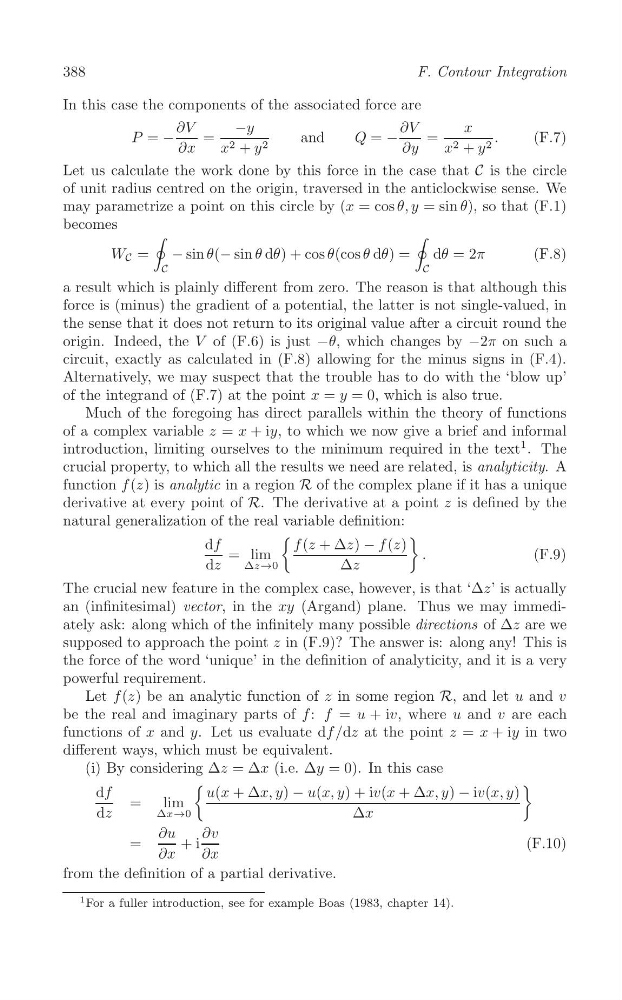
In this case the components of the associated force are
∂V
−y
∂V
x
P = −
=
and
Q = −
=
.
(F.7)
∂x
x 2 + y 2
∂y
x 2 + y 2
Let us calculate the work done by this force in the case that C is the circle
of unit radius centred on the origin, traversed in the anticlockwise sense. We
may parametrize a point on this circle by (x = cos θ, y = sin θ), so that (F.1)
becomes
∮
∮
W C =
− sin θ(− sin θ dθ) + cos θ(cos θ dθ) =
dθ = 2π
(F.8)
C
C
a result which is plainly different from zero. The reason is that although this
force is (minus) the gradient of a potential, the latter is not single-valued, in
the sense that it does not return to its original value after a circuit round the
origin. Indeed, the V of (F.6) is just −θ, which changes by −2π on such a
circuit, exactly as calculated in (F.8) allowing for the minus signs in (F.4).
Alternatively, we may suspect that the trouble has to do with the ‘blow up’
of the integrand of (F.7) at the point x = y = 0, which is also true.
Much of the foregoing has direct parallels within the theory of functions
of a complex variable z = x + iy, to which we now give a brief and informal
introduction, limiting ourselves to the minimum required in the text
1 . The
crucial property, to which all the results we need are related, is analyticity. A
function f (z) is analytic in a region R of the complex plane if it has a unique
derivative at every point of R. The derivative at a point z is defined by the
natural generalization of the real variable definition:
(
)
df
f (z + Δz) − f (z)
= lim
.
(F.9)
dz
Δz→0
Δz
The crucial new feature in the complex case, however, is that ‘Δz’ is actually
an (infinitesimal) vector, in the xy (Argand) plane. Thus we may immediately ask: along which of the infinitely many possible directions of Δz are we
supposed to approach the point z in (F.9)? The answer is: along any! This is
the force of the word ‘unique’ in the definition of analyticity, and it is a very
powerful requirement.
Let f (z) be an analytic function of z in some region R, and let u and v
be the real and imaginary parts of f : f = u + iv, where u and v are each
functions of x and y. Let us evaluate df /dz at the point z = x + iy in two
different ways, which must be equivalent.
(i) By considering Δz = Δx (i.e. Δy = 0). In this case
(
)
df
u(x + Δx, y) − u(x, y) + iv(x + Δx, y) − iv(x, y)
= lim
dz
Δx→0
Δx
∂u
∂v
=
+ i
(F.10)
∂x
∂x
from the definition of a partial derivative.
1 For a fuller introduction, see for example Boas (1983, chapter 14).
F. Contour Integration
In this case the components of the associated force are
∂V
−y
∂V
x
P = −
=
and
Q = −
=
.
(F.7)
∂x
x 2 + y 2
∂y
x 2 + y 2
Let us calculate the work done by this force in the case that C is the circle
of unit radius centred on the origin, traversed in the anticlockwise sense. We
may parametrize a point on this circle by (x = cos θ, y = sin θ), so that (F.1)
becomes
∮
∮
W C =
− sin θ(− sin θ dθ) + cos θ(cos θ dθ) =
dθ = 2π
(F.8)
C
C
a result which is plainly different from zero. The reason is that although this
force is (minus) the gradient of a potential, the latter is not single-valued, in
the sense that it does not return to its original value after a circuit round the
origin. Indeed, the V of (F.6) is just −θ, which changes by −2π on such a
circuit, exactly as calculated in (F.8) allowing for the minus signs in (F.4).
Alternatively, we may suspect that the trouble has to do with the ‘blow up’
of the integrand of (F.7) at the point x = y = 0, which is also true.
Much of the foregoing has direct parallels within the theory of functions
of a complex variable z = x + iy, to which we now give a brief and informal
introduction, limiting ourselves to the minimum required in the text
1 . The
crucial property, to which all the results we need are related, is analyticity. A
function f (z) is analytic in a region R of the complex plane if it has a unique
derivative at every point of R. The derivative at a point z is defined by the
natural generalization of the real variable definition:
(
)
df
f (z + Δz) − f (z)
= lim
.
(F.9)
dz
Δz→0
Δz
The crucial new feature in the complex case, however, is that ‘Δz’ is actually
an (infinitesimal) vector, in the xy (Argand) plane. Thus we may immediately ask: along which of the infinitely many possible directions of Δz are we
supposed to approach the point z in (F.9)? The answer is: along any! This is
the force of the word ‘unique’ in the definition of analyticity, and it is a very
powerful requirement.
Let f (z) be an analytic function of z in some region R, and let u and v
be the real and imaginary parts of f : f = u + iv, where u and v are each
functions of x and y. Let us evaluate df /dz at the point z = x + iy in two
different ways, which must be equivalent.
(i) By considering Δz = Δx (i.e. Δy = 0). In this case
(
)
df
u(x + Δx, y) − u(x, y) + iv(x + Δx, y) − iv(x, y)
= lim
dz
Δx→0
Δx
∂u
∂v
=
+ i
(F.10)
∂x
∂x
from the definition of a partial derivative.
1 For a fuller introduction, see for example Boas (1983, chapter 14).